
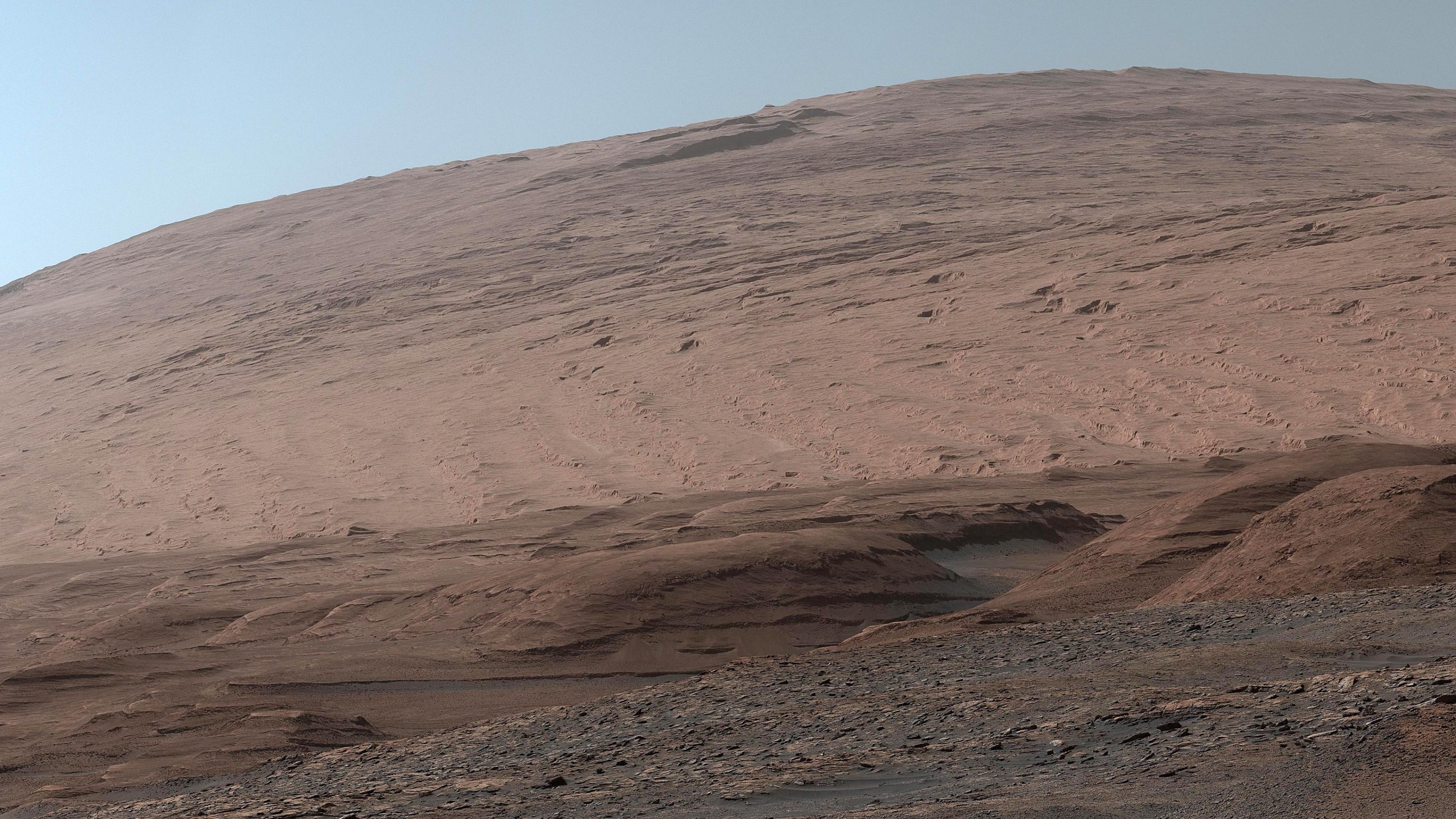
The NASA rover touched down eight years ago, on August 5, 2012, and will soon be joined by a second rover, Perseverance.
NASA’s Curiosity Mars rover has seen a lot since August 5, 2012, when it first set its wheels inside the 96-mile-wide (154-kilometer-wide) basin of Gale Crater. Its mission: to study whether Mars had the water, chemical building blocks, and energy sources that may have supported microbial life billions of years ago.
Curiosity has since journeyed more than 14 miles (23 kilometers), drilling 26 rock samples and scooping six soil samples along the way as it revealed that ancient Mars was indeed suitable for life. Studying the textures and compositions of ancient rock strata is helping scientists piece together how the Martian climate changed over time, losing its lakes and streams until it became the cold desert it is today.
The Curiosity mission is led by NASA’s Jet Propulsion Laboratory, which is managed by Caltech in Pasadena, California, and involves almost 500 scientists from the United States and other countries around the world. Here are eight postcards the rover has sent from Mars. Most of the panoramas were taken by the rover’s Mast Camera, or Mastcam, led by Malin Space Science Systems in San Diego.
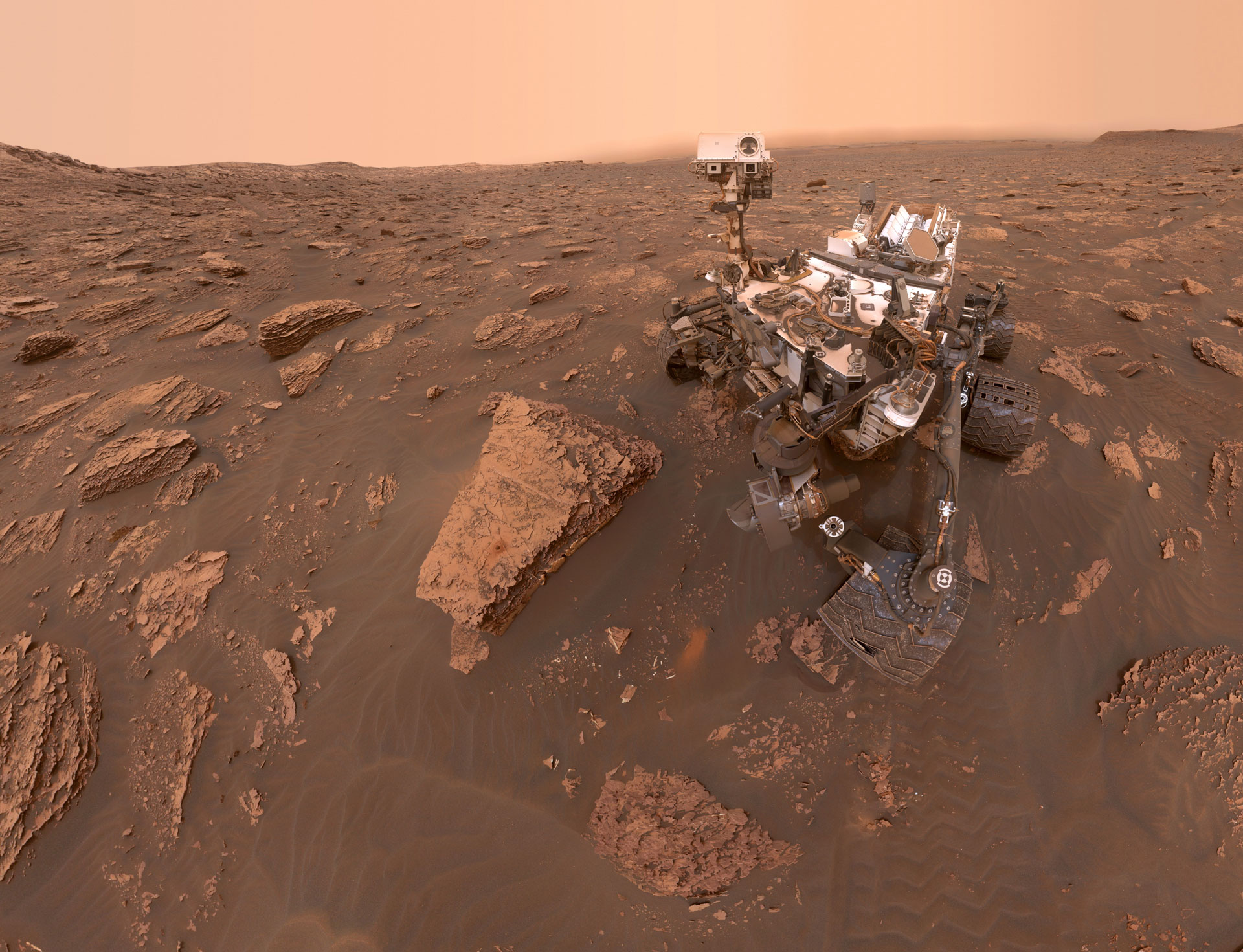
A Dusty Scientist
Curiosity took this selfie on June 20, 2018 (Sol 2082) as a global dust storm enshrouded Mars, filtering sunlight and obscuring the view. The rover drills rocks to analyze their composition and takes a selfie afterward to capture the landscape each sample was taken from (this one is called “Duluth”). Selfies are created by the Mars Hand Lens Imager (MAHLI) camera on the end of the rover’s robotic arm. If you’re wondering why you can’t see the arm in this photo, read more about how selfies are taken here.
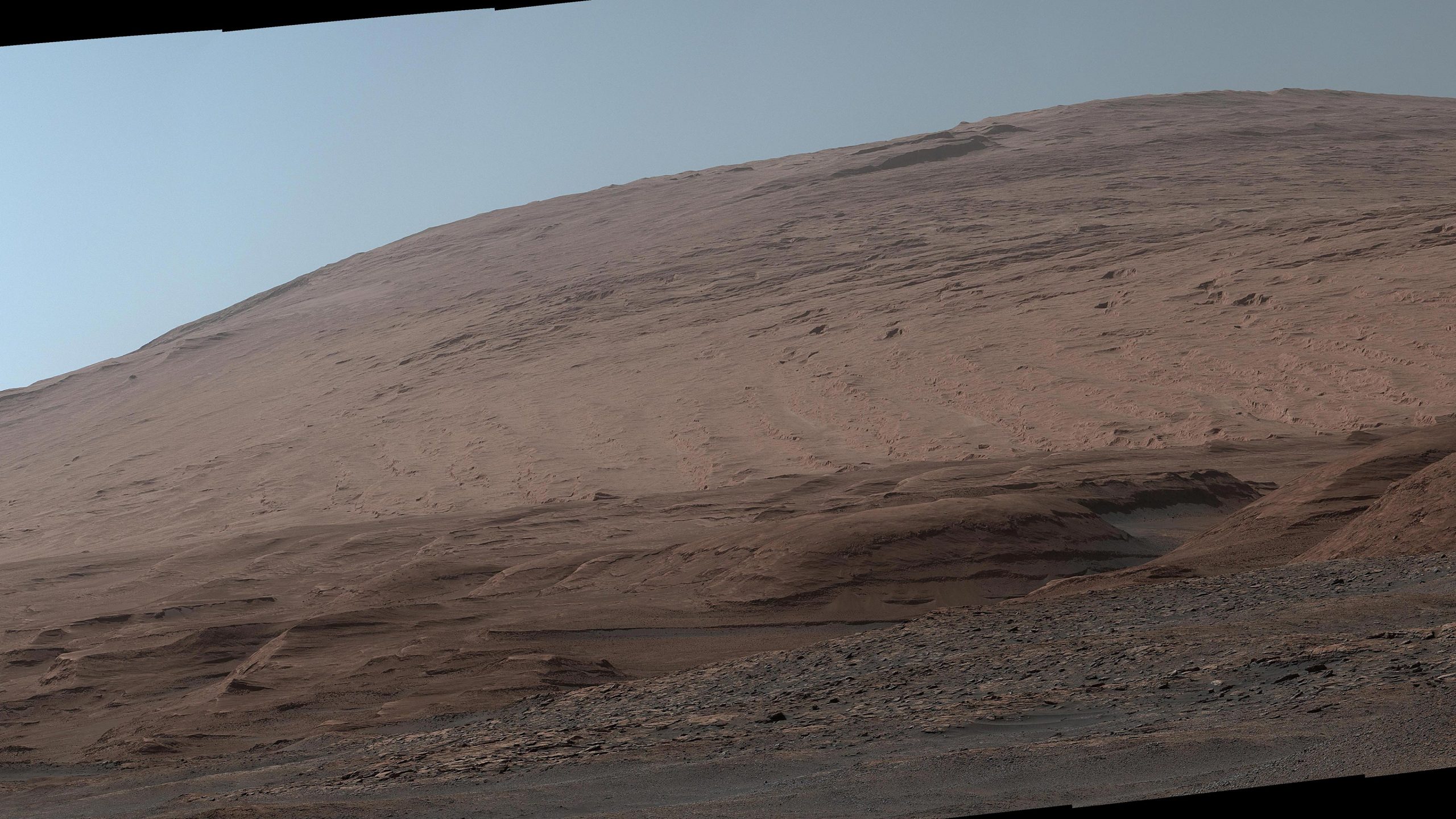
Mount Sharp Towers Above
Look up from Curiosity’s current location, and you’d be met with this dramatic view of Mount Sharp, the 3-mile-tall (5-kilometer-tall) peak that Curiosity is exploring. Composed of 44 individual images stitched together, this portrait was taken by the Mastcam on October 13, 2019 (Sol 2555).
Curiosity will never venture to the upper portion of the mountain; instead, it’s exploring the many layers found lower down. Each has a different story to tell about how Mars, which was once more like Earth (warmer and wetter), changed over time. The rover will reach the next layer later this year.
“I love this image because it tells two stories – one about the mission and one about Mars,” said Ashwin Vasavada, Curiosity’s project scientist at JPL. “The crater rim and floor where we started at eight years ago peek in from the left, while spread out before us is the future as Curiosity climbs higher on the mountain.”
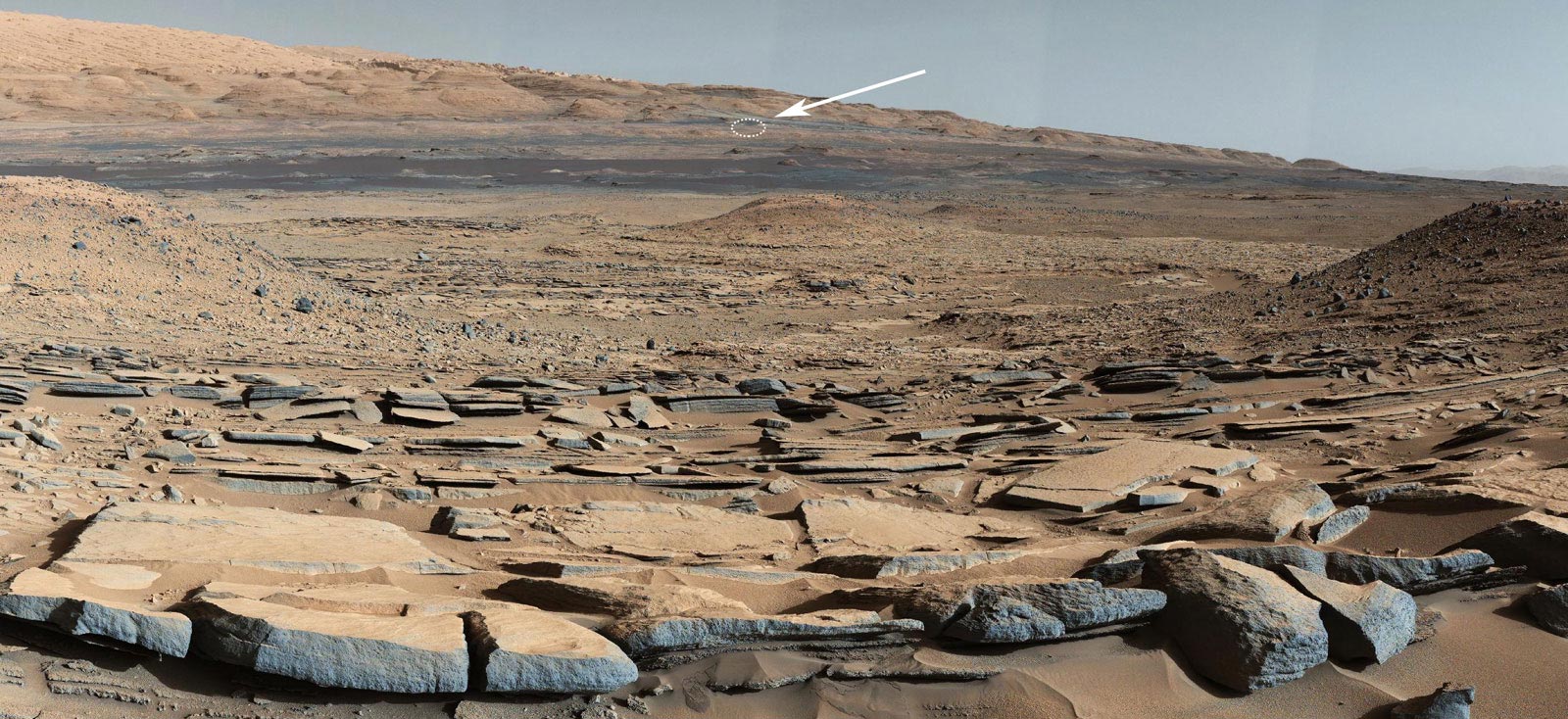
You Are Here
Shot near Mount Sharp’s base on March 24, 2014 (Sol 580), this panorama shows just how far Curiosity has traveled in a little over six years. The arrow indicates the rover’s location today, about 3 1/2 miles away (about 5 1/2 kilometers).
“I can’t help but also think about the corresponding distance we’ve traveled in our understanding of Mars’ habitable past since the time we took this picture,” said Abigail Fraeman of JPL, Curiosity’s deputy project scientist.
Curiosity Project Scientist Ashwin Vasavada gives a descriptive tour of the Mars rover’s view in Gale Crater. The white-balanced scene looks back over the journey so far.
You Were There
“I still can’t get over how amazingly clear the skies were when we took this, and how we could see for miles and miles and miles,” Fraeman said of this 2018 panorama, which shows the floor of Gale Crater as seen from higher up the mountain, at a location called Vera Rubin Ridge. “How spectacular would the rim of Gale Crater have looked to an astronaut if they were standing on Mount Sharp that day?”
Vasavada narrated this video tour of the journey up the mountain.

Martian Spaghetti Western
Parts of the Martian desert resemble the American Southwest. This wide panorama, shot by the Mastcam on December 19, 2019 (Sol 2620), includes 130 images stitched together. In the foreground on the right is “Western Butte”; the slope with a crusty cap in the background is the “Greenheugh Pediment,” which Curiosity ascended in March 2020 for a sneak peek of terrain scientists hope to investigate later in the mission.

A Sea of Dunes
This location, part of “Namib Dune,” shows two different-sized ripples that the wind sculpted in the sand. Curiosity discovered that the larger kind, standing roughly 10 feet (3 meters) apart, are found on Mars only as a result of its thin atmosphere. The panorama was taken on December 13, 2015 (Sol 1192).
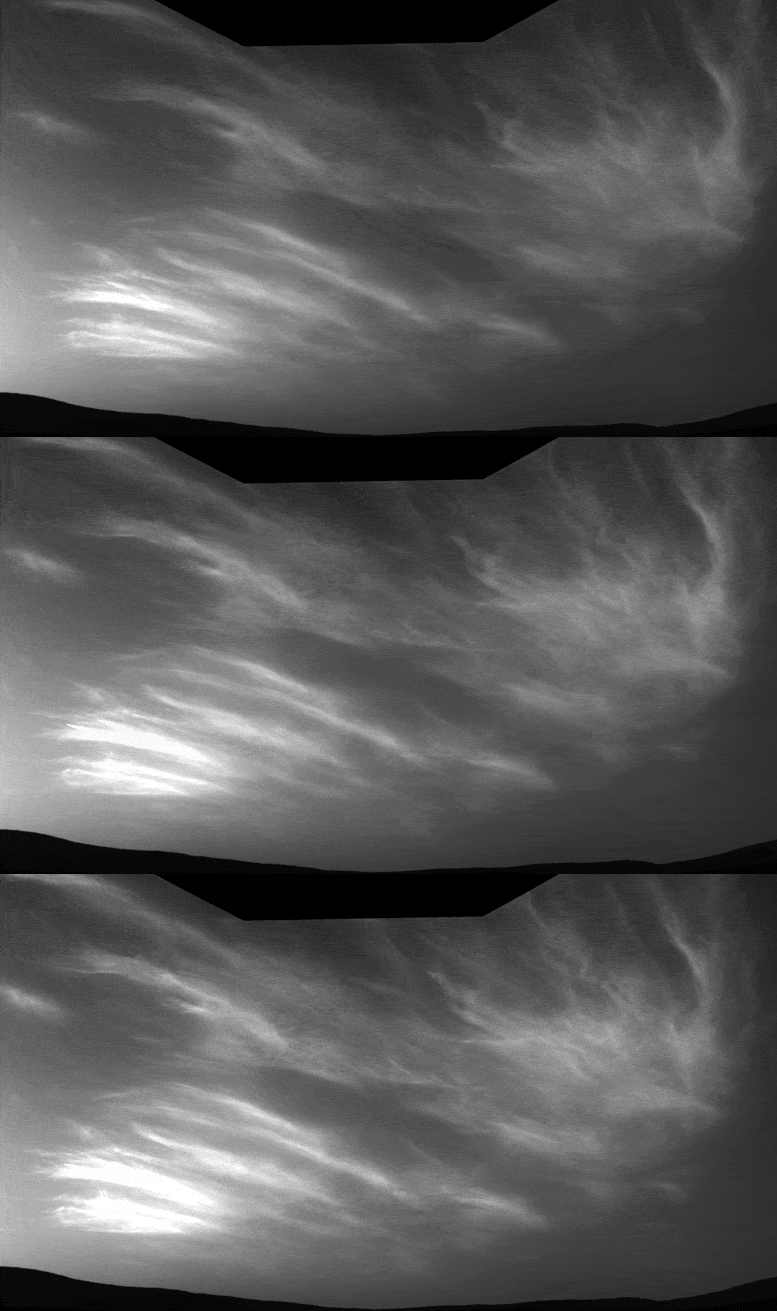
Staring at Clouds
Curiosity occasionally studies clouds to learn more about the Martian atmosphere. There is vanishingly little water in the Martian air, which is 1% as dense as Earth’s air, but water-ice clouds do sometimes form. The clouds shown here, which are likely water-ice, were captured about 19 miles (31 kilometers) above the surface on May 17, 2019 (Sol 2410), using the rover’s black-and-white Navigation Cameras.
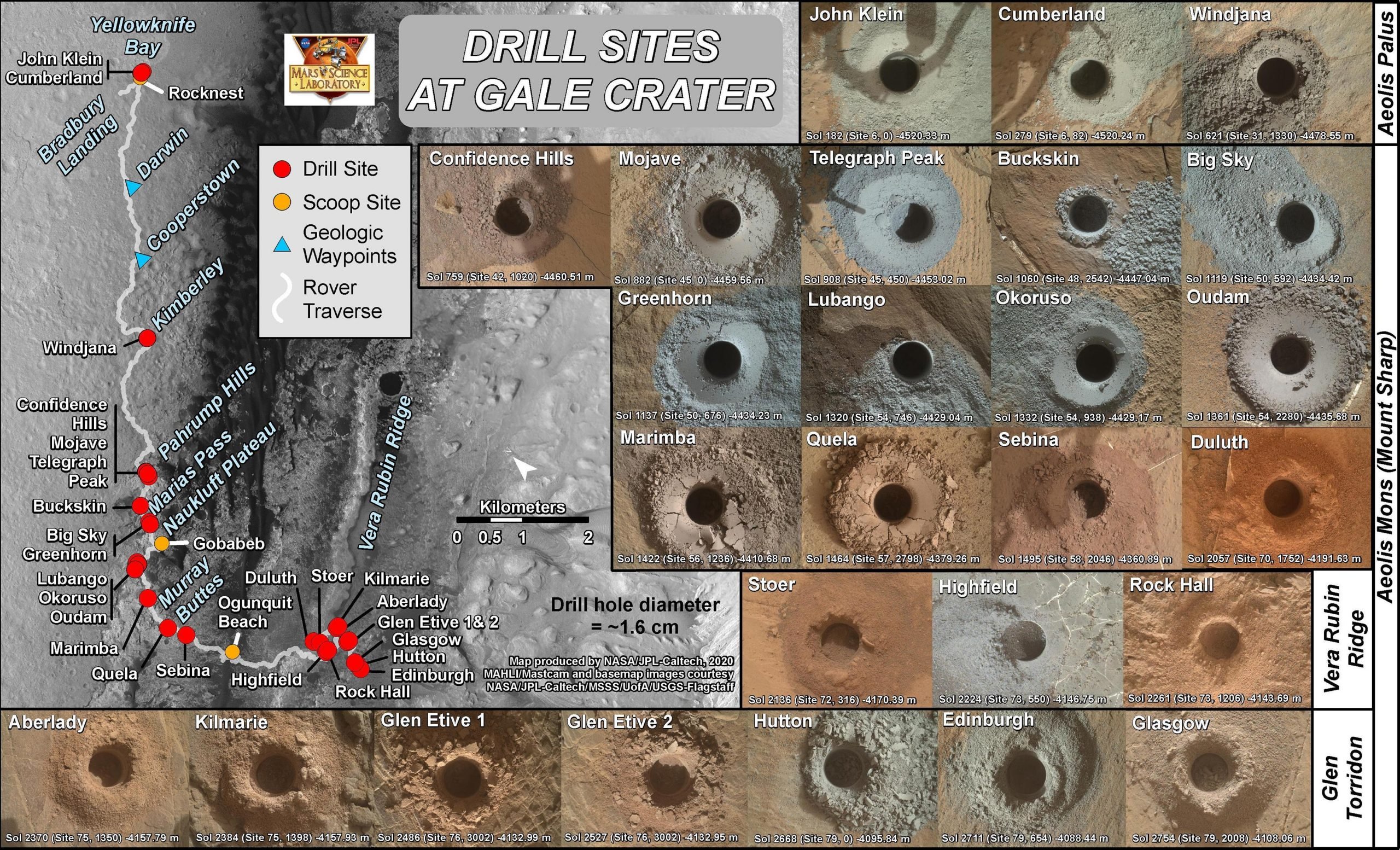
Curiosity’s Hole Story
These 26 holes represent each of the pulverized rock samples NASA’s Curiosity Mars rover has collected with its robotic arm as of early July 2020. A map in the upper left shows where the holes were drilled on the rover’s route, along with where it scooped six samples of soil for analysis.
Never miss a breakthrough: Join the SciTechDaily newsletter.
Follow us on Google and Google News.
19 Comments
Why white balance the video to make the rocks look the same color as they would on earth??? They are not on earth leave them as they are naturally.
8 yrs.?? Still vast of dunes..rocks. & pebbles??its a Waste of time & money..so much to do for earth improvements..Earth is Only Our Home.GOD give Us..
Why is the Martian sky blue?
Because it has an atmosphere? Duh ¿
Because it’s a joke
Are you off of your meds again?
If nasa can’t find rivers, lakes on mars, any heavy rain, why why wasting time years after years and didn’t find anything,also why don’t send some of seeds and water to mars to see if that will work or not, why wasting too much time and money?
It will be interesting to find out whether complex life systems, like ours here on Earth, ever existed on Mars, and if so, what led to their/its demise. Whatever we learn will at the least, be enlightening.
Quel est l’intérêt de faire des recherches sur une planète aussi inaccessible sans oxygène et sans intérêt pour la vie, quelle perte de temps d’argent en sachant que des millions d’hommes meurent de faim… On ne pourra jamais y vivre ni survivre le moindre soucis sur place et la température sont 2 choses qui devraient vous intéresser avant de faire de telles dépenses, c’est incroyable de perdre autant de temps pour rien.
Imagine you send a similar robot probe to an inhabited earth and it just strolls three miles. What the heck information you have of planet earth then of the vast continents, oceans, mountains, crust etc etc. Wasting all timme and money.Could anyone put light on this.
Too cold an too inhospitable world for the humans. We have everything here in our Wonderful planet.
Marte.fue nuestro planeta.de nuestros ancestros.y lo destruyeron.vinieron a este otro planeta y estamos haciendo lo mismo.
Why is the sky blue if there is no ocean to reflect?
I hope this is a joke, the sky isn’t blue because of that ocean, but from how light waves are scattered I’m our atmosphere.
In our*
Such a wonderful time for space travel and science I feel privileged to be a witness and my hats off to the scientists and engineers thank you
This is just too cool!
There are so many reasons to go to Mars. One most important one is to do it because we can figure out how to. A source of accomplishment by the brightest minds and tenacious courage of men and women from the Great United States of America. A great symbol of good, clean competition too.
Be proud to be an American today.
Those among you who think it’s a waste of money can go live somewhere else because this is what makes us great. There may because your somewhere in a 3rd-world country with your name on it.
It’s thrilling to imagine that humans would have successfully colonized Mars in another 30-40 years. WOW!
We all should be proud.
Thats what they said 30 to 40 years ago