
Close Menu
    Facebook X (Twitter) Instagram
    SciTechDaily
    • Biology
    • Chemistry
    • Earth
    • Health
    • Physics
    • Science
    • Space
    • Technology
    Facebook X (Twitter) Pinterest YouTube RSS
    SciTechDaily
    Home»Space»Mars in a Day: NASA’s Curiosity Captures Martian Morning and Afternoon in Single “Postcard”
    Space

    Mars in a Day: NASA’s Curiosity Captures Martian Morning and Afternoon in Single “Postcard”

    By Jet Propulsion LaboratoryJune 16, 2023No Comments4 Mins Read
    Facebook Twitter Pinterest Telegram LinkedIn WhatsApp Email Reddit
    Share
    Facebook Twitter LinkedIn Pinterest Telegram Email Reddit
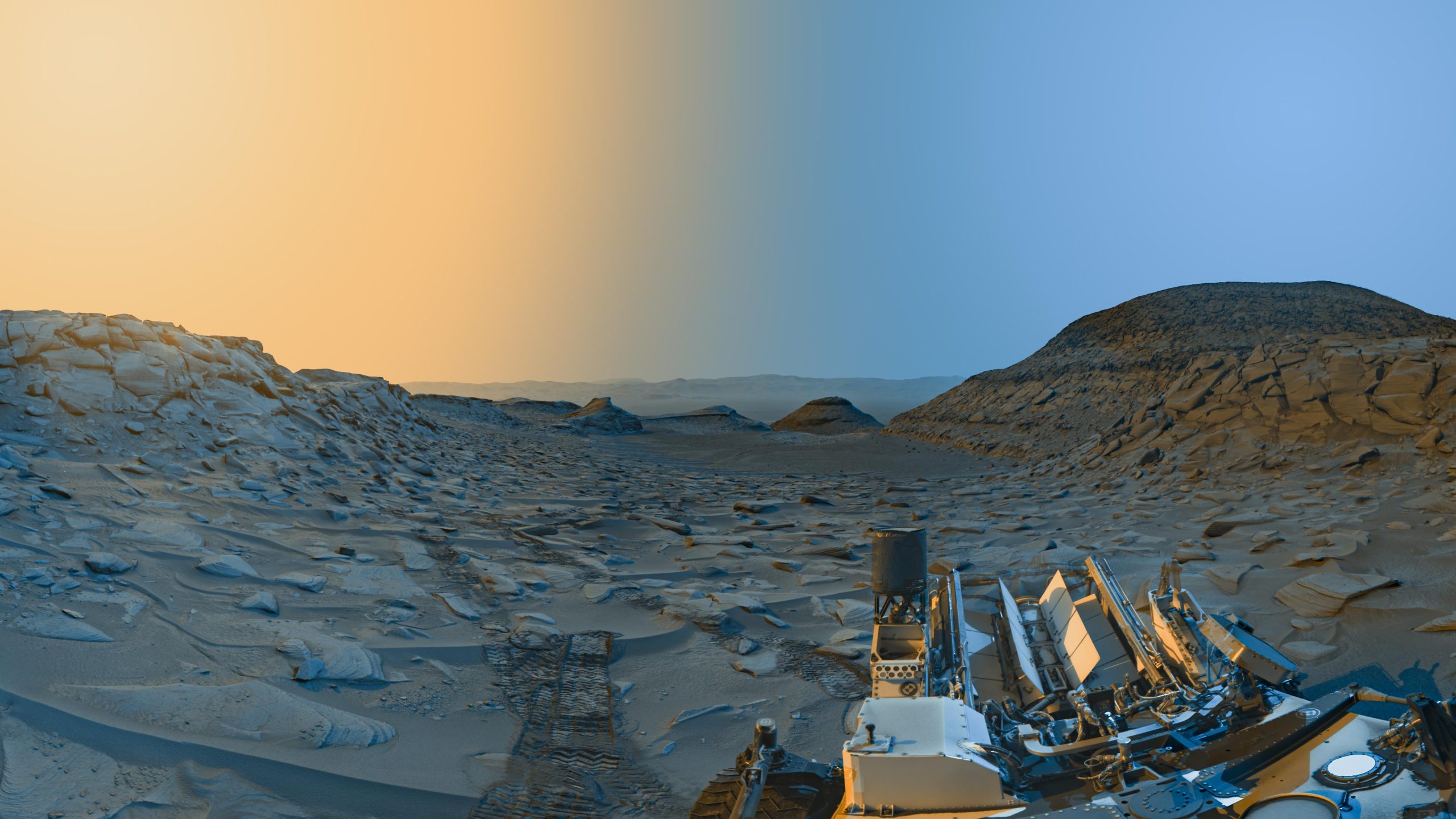
    NASA Curiosity Mars Rover Postcard of Marker Band Valley
    NASA’s Curiosity Mars rover used its black-and-white navigation cameras to capture panoramas at two times of day on April 8, 2023. Credit: NASA/JPL-Caltech

    Lighting from two times of day was combined for a stunning view of the terrain that the rover is leaving behind.

    After completing a major software update in April, NASA’s Curiosity Mars rover took a last look at “Marker Band Valley” before leaving it behind, capturing a “postcard” of the scene.

    The postcard is an artistic interpretation of the landscape, with color added over two black-and-white panoramas captured by Curiosity’s navigation cameras. The views were taken on April 8 at 9:20 a.m. and 3:40 p.m. local Mars time, providing dramatically different lighting that, when combined, makes details in the scene stand out. Blue was added to parts of the postcard captured in the morning and yellow to parts taken in the afternoon, just as with a similar postcard taken by Curiosity in November 2021.
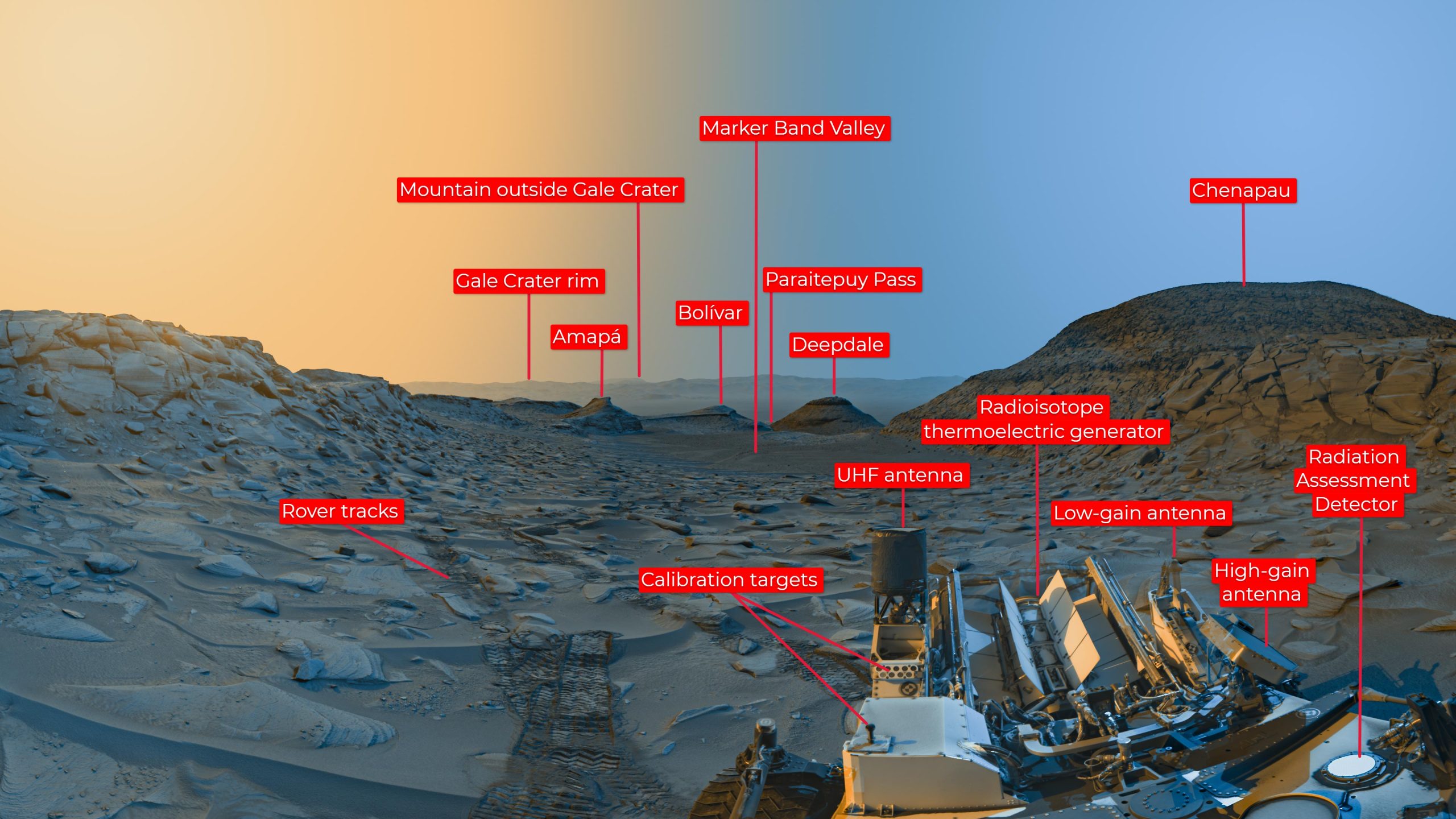
    NASA Curiosity Mars Rover Postcard of Marker Band Valley Annotated
    NASA’s Curiosity Mars rover used its black-and-white navigation cameras to capture panoramas at two times of day on April 8, 2023. Figure A is an annotated version of the postcard noting geographic features and elements of the rover. Credit: NASA/JPL-Caltech

    The resulting image is striking. Curiosity is in the foothills of Mount Sharp, which stands 3 miles (5 kilometers) high within Gale Crater, where the rover has been exploring since landing in 2012. In the distance beyond its tracks is Marker Band Valley, a winding area in the “sulfate-bearing region” within which the rover discovered unexpected signs of an ancient lake. Farther below (at center and just to the right) are two hills – “Bolívar” and “Deepdale” – that Curiosity drove between while exploring “Paraitepuy Pass.”
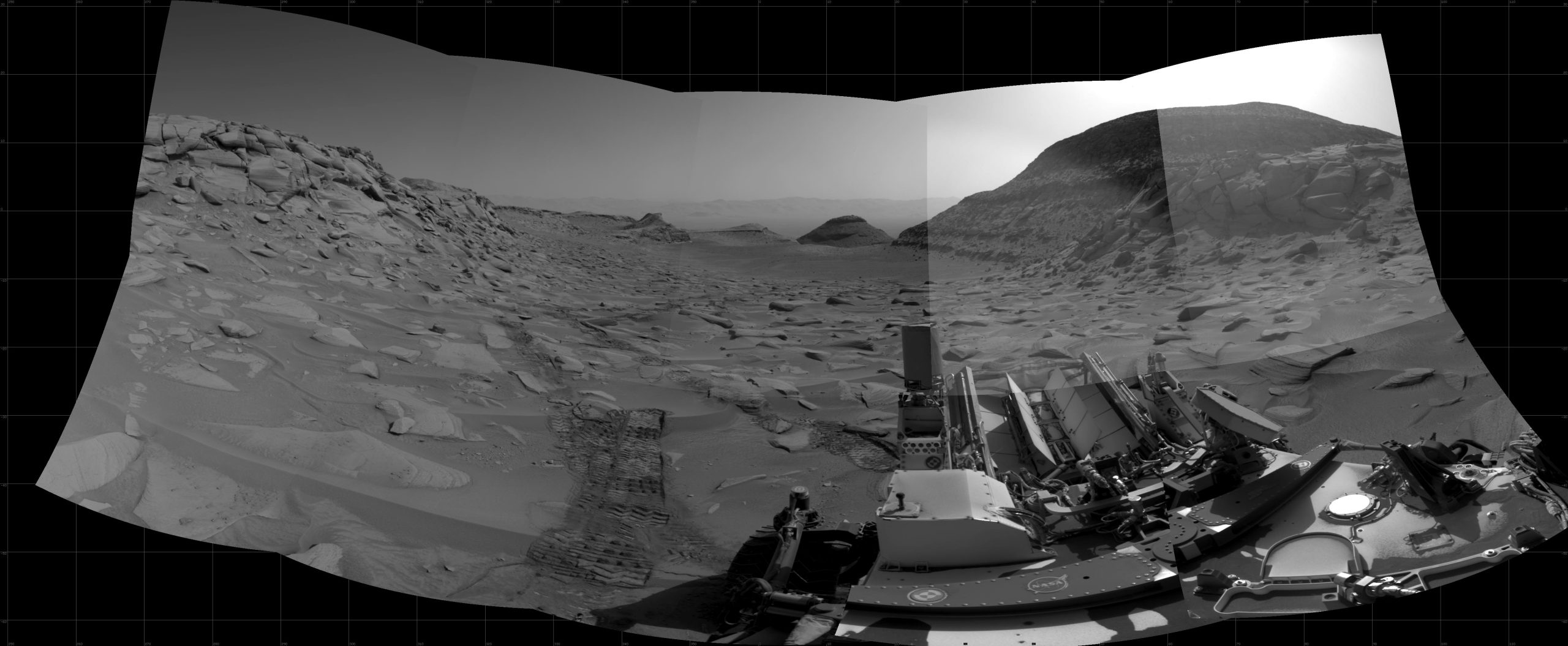
    NASA Curiosity Mars Rover Postcard of Marker Band Valley Morning Panorama
    Morning panorama without ad. Credit: NASA/JPL-Caltech

    “Anyone who’s been to a national park knows the scene looks different in the morning than it does in the afternoon,” said Curiosity engineer Doug Ellison of NASA’s Jet Propulsion Laboratory in Southern California, who planned and processed the images. “Capturing two times of day provides dark shadows because the lighting is coming in from the left and the right, like you might have on a stage – but instead of stage lights, we’re relying on the Sun.”
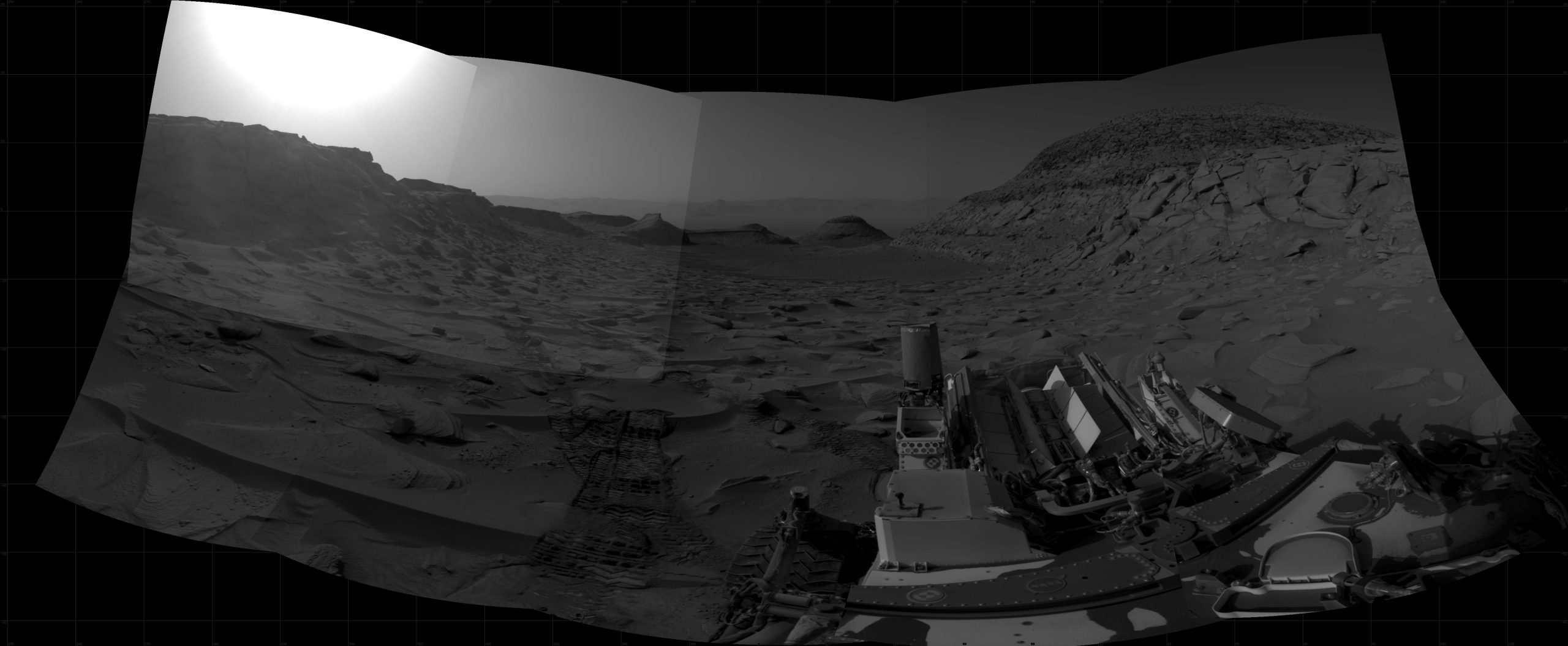
    NASA Curiosity Mars Rover Postcard of Marker Band Valley Afternoon Panorama
    Afternoon panorama without added color. Credit: NASA/JPL-Caltech

    Adding to the depth of the shadows is the fact that it was winter – a period of lower airborne dust – at Curiosity’s location when the images were taken. “Mars’ shadows get sharper and deeper when there’s low dust and softer when there’s lots of dust,” Ellison added.

    The image peers past the rear of the rover, providing a glimpse of its three antennas and nuclear power source. The Radiation Assessment Detector, or RAD, instrument, which appears as a white circle in the lower right of the image, has been helping scientists learn how to protect the first astronauts sent to Mars from radiation on the planet’s surface.

    More About the Mission

    Curiosity was built by NASA’s Jet Propulsion Laboratory (JPL), which is managed by the California Institute of Technology (Caltech) in Pasadena, California. JPL leads the mission on behalf of NASA’s Science Mission Directorate in Washington.

    NASA’s Mars Science Laboratory mission, with its rover named Curiosity, was launched on November 26, 2011, and successfully landed on Mars on August 6, 2012.

    Curiosity is about the size of a small SUV — 10 feet long (not including the arm), 9 feet wide, and 7 feet tall — much larger than previous Mars rovers. The rover is equipped with a wide array of sophisticated scientific instruments that help it to carry out its primary mission: to study the Martian climate and geology, assess whether the selected field site inside Gale Crater has ever offered environmental conditions favorable for microbial life, and for planetary habitability studies in preparation for future human exploration.

    The rover has instruments capable of scooping up soil and crushed rock samples, analyzing them for signs of organic compounds and environmental conditions that could have supported microbial life in the past. It also has a drill that can gather samples from inside rocks, cameras for detailed imaging, and many other tools.

    Never miss a breakthrough: Join the SciTechDaily newsletter.
    Follow us on Google and Google News.

    Curiosity Rover JPL Mars NASA Popular
    Share. Facebook Twitter Pinterest LinkedIn Email Reddit

    Related Articles

    Curiosity 2.0: NASA’s Mars Rover Software Upgrade Revs Up Performance

    NASA’s Curiosity Rover Views First Dazzling “Sun Rays” on Mars

    NASA’s Curiosity Rover Discovers Surprise Clues to Ancient Water on Mars

    Tantalizing Science and Dangerous Hazards: NASA’s Curiosity Mars Rover Reaches Long-Awaited Salty Region

    NASA’s Curiosity Mars Rover Still Going 10 Years After Landing – What It’s Learned

    NASA’s Curiosity Rover Measures Key Life Ingredient on Mars for First Time

    NASA’s Curiosity Rover Captures Stunning Mars Views – Unlocking Mysteries of Ancient Past

    NASA’s Curiosity Rover Spots a “Doorway” on Mars

    NASA’s Curiosity Mars Rover Reroutes Away From Knife-Edged “Gator-Back” Rocks

    Leave A Reply Cancel Reply

    • Facebook
    • Twitter
    • Pinterest
    • YouTube

    Don't Miss a Discovery

    Subscribe for the Latest in Science & Tech!

    Trending News

    Largest-Ever Study Finds Medicinal Cannabis Ineffective for Anxiety, Depression, PTSD

    250-Million-Year-Old Egg Solves One of Evolution’s Biggest Mysteries

    Living With Roommates Might Be Changing Your Gut Microbiome Without You Knowing

    Century-Old Cleaning Chemical Linked to 500% Increased Risk of Parkinson’s Disease

    What if Your Memories Never Happened? Physicists Take a New Look at the Boltzmann Brain Paradox

    One of the Universe’s Largest Stars May Be Getting Ready To Explode

    Scientists Discover Enzyme That Could Supercharge Ozempic-Like Weight Loss Drugs

    Popular Sweetener Linked to DNA Damage – “It’s Something You Should Not Be Eating”

    Follow SciTechDaily
    • Facebook
    • Twitter
    • YouTube
    • Pinterest
    • Newsletter
    • RSS
    SciTech News
    • Biology News
    • Chemistry News
    • Earth News
    • Health News
    • Physics News
    • Science News
    • Space News
    • Technology News
    Recent Posts
    • Scientists Say This Overlooked Organ Could Hold the Key to Longer Life
    • Want Less Stress? Landmark Study Points to a Simple Habit
    • Scientists Reveal Eating Fruits and Vegetables May Increase Your Risk of Lung Cancer
    • AI Reveals Explosive Growth of Floating Algae Across the World’s Oceans
    • 5.5 Million Bees Discovered Living Beneath a New York Cemetery
    Copyright © 1998 - 2026 SciTechDaily. All Rights Reserved.
    • Science News
    • About
    • Contact
    • Editorial Board
    • Privacy Policy
    • Terms of Use

    Type above and press Enter to search. Press Esc to cancel.