
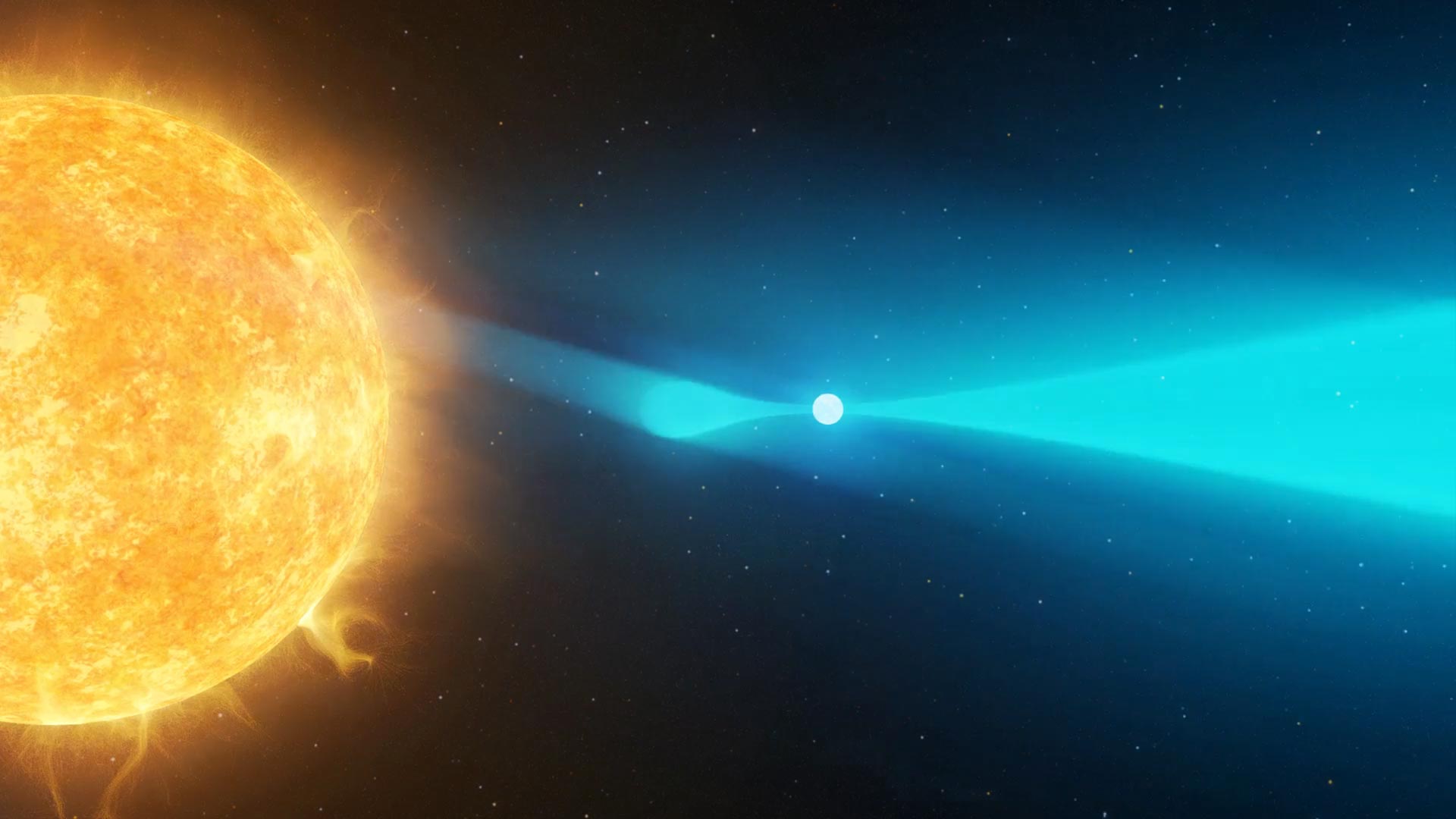
A dead star and its Sun-like companion have given astronomers an unexpected way to investigate mysterious radio pulses and detect stellar storms thousands of light-years away.
Mysterious radio signals have been appearing across the Milky Way, switching on and off over minutes or hours. Astronomers have found only about a dozen of these unusual sources, and one question has been especially difficult to answer: What is actually producing the pulses?
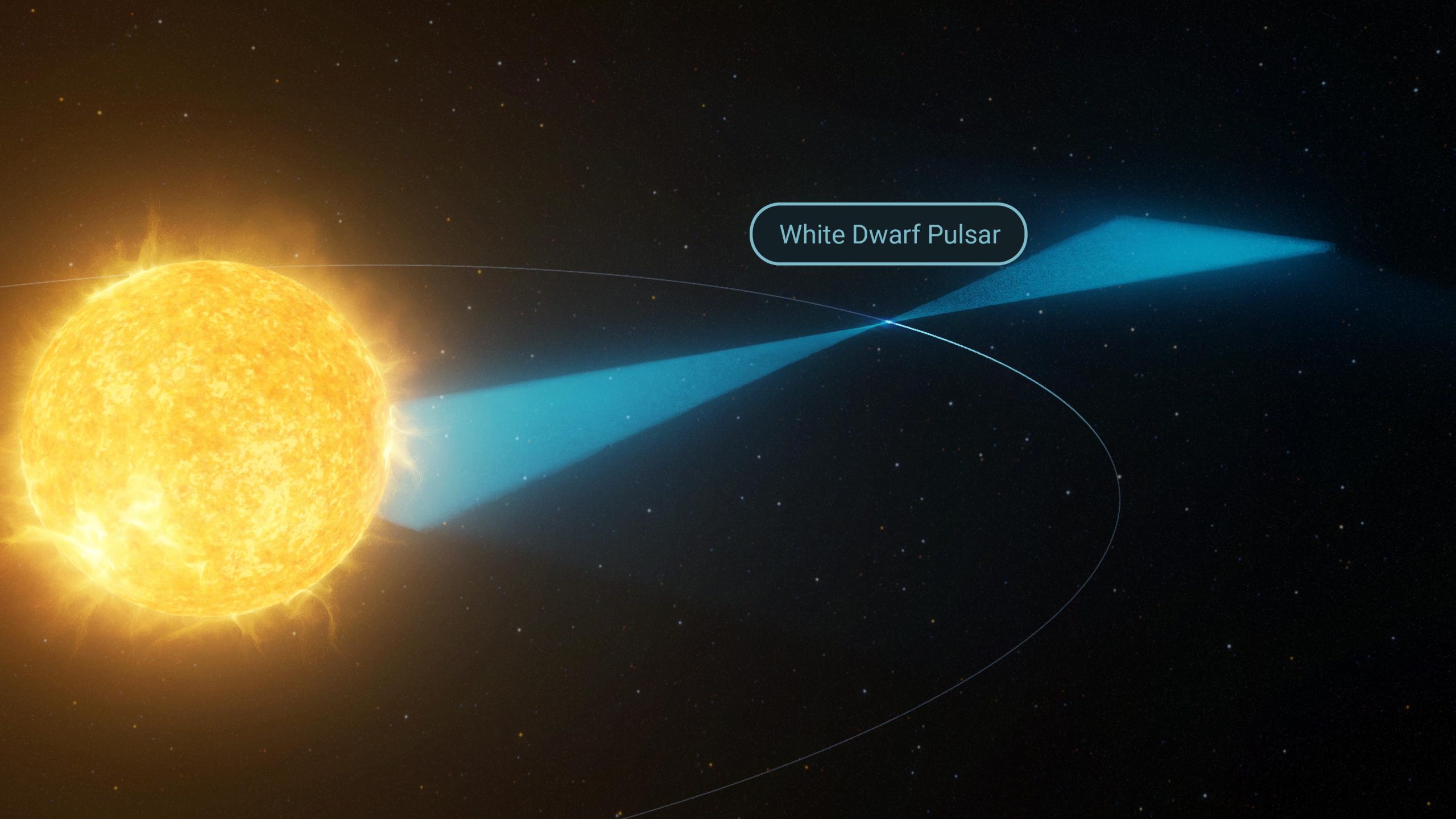
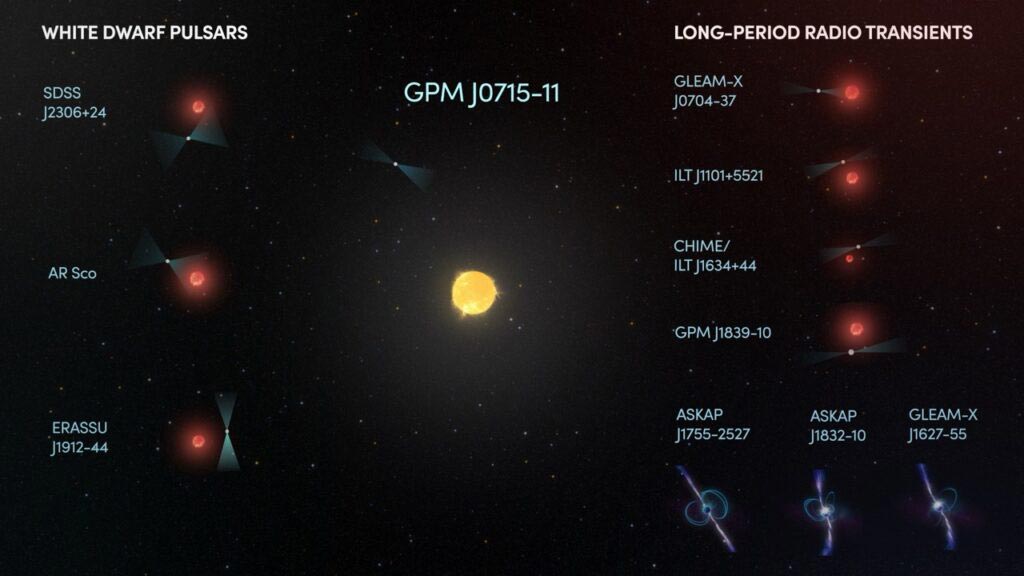
Now, a newly discovered star system more than 5,000 light-years away is offering an important clue. Known as GPM J071507−114153, it contains a white dwarf, the dense core left behind after a star dies, orbiting a companion remarkably similar to our Sun. The white dwarf spins once every eight minutes.
The discovery is unusual because astronomers have never before detected these radio pulses from a white dwarf paired with a Sun-like star. Previously identified systems producing similar signals have typically involved much smaller, cooler stars known as red dwarfs.
These mysterious sources belong to a class called long-period transients (LPTs). Since researchers at the International Center for Radio Astronomy Research (ICRAR) first discovered one in 2021, around a dozen have been identified. Several contain a white dwarf and another star, although astronomers have struggled to determine which one produces the radio signals.
Scientists at the Curtin University node at the International Centre for Radio Astronomy Research (ICRAR) have linked mysterious radio pulses to an unusual pairing of stars — a dead star that spins every eight minutes and a star similar to our own Sun. Credit: Natasha Hurley-Walker
Radio pulses reveal the white dwarf’s orbit
In the newly discovered system, scientists finally had enough information to narrow down the source.
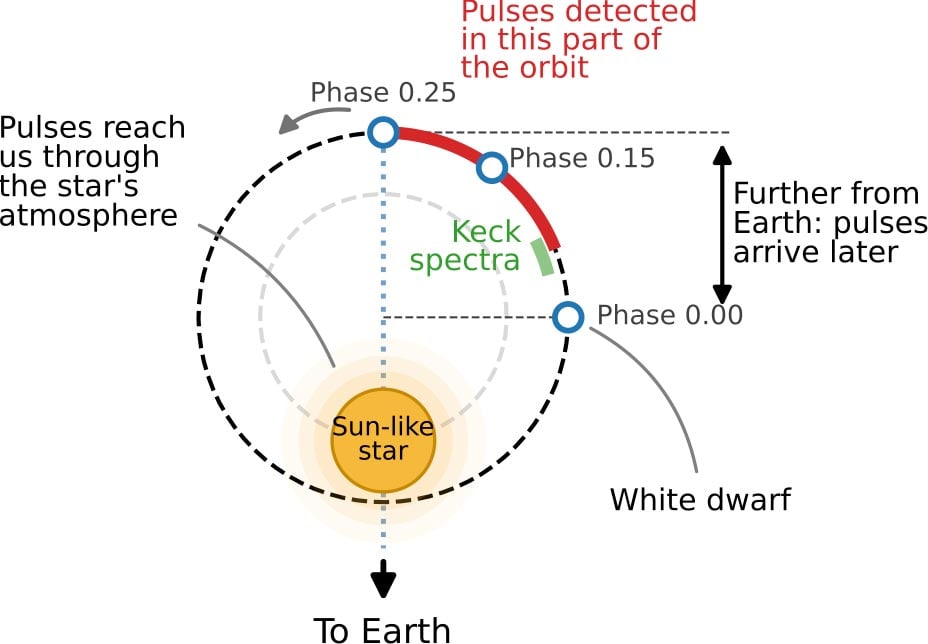
“This is the first time the pulses are clear enough to see the white dwarf moving in its orbit around its companion, so we know that the pulsations are coming from a region close to the white dwarf, or possibly even from the white dwarf itself,” said Dr Sam McSweeney, the study’s lead author and a commissioning scientist with the Square Kilometre Array Observatory.
McSweeney made the discovery while working as a researcher at the Curtin University node of ICRAR. To confirm and better understand the white dwarf’s movement, the team processed more than 100 hours of radio observations using computing resources at the Pawsey Supercomputing Research Center.
Stellar storms emerge 5,000 light-years away
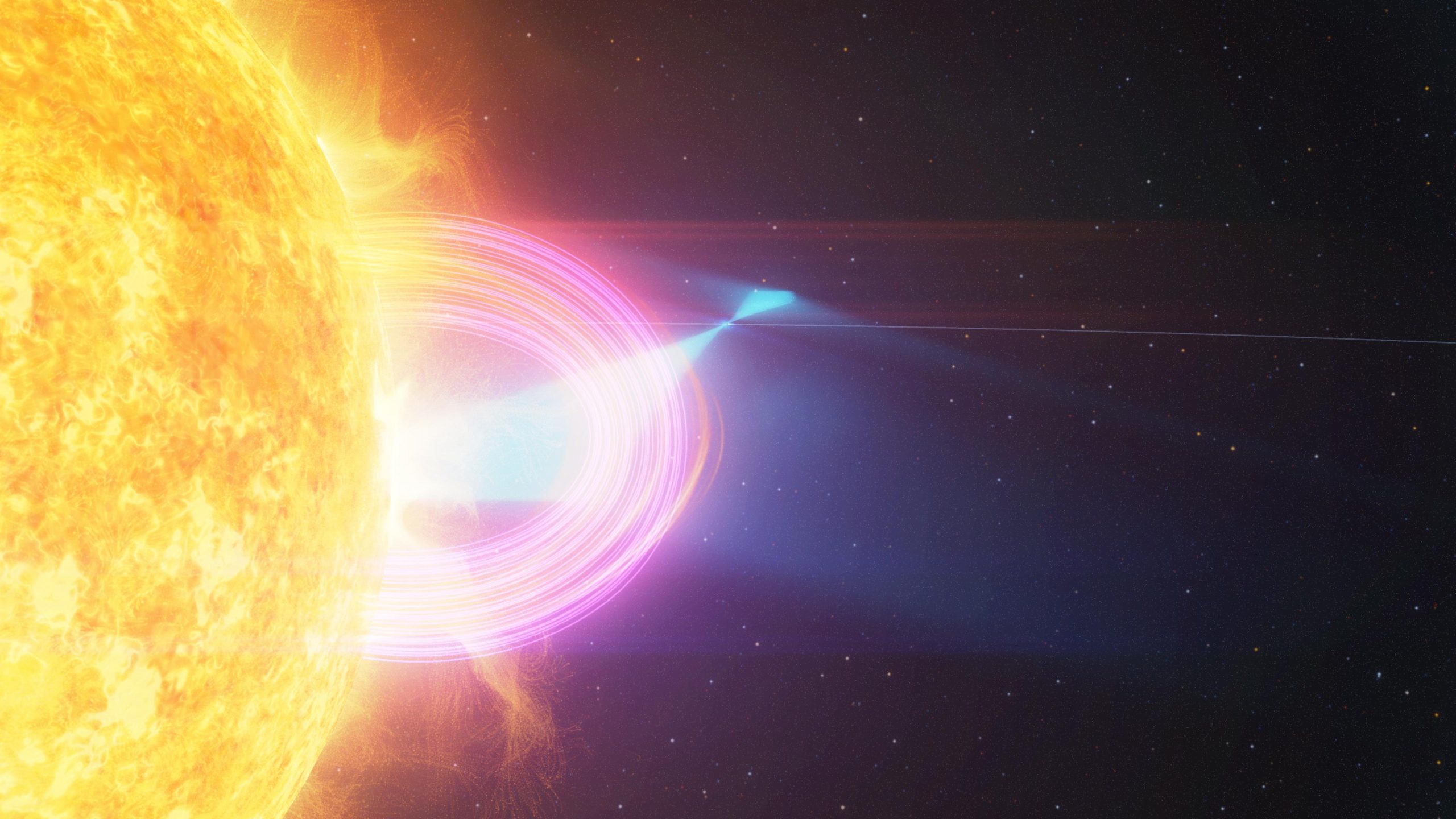
The radio pulses also revealed something unexpected about the white dwarf’s companion. Researchers detected evidence of stellar flares on the Sun-like star, similar to the activity associated with auroras here on Earth.
“As a bonus, we also saw the white dwarf moving behind a region with a strong magnetic field, most likely a ‘stellar prominence’, which is a large loop of plasma erupting from a star’s surface.”
The observation suggests astronomers can use radio signals to investigate magnetic activity on distant stars, even when those stars are thousands of light-years away.
“It’s amazing that by using radio wavelengths we can detect the storms on a star over 5000 light-years away.”
Both observations were described by Associate Professor Natasha Hurley-Walker, a co-author of the paper.
Three telescopes pinpoint the stellar pair
Finding such a rare system required several powerful telescopes working together. The researchers first identified its radio signals during a large survey of the Milky Way, then used additional observations to pinpoint its location.
“We detected this system in a large survey using the MWA (Murchison Widefield Array) to scan the entire Milky Way visible from Australia. We then used the MeerKAT radio telescope in South Africa to determine its precise position,” said Associate Professor Hurley-Walker.
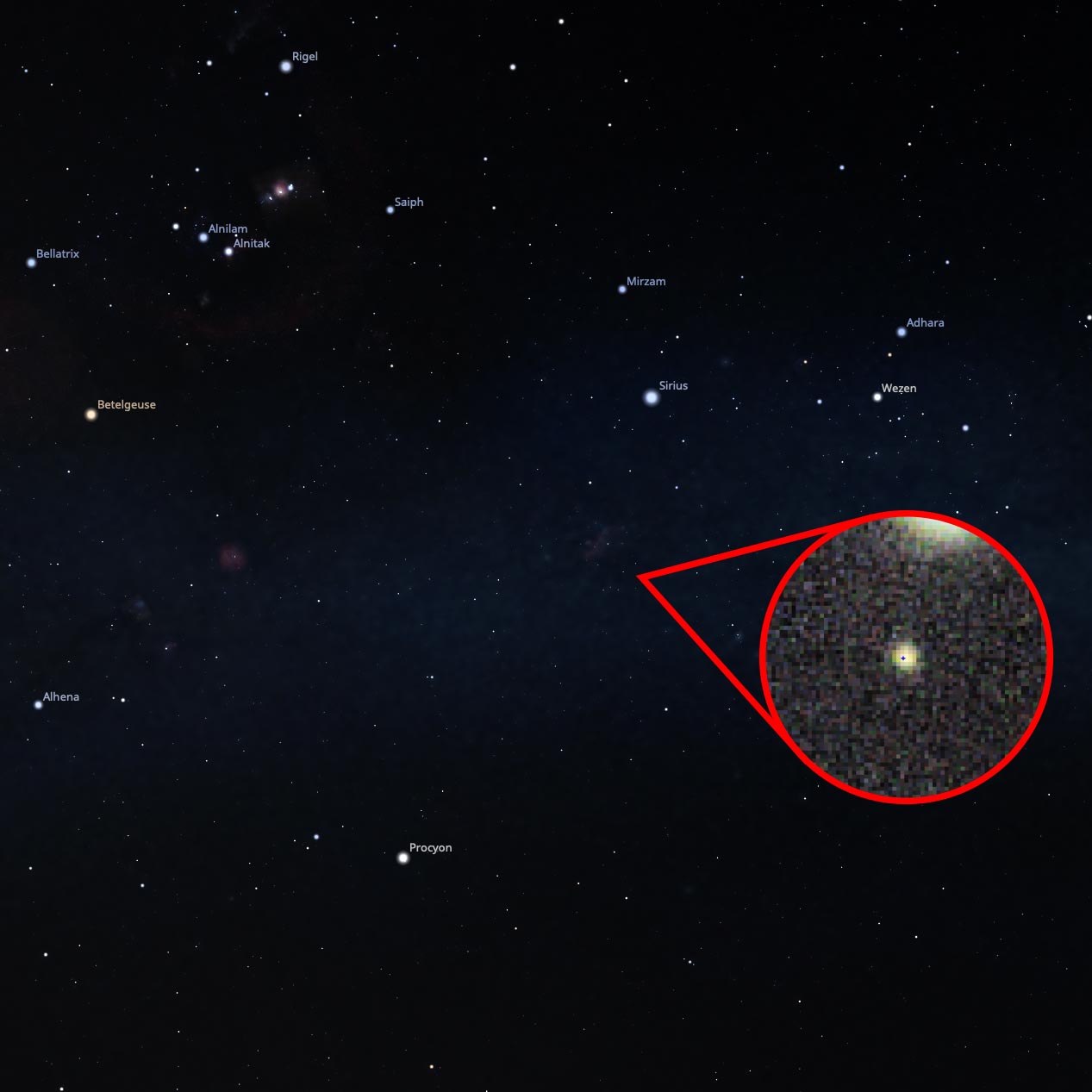
Once the radio source had been located, optical observations from the W.M. Keck Observatory on Maunakea, Hawaiʻi Island, confirmed its association with a G-type star, the same broad class as our Sun.
The MWA, led by Curtin University, is located at Inyarrimanha Ilgari Bundara, the CSIRO Murchison Radio-Astronomy Observatory on Wajarri Yamaji Country in Western Australia. MeerKAT, meanwhile, was built and is operated by the South African Radio Astronomy Observatory in South Africa’s North Cape province.
Both facilities are precursors to the larger SKA telescopes now being developed, SKA-Low in Australia and SKA-Mid in South Africa. These future observatories are expected to provide more detailed observations of unusual radio sources and help astronomers identify additional systems that have so far escaped detection.
“If we are already making such discoveries with precursor telescopes, just imagine how many more star systems we will be able to find, and what a beautifully detailed view of their signals we will have, once the SKAO telescopes are completely built,” said Dr McSweeney.
Reference: “A long-period transient with a Sun-like companion” by Samuel J. McSweeney, Natasha Hurley-Walker, Arash Bahramian, Csanád Horváth, Nanda Rea, Antonio C. Rodriguez and Ingrid Pelisoli, 12 November 2026, Nature Astronomy.
DOI: 10.1038/s41550-026-03016-z
Never miss a breakthrough: Join the SciTechDaily newsletter.
Follow us on Google and Google News.