
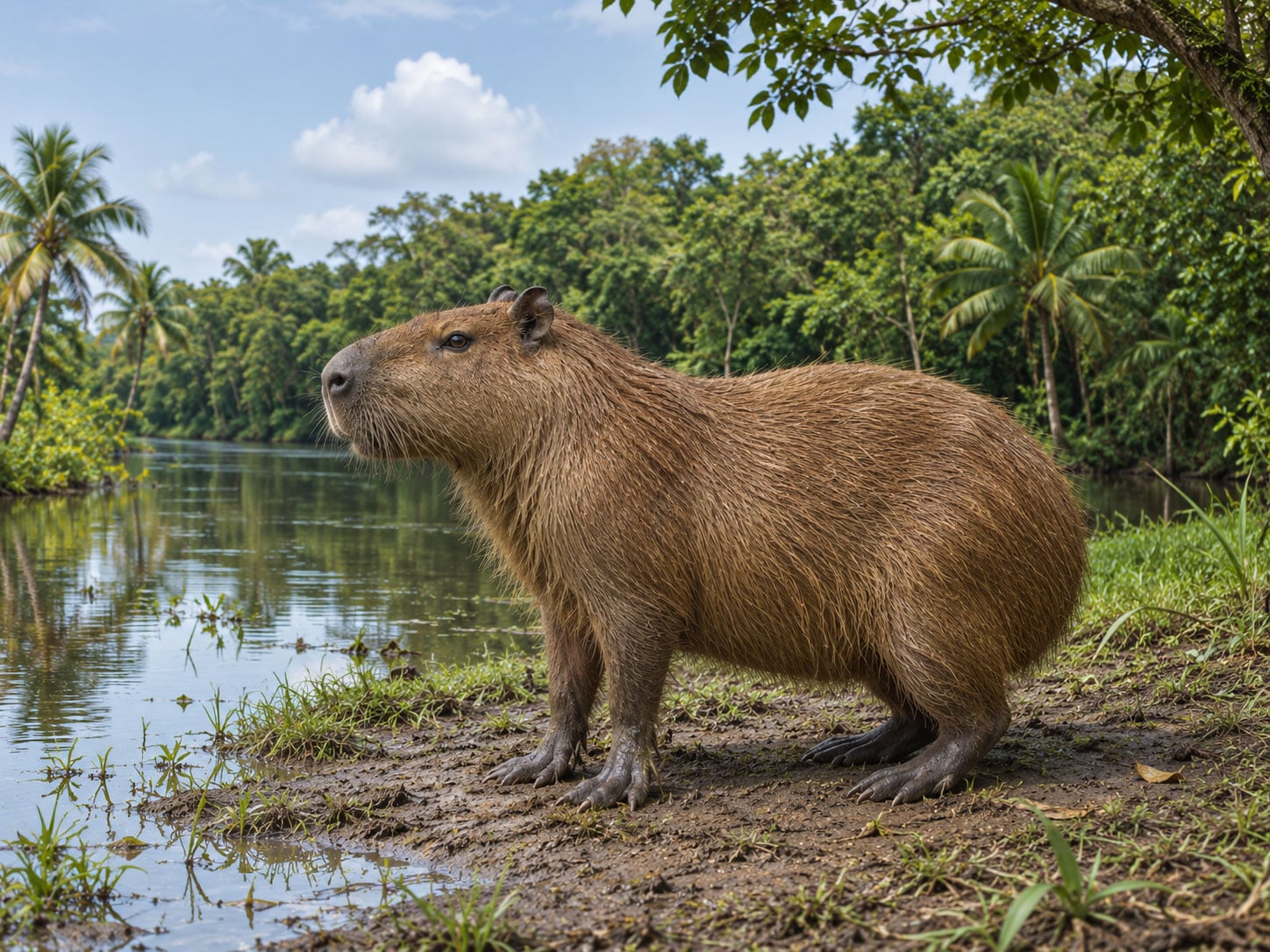
Paleontologists have uncovered fossils of an unusually large rodent that lived approximately 34 million years ago in what is now Thailand.
Fossilized teeth discovered in a coal mine in southern Thailand have revealed a previously unknown giant rodent that lived approximately 34 million years ago. Named Yakamys sirindhornae, the ancient mammal was substantially larger than other known rodents from its time, suggesting that the evolution of giant rodents began earlier and occurred across a wider geographic area than scientists previously recognized.
An international research team, including paleontologists from McGill University, identified the species from two fossilized teeth found at the Bang Mark Pit of the Krabi lignite mine in Thailand’s Krabi Province. The remains consist of a lower second molar and a lower incisor, providing limited but valuable evidence of an unusually large rodent that inhabited Southeast Asia during the Paleogene period.
An Ancient Rodent That May Have Weighed 66 Pounds
By analyzing the dimensions of the fossilized teeth using seven established methods for estimating body mass, researchers calculated that Yakamys weighed approximately 30 kilograms (66 pounds). That would make it roughly twice as heavy as other known rodents from the same period, including Hulgana.
The estimate remains uncertain because scientists must reconstruct the animal’s overall size from just two teeth.
“This is only a ballpark figure, as there is substantial uncertainty associated with fossil body-mass estimation,” said Virginie Millien, a study co-author and professor of biology at McGill University.
Giant Rodents Evolved Beyond South America
The largest living rodent is the capybara, a semiaquatic mammal native to South America. Although exceptionally large rodents have evolved multiple times, much of the known fossil evidence for rodent gigantism comes from South America, particularly during later periods of rodent evolution.
“Today, the largest living rodent is the capybara, but very large rodents are not restricted to recent ecosystems,” said Millien. “Giant rodents evolved repeatedly during the later history of the group, mostly in South America. This discovery suggests that Southeast Asia also played an important role in the early evolutionary history of large-bodied rodents.”
The Thai fossils extend the known history of unusually large rodents into Southeast Asia around 34 million years ago. However, the limited remains cannot establish precisely how Yakamys attained its large size or whether its evolutionary path resembled that of giant rodents that appeared elsewhere.
Fossil Discoveries in Thailand’s Krabi Basin
The fossils were recovered through an international research collaboration investigating ancient mammals in Thailand’s Krabi Basin. Participants include scientists from McGill University, Thailand’s Department of Mineral Resources, France’s National Center for Scientific Research (CNRS), and the University of Poitiers.
The researchers named the new genus Yakamys by combining the Thai word “yak,” meaning giant, with the Greek word “mys,” meaning mouse or rat.
“The species name, sirindhornae, honors Princess Maha Chakri Sirindhorn, in recognition of her longstanding support for science and paleontological research in Thailand,” Millien said.
With only two teeth available, many aspects of Yakamys remain unknown, including its diet, habitat preferences, and evolutionary relationships. Additional fossils could help researchers reconstruct its anatomy and determine how giant rodents emerged in Southeast Asia tens of millions of years ago.
Reference: “A giant eocene ischyromyid from Southeast Asia reveals the early evolution of rodent gigantism” by Yaowalak Chaimanee, Laurent Marivaux, Virginie Millien, Chotima Yamee, Pannipa Tian and Jean-Jacques Jaeger, 4 November 2026, Scientific Reports.
DOI: 10.1038/s41598-026-76711-6
The research was supported by CNRS, Université de Poitiers, Université de Montpellier, McGill University and the Department of Mineral Resources of Thailand.
Never miss a breakthrough: Join the SciTechDaily newsletter.
Follow us on Google and Google News.