
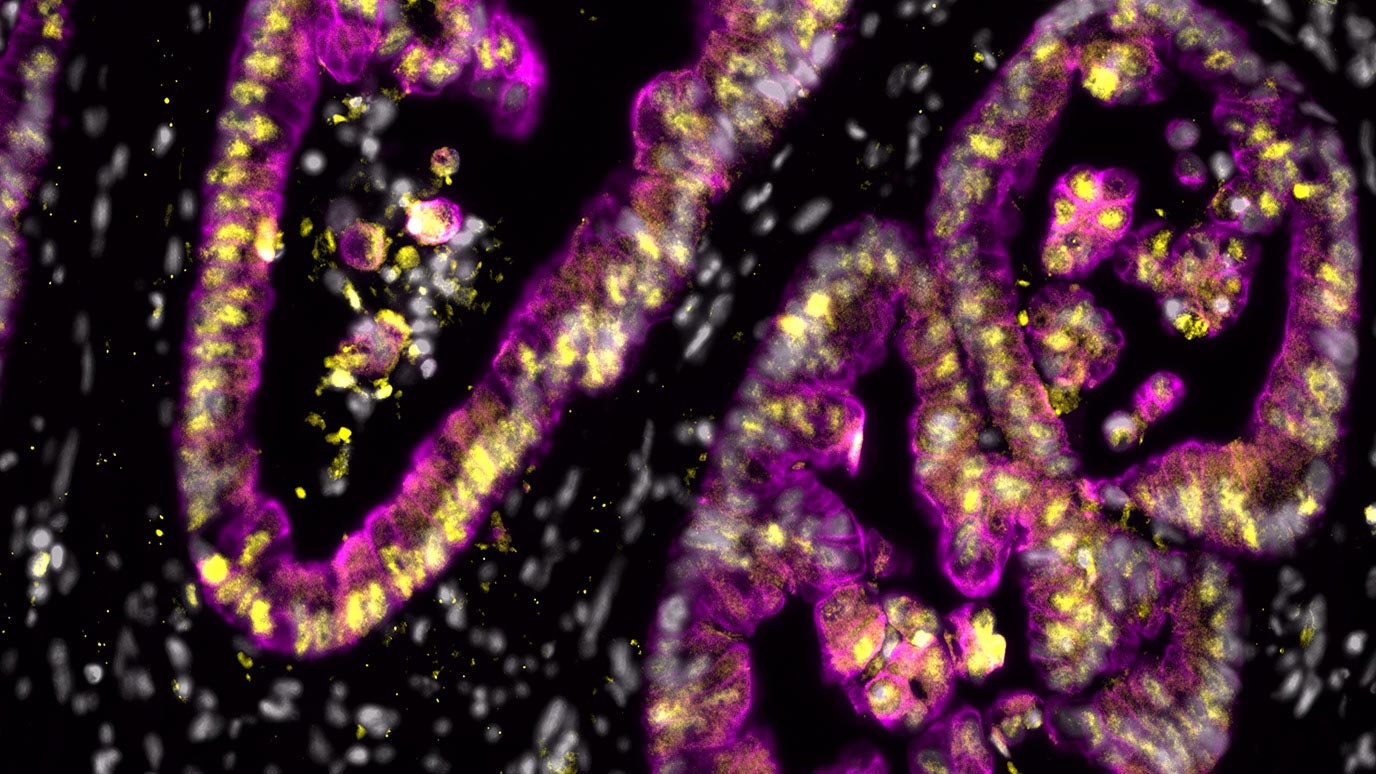
In preclinical experiments, drugs designed to fight pancreatic cancer also increased a protein that helps tumors survive, offering a possible clue to why treatment resistance develops.
Pancreatic cancer has ways of protecting itself from the immune system, allowing tumor cells to survive when they might otherwise be destroyed. Researchers at The University of Texas MD Anderson Cancer Center have identified a protein that appears to help tumors maintain this defense, and targeting it could make certain cancer treatments more effective.
The protein, called IL-18, normally helps regulate inflammation and the immune response. However, its levels are often elevated in people with pancreatic cancer, and higher levels have been linked to poorer outcomes. Scientists wanted to understand whether IL-18 was actively helping tumors grow or simply associated with more aggressive disease.
To investigate, they created genetically engineered models of pancreatic cancer with reduced IL-18 levels. Without as much of the protein, tumors grew more slowly, disease progression was delayed, and survival improved.
The signal that shields cancer cells
A closer examination of individual cells revealed a possible explanation. IL-18 increased levels of another protein called CD47, which acts as a “don’t eat me” signal. Cancer cells use this signal to avoid being destroyed by macrophages, immune cells that normally recognize and clear harmful or abnormal cells.
When IL-18 was reduced, macrophages became better at identifying and destroying tumor cells. The findings also suggest that IL-18 may influence how these immune cells enter tumors, remain there, or survive in the surrounding tissue, known as the tumor microenvironment.
Cancer drugs may activate another defense
The researchers also uncovered a potential connection to treatment resistance. Some promising pancreatic cancer drugs work by blocking KRAS, a protein that can drive cancer growth. Although these targeted therapies offer hope, some patients develop resistance.

In preclinical experiments, blocking KRAS increased IL-18 levels, potentially giving tumors another way to survive treatment. When researchers combined KRAS inhibition with reduced IL-18, the antitumor response improved, suggesting that targeting both proteins could be more effective than blocking KRAS alone.
The study, published in Gastroenterology, was co-led by Yang Chen, Ph.D., assistant professor of Translational Molecular Pathology, and Xinlei Sun, Ph.D., a postdoctoral fellow in the same department.
“Our results show that IL-18 helps pancreatic tumors stay hidden from the immune system and significantly contributes to disease progression and reduced survival,” Chen said. “Finding a way to safely target IL-18 in humans could have tremendous potential for enhancing the benefits of KRAS-targeted therapies and improving patient outcomes.”
The findings are still limited to preclinical research. Scientists will need to develop and test treatments that safely target IL-18 before determining whether combining them with KRAS inhibitors or other therapies can improve outcomes for people with pancreatic cancer.
Reference: “Depletion of Endogenous IL-18 Suppresses Pancreatic Cancer Progression, Reprograms the Tumor Microenvironment, and Enhances KRAS Inhibitor Efficacy” by Xinlei Sun, Yifan Ma, Lingzhi Wang, Jian Gao, Yue Fei, Xiaowei Zhang, Rance B. Tino, Yeseul Kim, Hua Wang, Kangyu Lin, Dongwei Zhang, Zhongming Zhao, Chunru Lin, John Paul Shen, Sue-Hwa Lin, Linghua Wang, Vincent Bernard, Eugene J. Koay, Dan Zhao, Huamin Wang, Wen Jiang, Betty Y. S. Kim, Anirban Maitra and Yang Chen, 13 November 2026, Gastroenterology.
DOI: 10.1053/j.gastro.2026.10.383
This work was supported in part by Concern Foundation, the National Institutes of Health, the American Pancreatic Association Foundation, the Phi Beta Psi Charity Trust, the Hirschberg Foundation for Pancreatic Cancer Research, and UT MD Anderson institutional funding.
Never miss a breakthrough: Join the SciTechDaily newsletter.
Follow us on Google and Google News.