
Close Menu
    Facebook X (Twitter) Instagram
    SciTechDaily
    • Biology
    • Chemistry
    • Earth
    • Health
    • Physics
    • Science
    • Space
    • Technology
    Facebook X (Twitter) Pinterest YouTube RSS
    SciTechDaily
    Home»Health»Scientists Compare How COVID-19 Cough Clouds Travel With and Without Face Masks
    Health

    Scientists Compare How COVID-19 Cough Clouds Travel With and Without Face Masks

    By American Institute of PhysicsOctober 20, 20201 Comment3 Mins Read
    Facebook Twitter Pinterest Telegram LinkedIn WhatsApp Email Reddit
    Share
    Facebook Twitter LinkedIn Pinterest Telegram Email Reddit
    Volume of Cough Cloud
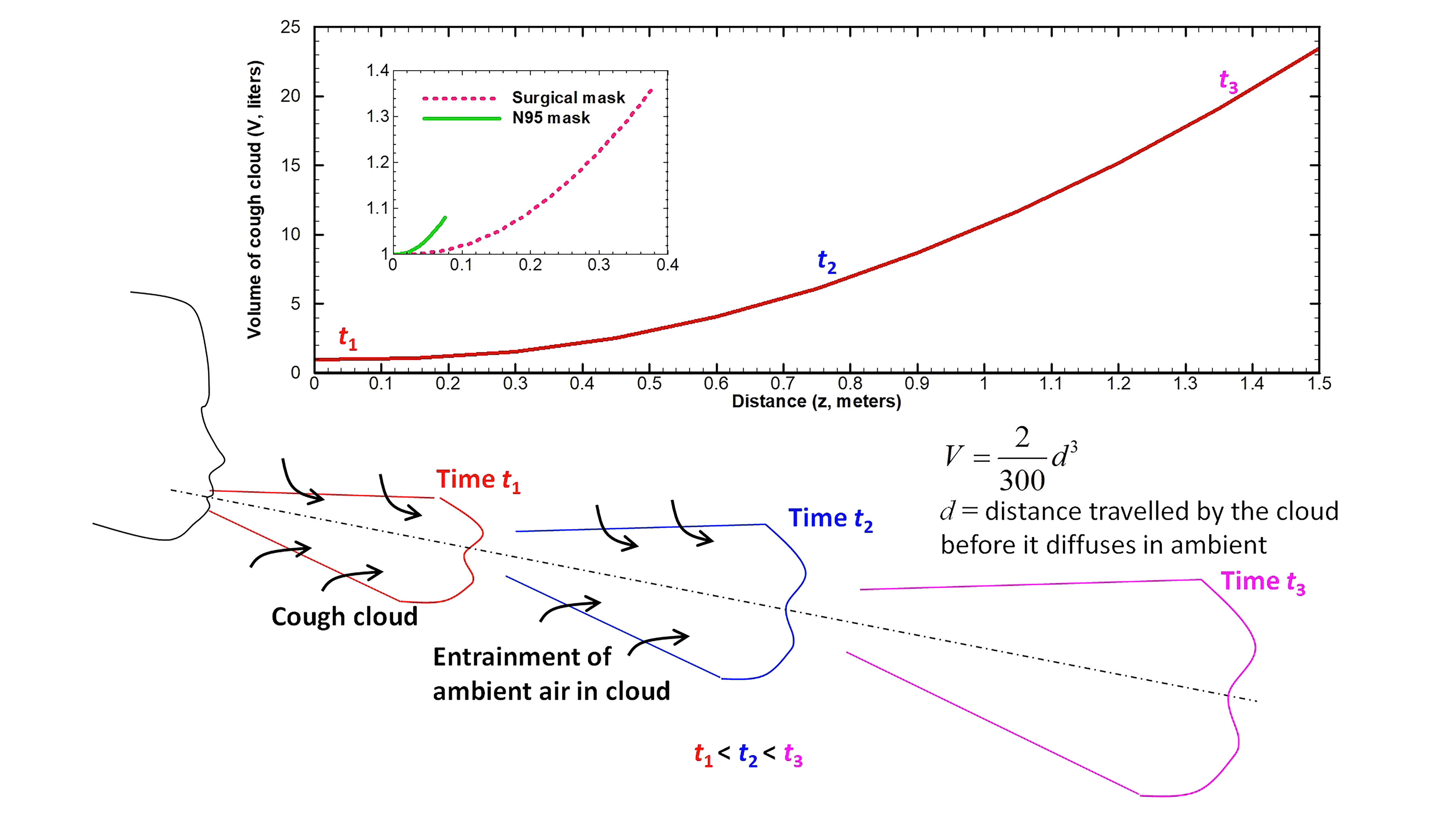
    Volume of cough cloud generated by a human subject increases with time due to entrainment of the surrounding air into it (Bottom). Change in volume of the cloud as a function of distance from mouth (Top). Masks reduce the volume significantly as seen in the inset. Credit: Amit Agrawal and Rajneesh Bhardwaj

    As the coronavirus has affected more than 30 million people globally, researchers have increasingly focused on the extent to which airborne respiratory droplets carrying the SARS-CoV-2 virus travel and contaminate the air after a COVID-19 infected person coughs.

    While scientists have studied the properties of air at the mouth, such as volume, temperature, droplet distribution, and humidity, less is known about how these properties change as the cough cloud travels. In Physics of Fluids, by AIP Publishing, researchers estimate the evolving volume of the cough cloud and quantify the reduction in its volume in the presence of a face mask.

    The scientists found the cloud volume without a mask is about 7 times larger than with a surgical mask and 23 times larger than with an N95 mask.

    “We estimate this volume of the air, which may help to design ventilation of closed spaces and consequently reduce the spread of the disease,” said Amit Agrawal, one of the authors.

    The researchers also examined the variation in temperature and humidity in the cough cloud as the determinant that impacts the droplet distribution in the cloud.

    Using an analysis based on jet theory and experimental data from the literature, they found that it’s the first 5 to 8 seconds after coughing that matter for suspending the exhaled droplets in the air and, consequently, for the spread of the disease. After that time, the cough cloud typically starts to disperse.

    The scientists found the cloud volume without a mask is about 7 times larger than with a surgical mask and 23 times larger than with an N95 mask.

    “We found that anything that reduces the distance traveled by the cloud, such as a mask, handkerchief, or coughing into an elbow, should greatly reduce the region over which the droplets disperse upon coughing and therefore the chances of infection,” said Rajneesh Bhardwaj, another author.

    Interestingly, the researchers found how hard a person coughs, which impacts the initial velocity and volume of coughing, does not affect the volume in the cough cloud when the person is not wearing a mask, although the initial volume is very important for a person wearing a mask.

    The scientists determined the volume of a cough cloud varies as a cube of the total distance traveled by the cloud with the proportionality constant being 1 to 150. This formula will be helpful in determining the maximum number of people that can be accommodated in a hospital ward, and the minimum rate at which air in a room, elevator, cinema hall, car, aircraft cabin, or restaurant needs to be circulated to maintain freshness and reduce the chance of infection.

    Reference: “Reducing chances of COVID-19 infection by a cough cloud in a closed space” by Amit Agrawal and Rajneesh Bhardwaj, 20 October 2020, Physics of Fluids.
    DOI: 10.1063/5.0029186

    Never miss a breakthrough: Join the SciTechDaily newsletter.
    Follow us on Google and Google News.

    American Institute of Physics COVID-19 Fluid Dynamics Infectious Diseases Popular Public Health
    Share. Facebook Twitter Pinterest LinkedIn Email Reddit

    Related Articles

    Cloth COVID Masks Filter Less Than 10% of Particles – Inferior for Protection Against Airborne Viral Spread

    Deactivating COVID-19 Virus Cough Droplets With UV-C Lamps

    Simply Talking While Infected Can Spread COVID-19 – Even While Wearing Masks

    Fluid Dynamics Expert Explains How to Reduce the Risk of COVID-19 Airborne Transmission Inside a Car

    Disposable Helmet Designed to Retain Cough Droplets, Minimize COVID-19 Transmission

    Some Masks Can Be Worse Than Not Wearing One at All: Physics of How Masks Affect Airflow and COVID-19 Protection

    Aerodynamics of Infectious Disease: Airflow Studies Reveal Strategies to Reduce Indoor Transmission of COVID-19

    COVID-19 Transmission: Tracking Flight Trajectory of Evaporating Cough Droplets

    Aerosol Microdroplets Not Very Effective at Spreading the COVID-19 Virus

    1 Comment

    1. kamir bouchareb st on October 21, 2020 12:34 am

      very good

      Reply
    Leave A Reply Cancel Reply

    • Facebook
    • Twitter
    • Pinterest
    • YouTube

    Don't Miss a Discovery

    Subscribe for the Latest in Science & Tech!

    Trending News

    Researchers Warn Widely Prescribed Blood Pressure Drugs Could Be Harming Diabetic Kidneys

    James Webb Spots Something Strange Between Day and Night on an Alien Planet

    How Ancient People Moved a 6-Ton Stone 700 Kilometers to Stonehenge

    The Unexpected Gut Health Risk of Cutting Out Sugar

    Popular Weight-Loss Drugs Like Ozempic Linked to Lower Breast Cancer Risk

    AI Learned the Rules of the Universe and That Became a Problem

    Scientists Found a Hidden Brain Signal That Predicts Social Behavior

    Even GPT-5 Failed This Human Attention Test

    Follow SciTechDaily
    • Facebook
    • Twitter
    • YouTube
    • Pinterest
    • Newsletter
    • RSS
    SciTech News
    • Biology News
    • Chemistry News
    • Earth News
    • Health News
    • Physics News
    • Science News
    • Space News
    • Technology News
    Recent Posts
    • Women’s Brains May Be More Vulnerable to Dementia Risk Factors Than Scientists Realized
    • Scientists Say We’ve Been Wrong About the Aging Brain
    • More Weight Loss, Fewer Fractures? New Study Points to Semaglutide
    • These Tiny Birds Became Giants on Remote Scottish Islands
    • A Fatal Deer Disease May Be Spreading in Ways No One Expected
    Copyright © 1998 - 2026 SciTechDaily. All Rights Reserved.
    • Science News
    • About
    • Contact
    • Editorial Board
    • Privacy Policy
    • Terms of Use

    Type above and press Enter to search. Press Esc to cancel.