
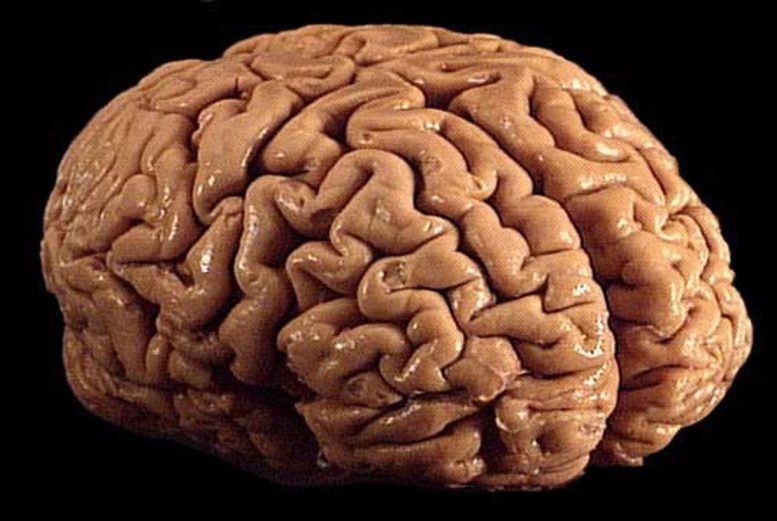
The characteristic wrinkled surface of the brain is usually associated with enhanced cognitive function, however, excessive folding can have the opposite effect.
The human brain’s outer layer, known as the cerebral cortex, is characterized by its unique gyri and sulci, or ridges and furrows. This layer is responsible for managing cognitive and executive functions, encompassing everything from conscious thought and speech to emotional regulation.
The cerebral cortex is made up of over 10 billion cells and more than 100 trillion connections, forming a gray matter layer that is only 5 millimeters thick — equivalent to a little less than three stacked quarters.
Most animals with large brains exhibit cortical folding, which allows a very large area of cerebral cortex tissue (approximately 2.6 square feet OR 0.24 square meters) to be compacted inside the confines of the skull. The more cortical folding, the more advanced and complex the cognitive functions of the species. Lower species like mice and rats have smaller, smooth-surfaced brains; higher-order species like elephants, porpoises, and apes display different degrees of gyrification or folding of the cerebral cortex. Humans possess among the most wrinkly of brains, considered an indicator of advanced evolution.
Excessive Brain Folding and Neurodevelopmental Disorders
In some humans, however, excess folding of the cerebral cortex is associated not with greater cognitive abilities, but the opposite, and is linked to neurodevelopmental delay, intellectual disability, and epileptic seizures. The genes controlling this folding are mostly unknown.
Writing in the January 16, 2023 issue of PNAS, researchers at the University of California San Diego School of Medicine and Rady Children’s Institute for Genomic Medicine describe new findings that deepen understanding of human gyrification.
UC San Diego researchers identify a mutation that causes excessive folding in the human brain’s wrinkly cerebral cortex, resulting in diminished cognitive function. Credit: UC San Diego Health Sciences
Led by senior study author Joseph Gleeson, MD, Rady Professor of Neuroscience at UC San Diego School of Medicine and director of neuroscience research at the Rady Children’s Institute for Genomic Medicine, an international consortium of researchers called the Neurogenetics Consortium performed genomic analysis on nearly 10,000 families with pediatric brain disease over the course of 10 years to look for new causes of disease.
“From our cohort, we found four families with a condition called polymicrogyria, meaning too many gyri that are too tightly packed,” said Gleeson. “Until recently, most hospitals treating patients with this condition did not test for genetic causes. The Consortium was able to analyze all four families together, which aided in our discovery of a cause for this condition.”
Specifically, all four families displayed mutations in a gene called Transmembrane Protein 161B (TMEM161B), which produces a protein of previously unknown function on cell surfaces.
“Once we identified TMEM161B as the cause, we set out to understand how excessive folding occurs,” said first author Lu Wang, Ph.D., a postdoctoral fellow in the Gleeson lab. “We discovered the protein controls the cellular skeleton and polarity, and these control folding.”
TMEM161B in Brain Development
Using stem cells derived from patient skin samples, and engineered mice, the researchers identified defects in neural cell interactions early in embryogenesis.
“We found the gene is necessary and sufficient for cytoskeletal changes required for how neural cells interact with one another,” said Wang. “It was interesting that the gene first appeared in evolution in sponges, which don’t even have a brain, so clearly the protein must have other functions. Here we found a critical role in regulating the number of folds in the human brain.”
The study authors emphasized that genetic discovery studies are important because they pinpoint the causes of human disease, but that these discoveries can take many years to evolve into new treatments.
“We hope that physicians and scientists can expand upon our results to improve diagnosis and care of patients with brain disease,” said Gleeson.
Reference: “TMEM161B modulates radial glial scaffolding in neocortical development” by Lu Wang, Caleb Heffner, Keng loi Vong, Chelsea Barrows, Yoo-Jin Ha, Sangmoon Lee, Pablo Lara-Gonzalez, Ishani Jhamb, Dennis Van Der Meer, Robert Loughnan, Nadine Parker, David Sievert, Swapnil Mittal, Mahmoud Y. Issa, Ole A. Andreassen, Anders Dale, William B. Dobyns, Maha S. Zaki, Stephen A. Murray and Joseph G. Gleeson, 20 January 2023, Proceedings of the National Academy of Sciences.
DOI: 10.1073/pnas.2209983120
Funding: National Institutes of Health NIH/NINDS Pathway to Independence, CIRM Training Grant Postdoc award, Brain and Behavior Research Foundation, Rady Children’s Hospital Neuroscience Endowment, UC San Diego Microscopy Core, NIH grants, CIRM grant
Never miss a breakthrough: Join the SciTechDaily newsletter.
Follow us on Google and Google News.
1 Comment
… aren’t Orca better at that?