
Climate change is making plants more susceptible to disease. New research could help them fight back.
When heat waves strike, they don’t just take a toll on people — plants that we depend on for food suffer too. This is because when temperatures get too high, certain plant defenses don’t work very well, leaving them more vulnerable to attacks from pathogens and insect pests.
Now, researchers say they have identified a specific protein in plant cells that explains why immunity falters as temperatures rise. They’ve also discovered a way to reverse the loss and strengthen plant defenses against the heat.
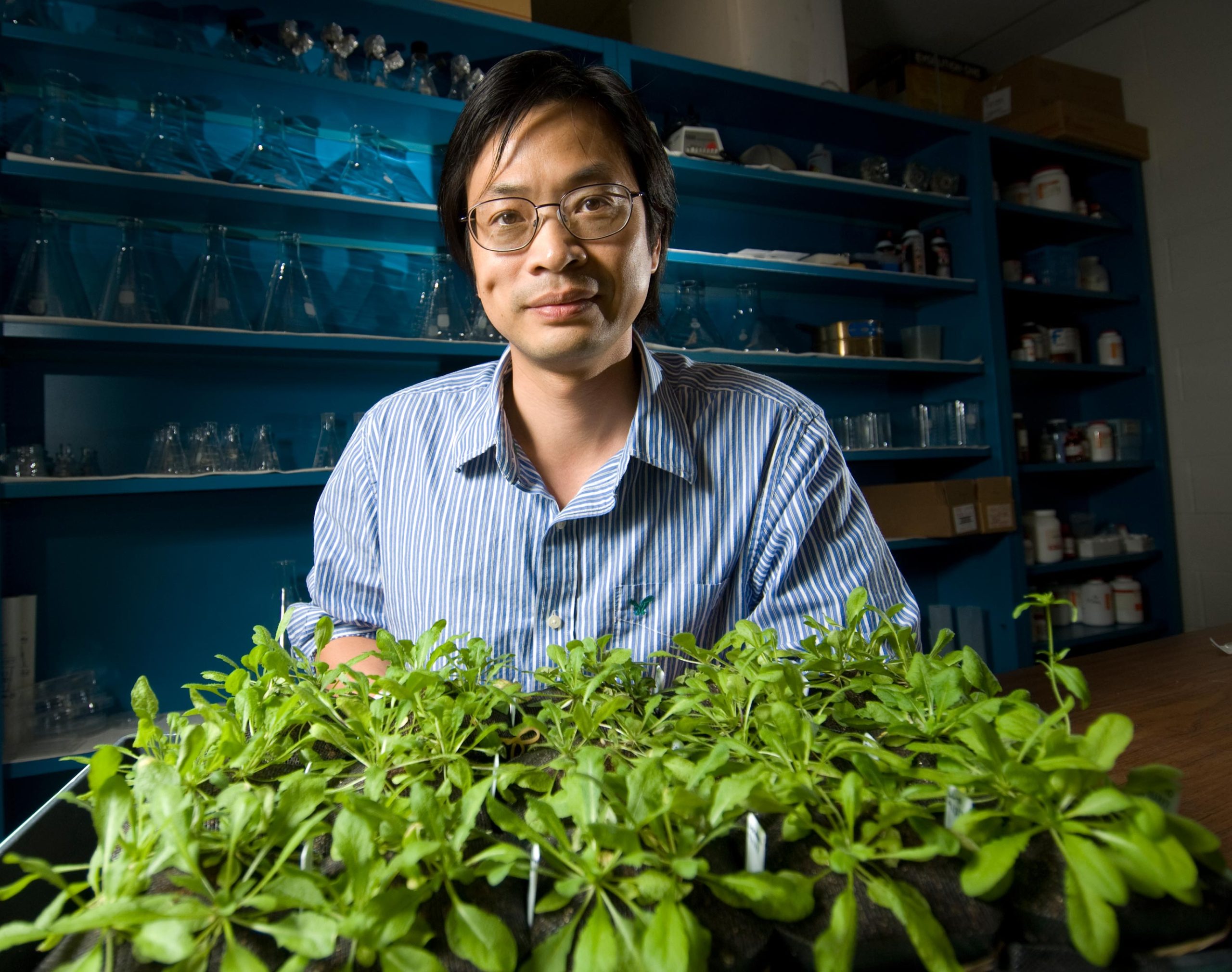
The findings, which will be published today (June 29, 2022) in the journal Nature, were discovered in a spindly plant with white flowers called Arabidopsis thaliana, which is the “lab rat” of plant research. If the same results hold up in crops, it would be welcome news for food security in a warming world, said Duke University biologist and corresponding author Sheng-Yang He.
The Role of Salicylic Acid in Plant Defense
Scientists have known for decades that above-normal temperatures suppress a plant’s ability to make salicylic acid, a defense hormone that fires up the plant’s immune system and stops invaders before they cause too much damage. However, the molecular basis of this immunity meltdown wasn’t well understood.
In the mid 2010s, He and his then-graduate student Bethany Huot found that even brief heat waves can have a dramatic effect on hormone defenses in Arabidopsis plants, leaving them more prone to infection by a bacterium called Pseudomonas syringae.
Normally when this pathogen attacks, the levels of salicylic acid in a plant’s leaves go up 7-fold to keep bacteria from spreading. But when temperatures rise above 86 degrees for just two days — not even triple digits — plants can no longer make enough defense hormone to keep infection from taking hold.
“Plants get a lot more infections at warm temperatures because their level of basal immunity is down,” He said. “So we wanted to know, how do plants feel the heat? And can we actually fix it to make plants heat-resilient?”
Around the same time, a different team had found that molecules in plant cells called phytochromes function as internal thermometers, helping plants sense warmer temperatures in the spring and activate growth and flowering.
So He and his colleagues wondered: could these same heat-sensing molecules be what’s knocking down the immune system when things warm up, and be the key to bringing it back?
To find out, the researchers took normal plants and mutant plants whose phytochromes were always active regardless of temperature, infected them with P. syringae bacteria, and grew them at 73 and 82 degrees to see how they did. But the phytochrome mutants fared exactly like normal plants: they still couldn’t make enough salicylic acid when temperatures rose to fend off infections.
The CBP60g Gene: Master Switch of Plant Immune Response
Co-first authors Danve Castroverde and Jonghum Kim spent several years doing similar experiments with other gene suspects, and those mutant plants got sick during warm spells too. So they tried a different strategy. Using next-generation sequencing, they compared gene readouts in infected Arabidopsis plants at normal and elevated temperatures. It turned out that many of the genes that were suppressed at elevated temperatures were regulated by the same molecule, a gene called CBP60g.
The CBP60g gene acts like a master switch that controls other genes, so anything that downregulates or “turns off” CBP60g means lots of other genes are turned off, too — they don’t make the proteins that enable a plant cell to build up salicylic acid.
Further experiments revealed that the cellular machinery needed to start reading out the genetic instructions in the CBP60g gene doesn’t assemble properly when it gets too hot, and that’s why the plant’s immune system can’t do its job anymore.
Engineering Heat-Resilient Plants
The team was able to show that mutant Arabidopsis plants that had their CBP60g gene constantly “switched on” were able to keep their defense hormone levels up and bacteria at bay, even under heat stress.
Next the researchers found a way to engineer heat-resilient plants that turned on the CBP60g master switch only when under attack, and without stunting their growth — which is critical if the findings are going to help protect plant defenses without negatively impacting crop yields.
The findings could be good news for food supplies made insecure by climate change, He said.
Food Security in a Warming World
Global warming is making heat waves worse, weakening plants’ natural defenses. But already, up to 40% of food crops worldwide are lost to pests and diseases each year, costing the global economy some $300 billion.
At the same time, population growth is driving up the world’s demand for food. To feed the estimated 10 billion people expected on Earth by 2050, forecasts suggest that food production will need to increase by 60%.
When it comes to future food security, He says the real test will be whether their strategy to protect immunity in Arabidopsis plants works in crops as well.
The team found that elevated temperatures didn’t just impair salicylic acid defenses in Arabidopsis plants — it had a similar effect on crop plants such as tomato, rapeseed, and rice.
Follow-up experiments to restore CBP60g gene activity in rapeseed thus far are showing the same promising results. In fact, genes with similar DNA sequences are found across plants, He says.
In Arabidopsis, keeping the CPB60g master switch from feeling the heat not only restored genes involved in making salicylic acid, but also protected other defense-related genes against warmer temperatures too.
“We were able to make the whole plant immune system more robust at warm temperatures,” He said. “If this is true for crop plants as well, that’s a really big deal because then we have a very powerful weapon.”
Reference: “Strengthening the Resilience of Plant Immunity to a Warming Climate,” Jonghum Kim, Christian Danve M. Castroverde, Shuai Huang, Chao Li, Richard Hilleary, Adam Seroka, Reza Sohrabi, Diana Medina-Yerena, Bethany Huot, Jie Wang, Kinya Nomura, Sharon K. Marr, Mary C. Wildermuth, Tao Chen, John D, MacMicking and Sheng Yang He, 29 June 2022, Nature.
DOI: 10.1038/s41586-022-04902-y
This work was a joint effort between He’s team and colleagues at Yale University, the University of California, Berkeley, and Tao Chen Huazhong Agricultural University in China. A patent application has been filed based on this work.
This research was supported by the Natural Sciences and Engineering Research Council of Canada, Korean Research Foundation Postdoctoral Fellowship, National Institutes of Health T32 Predoctoral Fellowship, Howard Hughes Medical Institute Exceptional Research Opportunities Fellowship, National Natural Science Foundation of China, and MSU Plant Resilience Institute and Duke Science and Technology Initiative.
Never miss a breakthrough: Join the SciTechDaily newsletter.
Follow us on Google and Google News.
1 Comment
One of the most common, if not THE most common, mistakes in logic is to not examine basic assumptions. For example, are plants stressed by temperature during heat wave, or are they stressed by inadequate water? Is it reasonable to assume that plants, which typically survive between freezing and over 100 deg F with adequate water, will be at risk in the future with a 3 deg F rise in average global temperature? Because, that predicted rise is a global average for all latitudes, with most of the annual rise being at night and in the Winter. Implicit in the motivation for the research is the assumption that heat waves will become more intense and more frequent in the future. Outside of questionable models, there is scant evidence to support that assumption:
https://wattsupwiththat.com/2019/09/06/the-gestalt-of-heat-waves/