

Close Menu
    Facebook X (Twitter) Instagram
    SciTechDaily
    • Biology
    • Chemistry
    • Earth
    • Health
    • Physics
    • Science
    • Space
    • Technology
    Facebook X (Twitter) Pinterest YouTube RSS
    SciTechDaily
    Home»Earth»Breathtaking View of Moon’s Shadow Over the U.S. During the Annular Solar Eclipse
    Earth

    Breathtaking View of Moon’s Shadow Over the U.S. During the Annular Solar Eclipse

    By Emily Cassidy, NASA Earth ObservatoryOctober 17, 2023No Comments4 Mins Read
    Facebook Twitter Pinterest Telegram LinkedIn WhatsApp Email Reddit
    Share
    Facebook Twitter LinkedIn Pinterest Telegram Email Reddit
    Earth Darkened by Moon's Shadow
    Stunning image of the Moon’s shadow cast on Earth during the annular eclipse on October 14, 2023. This image was captured by NASA’s EPIC imager aboard the Deep Space Climate Observatory, a satellite located at Lagrange Point 1.

    As the Moon crossed between the Sun and Earth during the 2023 annular solar eclipse, its shadow darkened skies across the United States.

    On October 14, 2023, the Moon aligned with the Sun and Earth to produce an annular solar eclipse. The spectacle bathed millions of Americans in a lunar shadow as the Moon blocked the Sun’s rays.

    An annular eclipse occurs when the Moon passes in front of the Sun but is too far from Earth to completely obscure it. The Moon is at or near its farthest distance from Earth—known as its apogee—during an annular eclipse, making it look smaller in the sky. This leaves the Sun’s edges exposed in a red-orange ring, dubbed the “ring of fire.” A satellite caught an earthly view of the event, as the Moon’s shadow crossed North America.

    Diagram of Umbra and Penumbra
    During an eclipse, two shadows are cast. The first is called the umbra (UM bruh). This shadow gets smaller as it goes away from the sun. It is the dark center of the eclipse shadow. The second shadow is called the penumbra (pe NUM bruh). The penumbra gets larger as it goes away from the sun. Credit: NASA

    The above image was acquired during the eclipse by NASA’s EPIC (Earth Polychromatic Imaging Camera) imager aboard DSCVR (Deep Space Climate Observatory), a joint NASA, NOAA, and U.S. Air Force satellite. The sensor provides frequent global views of Earth from its position at Lagrange Point 1, a gravitationally stable point between the Sun and Earth about 1.5 million kilometers from Earth. In this view, acquired at 16:58 Universal Time (11:58 a.m. Central Daylight Time), the shadow, or umbra, from the Moon can be seen falling across the southeastern coast of Texas, near Corpus Christi.
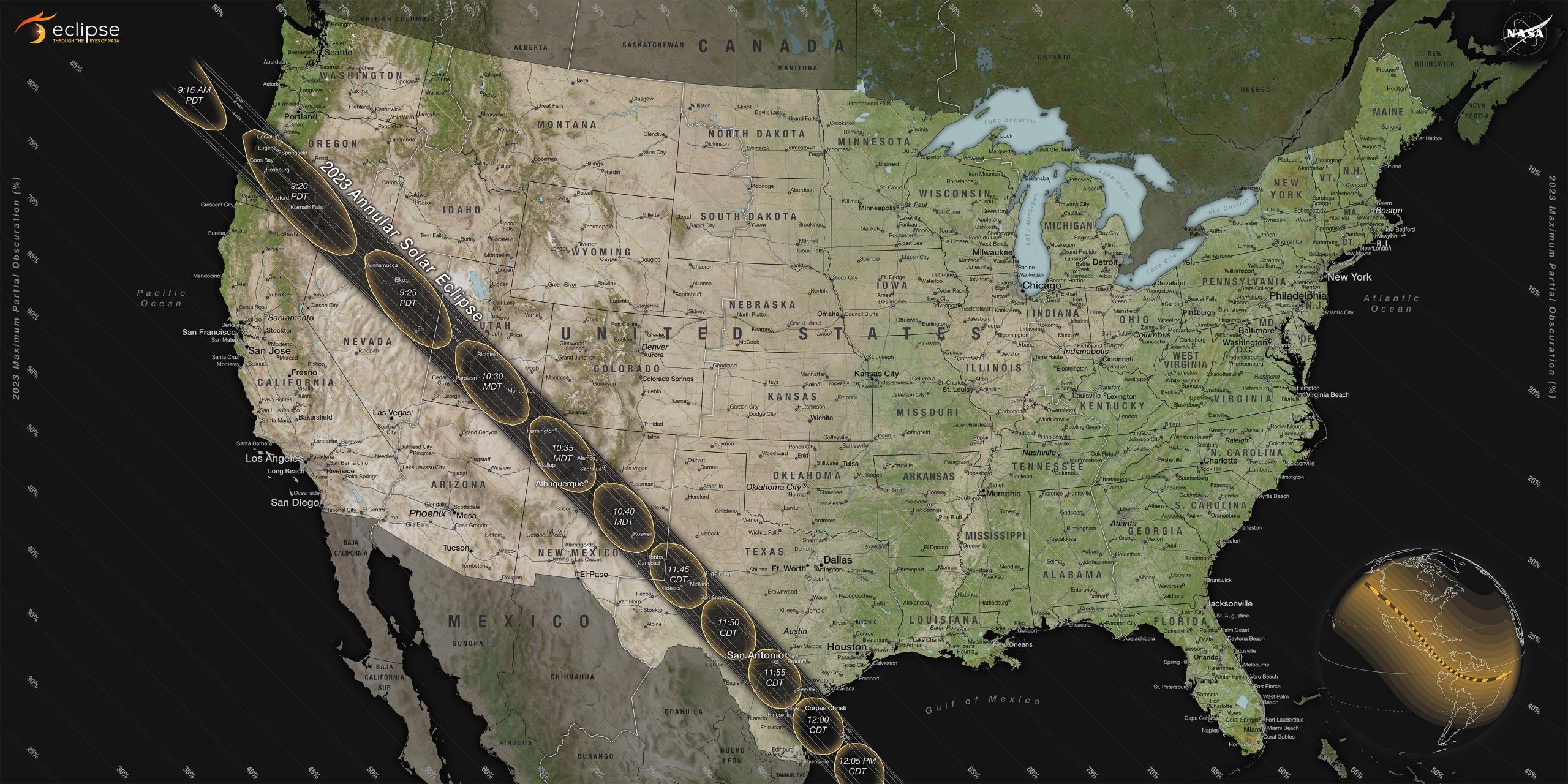
    2023 Solar Eclipse Map
    The path of annularity and partial contours crossing the U.S. for the 2023 annular solar eclipse occurring on October 14, 2023. Credit: NASA’s Scientific Visualization Studio

    While the annular eclipse was partially visible across the entire United States, Mexico, and countries in Central and South America, the path of annularity—where the largest area of the Sun was covered by the Moon from the observers’ point of view—was the best place to view it.

    The map above, developed by NASA’s Scientific Visualization Studio, shows the dark path of the annularity stretching across the lower 48 states from Oregon to Texas. The map uses datasets from several NASA missions. Imagery from MODIS (Moderate Resolution Imaging Spectroradiometer) instruments on the Terra and Aqua satellites was the source of the Blue Marble Next Generation composite used to depict the terrain.


    Watch live with NASA as a “ring of fire” eclipse travels across the United States on October 14, 2023, from Oregon to Texas.

    The path of annularity started in Oregon around 9:13 a.m. Pacific Daylight Time, though cloudy skies blocked the view for some sky watchers. The shadow then moved southeast across Nevada, Utah, Arizona, Colorado, and New Mexico, before passing over Texas and the Gulf of Mexico.

    Also visible on the map within the path are duration contours. These delineate the length of time annularity lasted. The closer to the center of the solar eclipse path, the longer it lasted. For the annular path, times range from a few seconds on the outer edge to a maximum of around 4.5 minutes in the center.

    The next annular solar eclipse visible from the United States will be on June 21, 2039. But a total solar eclipse will darken skies from Texas to Maine on Monday, April 8, 2024.

    NASA image courtesy of the DSCOVR EPIC team. NASA Scientific Visualization Studio map by Michala Garrison.

    Never miss a breakthrough: Join the SciTechDaily newsletter.
    Follow us on Google and Google News.

    Eclipse NASA NASA Earth Observatory Popular Solar Eclipse
    Share. Facebook Twitter Pinterest LinkedIn Email Reddit

    Related Articles

    Cloudy With a Chance of Eclipse: NASA’s GLOBE Project Illuminates 2024’s Celestial Phenomenon

    NASA’s Lunar Reconnaissance Orbiter Captures 2024 Solar Eclipse Shadow From 223,000 Miles Away

    Stunning Views From Earth and Space During the Total Solar Eclipse

    Total Solar Eclipse: The Moon’s Shadow Races Across North America in Stunning Satellite View

    Chasing the Shadow: NASA’s Jet-Fueled Quest for Solar Secrets

    When Day Turns to Night: The Best Places to View the Total Solar Eclipse

    Antarctica Eclipsed: Moon Blots Out the Sun in Stunning Space Photo of the Total Solar Eclipse

    Incredible Satellite View of the Moon’s Shadow Crossing the Surface of Earth During the Total Solar Eclipse

    Incredible Astronaut’s View of an Annular “Ring of Fire” Eclipse

    Leave A Reply Cancel Reply

    • Facebook
    • Twitter
    • Pinterest
    • YouTube

    Don't Miss a Discovery

    Subscribe for the Latest in Science & Tech!

    Trending News

    Popular Sugar-Free Sweetener Linked to Liver Disease, Study Warns

    What Is Hantavirus? The Deadly Disease Raising Alarm Worldwide

    Scientists Just Discovered How the Universe Builds Monster Black Holes

    Scientists Unveil New Treatment Strategy That Could Outsmart Cancer

    A Simple Vitamin May Hold the Key to Treating Rare Genetic Diseases

    Scientists Think the Real Fountain of Youth May Be Hiding in Your Gut

    Ravens Don’t Follow Wolves, They Predict Them

    This Common Knee Surgery May Be Doing More Harm Than Good

    Follow SciTechDaily
    • Facebook
    • Twitter
    • YouTube
    • Pinterest
    • Newsletter
    • RSS
    SciTech News
    • Biology News
    • Chemistry News
    • Earth News
    • Health News
    • Physics News
    • Science News
    • Space News
    • Technology News
    Recent Posts
    • Scientists Just Found a Surprising Way To Destroy “Forever Chemicals”
    • Popular Supplement Ingredient Linked to Shorter Lifespan in Men
    • Scientists May Have Found a Way To Repair Nerve Damage in Multiple Sclerosis
    • GLP-1 Weight Loss Linked To Dramatically Lower Risk of Sleep Apnea, Kidney Disease and More
    • Scientists Uncover the Surprising Source of Strange Clouds Near the Milky Way’s Supermassive Black Hole
    Copyright © 1998 - 2026 SciTechDaily. All Rights Reserved.
    • Science News
    • About
    • Contact
    • Editorial Board
    • Privacy Policy
    • Terms of Use

    Type above and press Enter to search. Press Esc to cancel.