
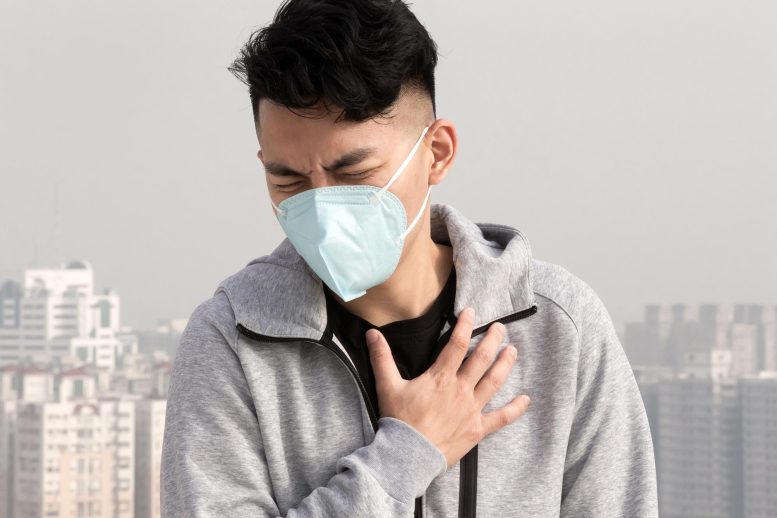
Greater exposure to PM2.5, nitrogen dioxide, and black carbon was found to be associated with a higher risk of admission to a hospital or an intensive care unit and death.
A long history of exposure to air pollution is associated with a higher risk of developing severe disease, admission to a hospital or an intensive care unit (ICU), and death by COVID-19 according to a study led by the Barcelona Institute for Global Health (ISGlobal), a research center supported by the ”la Caixa” Foundation. The study, published today (May 24) in the journal Nature Communications, was based on a large cohort of 4,660,502 adults resident in Catalonia in 2020, the year the Spanish autonomous community had a high incidence of COVID-19.
The researchers determined the mean annual levels of fine particulate matter (PM2.5, particles with an aerodynamic diameter of =2.5 µm), nitrogen dioxide (NO2), black carbon (BC), and ozone (O3) at the residential address of each participant. They also collected data on severe cases of COVID-19 in 2020, including the number of hospital and ICU admissions, length of hospital stay, and COVID-19-related deaths. An analysis of this data revealed the following associations:
- An increase in exposure to PM2.5 of 3.2 µg/m3 was associated with a 19% increase in hospital admissions.
- An increase in exposure to NO2 of 16.1 µg/m3 was associated with a 42% increase in ICU admissions.
- An increase in exposure to BC of 0.7 µg/m3 was associated with a 6% increase in mortality.
“Our findings add further compelling evidence on the importance of reducing levels of air pollution to improve the health of the population in general and, in particular, to reduce the incidence of severe acute respiratory infections,” concludes Otavio Ranzani, ISGlobal researcher and first author of the study.
Possible Explanations for the Association
There are several biological mechanisms that may explain why long-term exposure to air pollution increases the risk of severe COVID-19.
- One hypothesis is that exposure to air pollution increases the individual’s risk of developing chronic comorbidities associated with severe COVID-19, such as hypertension.
- Another hypothesis is that air pollution may facilitate the infection, as there is published evidence that exposure to fine particulate matter increases the expression of the receptors the SARS-CoV-2 virus binds to, particularly in the lung.
- Exposure to air pollution has also been associated in another study with changes in the immune defenses key to mitigating SARS-CoV-2, such as a decrease in the type II interferon response to SARS-CoV-2 and the antibody response.
Nonetheless, the study authors believe that more research is needed to gain a better understanding of the main biological pathways involved.
How the Study was Carried Out
The COVAIR-CAT cohort is based on data from the Catalan public health system covering primary care, emergency care and the discharge from hospital of patients with acute conditions. It also includes data from a SARS-CoV-2 surveillance system (SUVEC), which gathered information on PCR and rapid antigen test results in cohort participants in Catalonia.
According to the data analyzed in this study, 340,608 people were diagnosed with COVID-19 in Catalonia in 2020. Of these, 14% (47,174) were admitted to a hospital and 1.4% (4,699) to an intensive care unit. In total, taking into account inpatients and outpatients, 10,001 COVID-19-related deaths (3%) were recorded.
The meteorological and air pollution data were obtained from the pertinent Catalan and Spanish monitoring networks. These data were cross-checked with the place of residence of the 4,660,502 people in the study cohort.
Study Strengths
“One of the strengths of our analysis is that the population is very well represented. The study covers both large urban conglomerations and rural areas and we were able to obtain detailed individual-level data on the participants’ exposure to ambient air pollution in a country heavily affected by the pandemic in 2020,” explains Cathryn Tonne, an ISGlobal researcher and final author of the study.
While many studies have been published on the effects of short- and long-term exposure to air pollution on chronic respiratory diseases, there is less data available on the effects of long-term exposure on the incidence and severity of acute respiratory infections. Otavio Ranzani concludes, “Our study provides robust evidence that long-term exposure to ambient air pollution is associated with severe COVID-19.”
Reference: “Long-term exposure to air pollution and severe COVID-19 in Catalonia: a population-based cohort study” by Otavio Ranzani, Anna Alari, Sergio Olmos, Carles Milà, Alex Rico, Joan Ballester, Xavier Basagaña, Carlos Chaccour, Payam Dadvand, Talita Duarte-Salles, Maria Foraster, Mark Nieuwenhuijsen, Jordi Sunyer, Antònia Valentín, Manolis Kogevinas, Uxue Lazcano, Carla Avellaneda-Gómez, Rosa Vivanco and Cathryn Tonne, 24 May 2023, Nature Communications.
DOI: 10.1038/s41467-023-38469-7
Never miss a breakthrough: Join the SciTechDaily newsletter.
Follow us on Google and Google News.