

A new University of Maryland-led study found that burying wood in the right environmental conditions can stop its decomposition and help curb carbon dioxide emissions.
Researchers have discovered an ancient log preserved for over 3,775 years, shedding light on potential strategies for combating climate change through “wood vaulting.” This method involves burying wood in low-permeability soil to prevent decomposition and carbon dioxide release. The study highlights how natural preservation can inform effective, low-cost climate solutions.
Wood Vaulting and Climate Change
An ordinary old log could help refine strategies to tackle climate change according to a new study published on September 26 in the journal Science.
A team of scientists led by University of Maryland Atmospheric and Oceanic Science Professor Ning Zeng analyzed a 3,775-year-old log and the soil it was excavated from. Their analysis revealed that the log had lost less than 5% carbon dioxide from its original state thanks to the low-permeability clay soil that covered it.
“The wood is nice and solid—you could probably make a piece of furniture out of it,” Zeng noted.
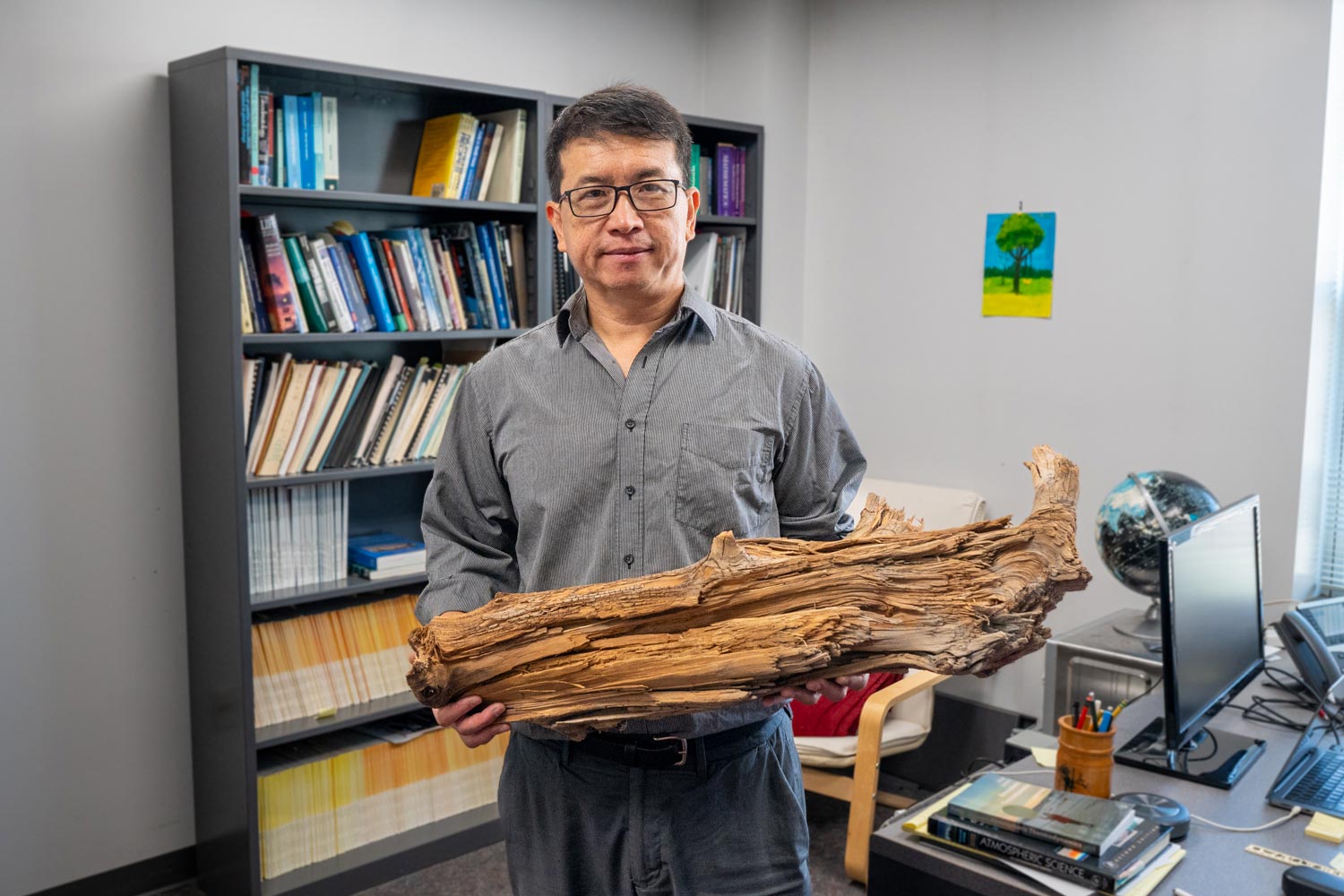
The Preservation of Ancient Wood
Understanding the unique environmental factors that kept that ancient log in mint condition could help researchers perfect an emerging climate solution known as “wood vaulting,” which involves taking wood that is not commercially viable—such as trees destroyed by disease or wildfires, old furniture or unused construction materials—and burying it to stop its decomposition.
Trees naturally sequester carbon dioxide—a potent planet-warming gas—for as long as they live, making tree-planting projects a popular method of mitigating climate change. But on the flip side, when trees die and decompose, that greenhouse gas is released back into the atmosphere, contributing to global warming.
“People tend to think, ‘Who doesn’t know how to dig a hole and bury some wood?’” Zeng said. “But think about how many wooden coffins were buried in human history. How many of them survived? For a timescale of hundreds or thousands of years, we need the right conditions.”
Discovering a Centuries-Old Solution
In 2013, while conducting a wood vaulting pilot project in Quebec, Canada, Zeng discovered the 3,775-year-old log that became the focus of the Science study—a chance encounter that for Zeng felt “kind of miraculous.” While digging a trench to bury fresh wood, Zeng and other researchers spotted the log about 6.5 feet below the surface.
“When the excavator pulled a log out of the ground and threw it over to us, the three ecologists that I had invited from McGill University immediately identified it as Eastern red cedar,” Zeng recalled. “You could tell how well it was preserved. I remember standing there thinking, ‘Wow, here’s the evidence that we need!’”
While past studies have analyzed old samples of preserved wood, they tended to overlook the surrounding soil conditions, according to Zeng.
Advancements in Wood Vault Preservation
“There is a lot of geological and archeological evidence of preserved wood from hundreds to millions of years ago, but the focus of those studies was not ‘How we can engineer a wood vault to preserve that wood?’” Zeng said. “And the problem with designing a new experiment is that we can’t wait 100 years for the results.”
Shortly after the Quebec dig, UMD’s collaborators at MAPAQ, a government ministry in Montreal, conducted carbon dating to determine the log’s age. Then, in 2021, Visiting Research Professor Liangbing Hu in UMD’s Department of Materials Science and Engineering helped Zeng analyze the 3,775-year-old sample’s microscopic structure, chemical composition, mechanical strength, and density. They then compared those results to that of a freshly cut Eastern red cedar log, which revealed that the older sample had lost very little carbon dioxide.
The type of soil covering the log was the key reason for its remarkable preservation. The clay soil in that part of Quebec had an especially low permeability, meaning that it prevented or drastically slowed oxygen from reaching the log while also keeping out fungi and insects, the decomposers typically found in soil.
Because clay soil is common, wood vaulting could become a viable and low-cost option in many parts of the world. As a climate solution, Zeng noted that wood vaulting is best paired with other tactics to slow global warming, including reducing greenhouse gas emissions.
As he and his colleagues continue to optimize wood vaulting, he looks forward to putting what they’ve learned into practice to help curb climate change.
“It’s quite an exciting discovery,” Zeng said of this latest study. “The urgency of climate change has become such a prominent issue, so there was even more motivation to get this analysis going.”
Reference: “3775-year-old wood burial supports “wood vaulting” as a durable carbon removal method” by Ning Zeng, Xinpeng Zhao, Ghislain Poisson, Bryson Clifford, Yu Liu, He Liu, Taotao Meng, Laura Picard, Elisa Zeng-Mariotti, Ben Zaitchik and Liangbing Hu, 26 September 2024, Science.
DOI: 10.1126/science.adm8133
In addition to Zeng and Hu, co-authors of this study included Laura Picard (B.S. ’24, chemistry; B.S. ’24, animal sciences), undergraduate student Elisa Zeng-Mariotti from the Department of Chemical and Biomolecular Engineering, and Ph.D. student Bryson Clifford and postdocs He Liu, Yu Liu, Taotao Meng and Xinpeng Zhao from the Department of Materials Science and Engineering.
This study was supported by MAPAQ, the NOAA Climate Program Office and the NIST Greenhouse Gas Measurement Program. This article does not necessarily reflect the views of these organizations.
Never miss a breakthrough: Join the SciTechDaily newsletter.
Follow us on Google and Google News.
16 Comments
Carbon Dioxide has NOTHING major to do with climate change. Bury all the wood you want. Hate the life causing atom all you want. Climate changes in all eras. It’s been hotter and colder by far in human history and has never stopped us. Anyone still buying the climate cult’s Shylock malarkey needs a padded wall room on Shutter Island. Find a REAL cause to get behind like saving reefs from pollution and runoff. Or ending the Lithium battery craze. Or producing Thorium salt nuclear plants. Establishing HAWT over VAWT. But if you swallow CO2 (trace gas) climate theory you are a complete and utter tool of the Establishment.
Every debunked fossil fuel lobby weapon. And a suplus of ad hominems.
Resistance: Western red cedar has been rated as durable to very durable in regard to decay resistance, though it has a mixed resistance to insect attack. Other woods might not last so long.
Florida has an extensive collection of wooden canoes found buried in organic soil. One is 8000 years old. The largest collection in the western hemisphere. They preserve them at the museum in water not clay. Submerged wood sequesters carbon. This is a fact.
Why bother with a science news site if you do not believe what people who actually research this tells you. Let me guess, COVID is a hoax?
Solutions that put carbon back in the ground in a significant way and be replicated on a global scale with existing earthmoving equipment are very important and a good start towards working on the other important issues you mentioned. And I often say an insult from a fool is a compliment to me if you think I’m a tool.
Foolish
Resistance: Western red cedar has been rated as durable to very durable in regard to decay resistance, though it has a mixed resistance to insect attack. Other woods might not last so long.
The amount of carbon burned from heavy equipment in the form of diesel fuel to handle the trees, excavate the soil, and backfill would exceed the amount of carbon that would be sequestered. Why are people wasting time on this?
I agree that what is needed is a cost-benefit analysis to see what the net gain would be if such a program would be implemented. The other thing that needs to be done is to determine the number of locations suitable for a burial program that won’t compete with other needs such as agriculture. If the conditions necessary are relatively rare, then it won’t be possible to remove, or prevent the release of a sufficient amount of CO2 to make it worthwhile to put in place the infrastructure necessary to have more than a negligible impact. Once again, we are presented with a ‘solution’ that doesn’t take into account the big picture and the difficulties of scaling up a theoretical approach to a practical result.
I have done this and have proof it works. A full LCA and pilot project in Florida. I have worked on this solution for over thirty years.
This is not true. The amount of carbon that can be captured by this method is 100s of thousands of tons at one facility alone per year. The machines can use biodiesel and the result is more cost efficient and effective than any other method available. This is a man made speed up of the Carboniferous period that significantly lowered global temperatures.
Yes! Brilliant!!!
Let’s cut the forests and burry tem all! That should do it! And then we’re good to go on driving pur cars for the next 1000 years!
You obviously read the whole article….em not. They are referring to used and reclaimed wood that it of no use, not burying fresh-cut trees. But I’m sure you knew that already, this is why we need to spend more money on education.
Yes if this method catches on and burying has value, at least when they clear the rainforest they will not burn the clearing. Also this can be done with waste instead of landfilling and making methane or burning.and making CO2. Also it’s not the clay. Clay is a sediment from turbid water that accumulates over time. It’s the water. Florida has the largest collection of wood canoes found buried in wet organic soil. One was 8000 years old.
Florida has an extensive collection of wooden canoes found buried in organic soil. One is 8000 years old. The largest collection in the western hemisphere. They preserve them at the museum in water not clay. Submerged wood sequesters carbon. This is a fact.