
A Phase I clinical trial of an implantable vaccine to treat melanoma has begun.
A cross-disciplinary team of scientists, engineers, and clinicians announced today that they have begun a Phase I clinical trial of an implantable vaccine to treat melanoma, the most lethal form of skin cancer.
The effort is the fruit of a new model of translational research being pursued at the Wyss Institute for Biologically Inspired Engineering at Harvard University that integrates the latest cancer research with bioinspired technology development. It was led by Wyss Core Faculty member David J. Mooney, Ph.D., who is also the Robert P. Pinkas Family Professor of Bioengineering at the Harvard School of Engineering and Applied Sciences (SEAS), and Wyss Institute Associate Faculty member Glenn Dranoff, M.D., who is co-leader of Dana-Farber Cancer Institute’s Cancer Vaccine Center.
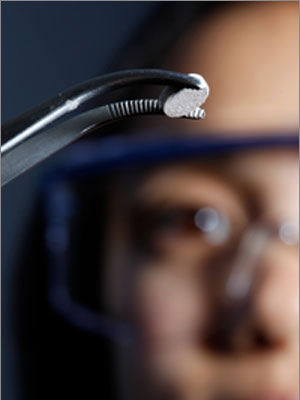
Most therapeutic cancer vaccines available today require doctors to first remove the patient’s immune cells from the body, then reprogram them and reintroduce them back into the body. The new approach, which was first reported to eliminate tumors in mice in Science Translational Medicine in 2009, the year the Wyss Institute was launched, instead uses a small disk-like sponge about the size of a fingernail that is made from FDA-approved polymers. The sponge is implanted under the skin, and is designed to recruit and reprogram a patient’s own immune cells “on site,” instructing them to travel through the body, home in on cancer cells, then kill them.
The technology was initially designed to target cancerous melanoma in skin, but might have application to other cancers. In the preclinical study reported in Science Translational Medicine, 50 percent of mice treated with two doses of the vaccine — mice that would have otherwise died from melanoma within about 25 days — showed complete tumor regression.
“Our vaccine was made possible by combining a wide range of biomedical expertise that thrives in Boston and Cambridge,” said Mooney, who specializes in the design of biomaterials for tissue engineering and drug delivery. “It reflects the bioinspired engineering savvy and technology development focus of engineers and scientists at the Wyss Institute and Harvard SEAS, as well as the immunological and clinical expertise of the researchers and clinicians at Dana-Farber and Harvard Medical School.”
“This is expected to be the first of many new innovative therapies made possible by the Wyss Institute’s collaborative model of translational research that will enter human clinical trials,” said Wyss Founding Director Don Ingber, M.D., Ph.D., who is also the Judah Folkman Professor of Vascular Biology at Harvard Medical School and Boston Children’s Hospital, and a Professor of Bioengineering at Harvard SEAS. “It validates our approach, which strives to move technologies into the clinical space much faster than would be possible in a traditional academic environment. It’s enormously gratifying to see one of our first technologies take this giant leap forward.”
Wyss Institute scientists Core Faculty member David Mooney, Ph.D. (left) and Senior Staff Scientist Ed Doherty (right) explain how their implantable, biodegradable cancer vaccine could help overcome melanoma, and how the Institute’s unique model of technology translation is speeding the vaccine to the clinic.
The Wyss Institute comprises a consortium of researchers, engineers, clinicians, and staff with industrial and business development experience from the Wyss Institute and nine other collaborating institutions in Greater Boston.
“It is rare to get a new technology tested in the laboratory and moved into human clinical trials so quickly,” said Dranoff, who is also a Professor of Medicine at Harvard Medical School, and Leader of the Dana-Farber/Harvard Cancer Center Program in Cancer Immunology. “We’re beyond thrilled with the momentum, and excited about its potential.”
Recruitment of participants for the clinical trial began recently under the leadership of F. Stephen Hodi, Jr., M.D., Director of Dana-Farber’s Melanoma Center and Associate Professor of Medicine at Harvard Medical School. The goal of the Phase I study, which is expected to conclude in 2015, is to assess the safety of the vaccine in humans.
The cancer vaccine work has received support from the Wyss Institute, Dana-Farber, and the National Institutes of Health. In addition to Mooney, Dranoff, and Hodi, other collaborators include Wyss Senior Staff Scientist Edward Doherty, Wyss Staff Scientist Omar Ali, M.D., Jerry Ritz, M.D., Director of the Cell Processing Laboratory at Dana-Farber, Sara Russell, M.D. and Charles Yoon, M.D., surgeons at Dana-Farber, and other clinical research team members based at Dana-Farber.
Reference: “In Situ Regulation of DC Subsets and T Cells Mediates Tumor Regression in Mice” by Omar A. Ali, Dwaine Emerich, Glenn Dranoff and David J. Mooney, 25 November 2009, Science Translational Medicine.
DOI: 10.1126/scitranslmed.3000359
NIHPA Manuscript of the Study: In situ regulation of DC subsets and T cells mediates tumor regression in mice
Never miss a breakthrough: Join the SciTechDaily newsletter.
Follow us on Google and Google News.
2 Comments
all very well and good, but by all accounts skin cancer can be easily cured with a simple application of concentrated Cannabis Indica essential oil. the combination of THC, CBD and other cannabinoids supplement the bodies own endocannabinoid system which normally deals with neoplastic abnormal cells. cannabinoids induce apoptosis in cancer cells. they prevent metastasis and invasion. they prevent angiogenesis in and around tumors. with so much science being done on the subject, and patents being granted concerning these approaches, it´s odd you guys don´t run a story on the science of cannabis and cancer…
I wish that there would be great results and that cancer can be cured soon.