
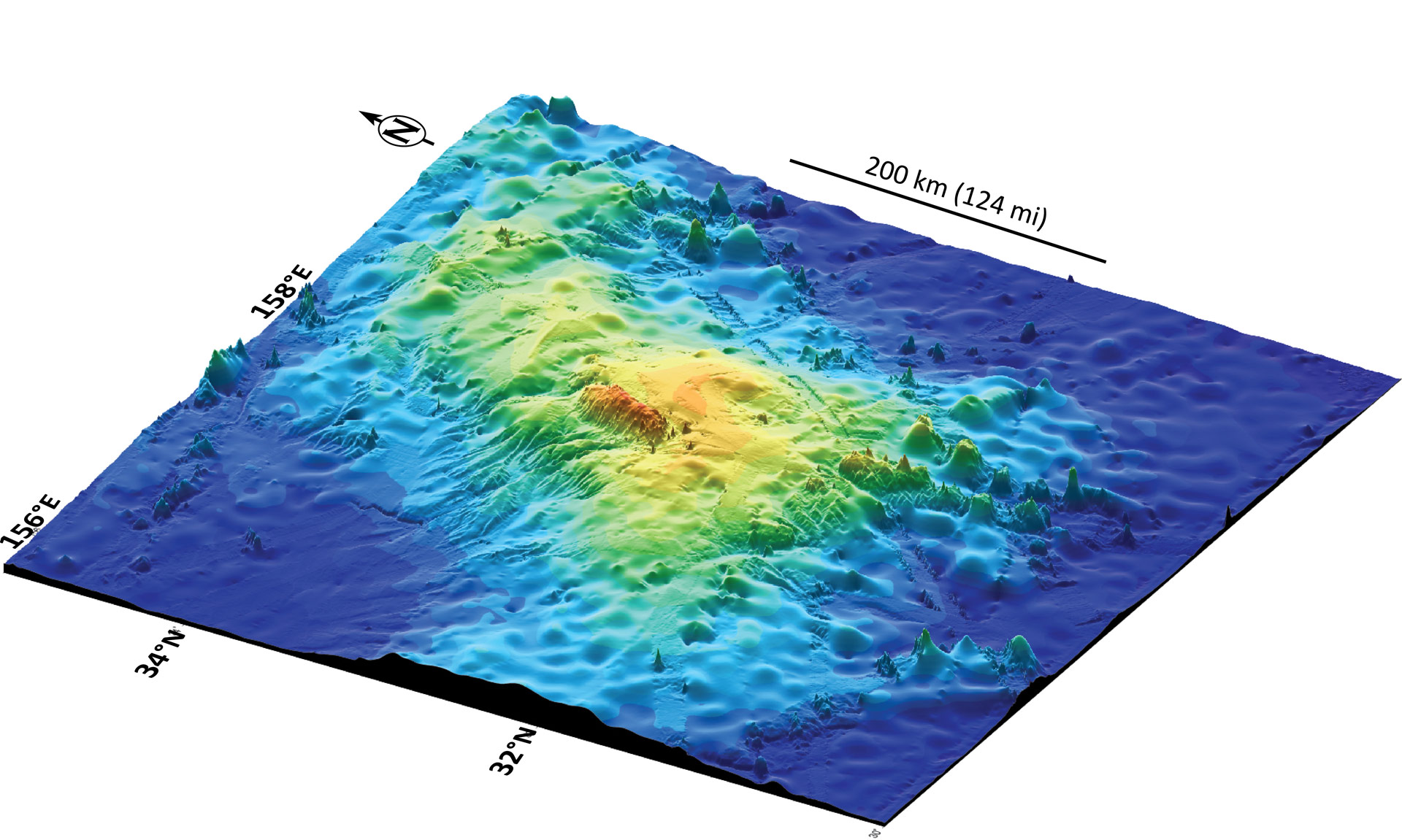
Scientists have confirmed that the northwest Pacific is home to the largest single volcano yet documented on Earth.
Houston – A University of Houston (UH) professor led a team of scientists to uncover the largest single volcano yet documented on Earth. Covering an area roughly equivalent to the British Isles or the state of New Mexico, this volcano, dubbed the Tamu Massif, is nearly as big as the giant volcanoes of Mars, placing it among the largest in the Solar System.
William Sager, a professor in the Department of Earth and Atmospheric Sciences at UH, first began studying the volcano about 20 years ago at Texas A&M’s College of Geosciences. Sager and his team’s findings appear in the September 8 issue of Nature Geoscience, the monthly multi-disciplinary journal reflecting disciplines within the geosciences.
Located about 1,000 miles (1,600 kilometers) east of Japan, Tamu Massif is the largest feature of Shatsky Rise, an underwater mountain range formed 130 to 145 million years ago by the eruption of several underwater volcanoes. Until now, it was unclear whether Tamu Massif was a single volcano or a composite of many eruption points. By integrating several sources of evidence, including core samples and data collected on board the JOIDES Resolution research ship, the authors have confirmed that the mass of basalt that constitutes Tamu Massif did indeed erupt from a single source near the center.
“Tamu Massif is the biggest single shield volcano ever discovered on Earth,” Sager said. “There may be larger volcanoes, because there are bigger igneous features out there such as the Ontong Java Plateau, but we don’t know if these features are one volcano or complexes of volcanoes.”
Tamu Massif stands out among underwater volcanoes not just for its size, but also its shape. It is low and broad, meaning that the erupted lava flows must have traveled long distances compared to most other volcanoes on Earth. The seafloor is dotted with thousands of underwater volcanoes, or seamounts, most of which are small and steep compared to the low, broad expanse of Tamu Massif.
“It’s not high, but very wide, so the flank slopes are very gradual,” Sager said. “In fact, if you were standing on its flank, you would have trouble telling which way is downhill. We know that it is a single immense volcano constructed from massive lava flows that emanated from the center of the volcano to form a broad, shield-like shape. Before now, we didn’t know this because oceanic plateaus are huge features hidden beneath the sea. They have found a good place to hide.”
Tamu Massif covers an area of about 120,000 square miles (310,000 square kilometers). By comparison, Hawaii’s Mauna Loa – the largest active volcano on Earth – is approximately 2,000 square miles (5,200 square kilometers), or roughly 2 percent the size of Tamu Massif. To find a worthy comparison, one must look skyward to the planet Mars, home to Olympus Mons. That giant volcano, which is visible on a clear night with a good backyard telescope, is only about 25 percent larger by volume than Tamu Massif.
The study relies on two distinct, yet complementary, sources of evidence – core samples collected on Integrated Ocean Drilling Program (IODP) Expedition 324 (Shatsky Rise Formation) in 2009, and seismic reflection data gathered on two separate expeditions of the R/V Marcus G. Langseth in 2010 and 2012. The core samples, drilled from several locations on Tamu Massif, showed that thick lava flows (up to 75 feet or 23 meters thick), characterize this volcano. Seismic data from the R/V Langseth cruises revealed the structure of the volcano, confirming that the lava flows emanated from its summit and flowed hundreds of miles downhill into the adjacent basins.
According to Sager, Tamu Massif is believed to be about 145 million years old, and it became inactive within a few million years after it was formed. Its top lies about 6,500 feet (2,000 meters) below the ocean surface, while much of its base is believed to be in waters that are almost four miles deep.
“Its shape is different from any other sub-marine volcano found on Earth, and it’s very possible it can give us some clues about how massive volcanoes can form,” Sager said. “An immense amount of magma came from the center, and this magma had to have come from the Earth’s mantle. So this is important information for geologists trying to understand how the Earth’s interior works.”
The project was funded by the National Science Foundation, both through direct grants and through its Integrated Ocean Drilling Program, an international research program dedicated to advancing scientific understanding of the Earth through drilling, coring, and monitoring the subsea floor.
Reference: “An immense shield volcano within the Shatsky Rise oceanic plateau, northwest Pacific Ocean” by William W. Sager, Jinchang Zhang, Jun Korenaga, Takashi Sano, Anthony A. P. Koppers, Mike Widdowson and John J. Mahoney, 5 September 2013, Nature Geoscience.
DOI: 10.1038/ngeo1934
Never miss a breakthrough: Join the SciTechDaily newsletter.
Follow us on Google and Google News.
6 Comments
Tamu Massif the largest underwater volcano of the size of British Isles together with Ireland formed about 145 million years ago 1000 miles East of Japan in Pacific should be a consolidation of several eruption at the site under the Ocean. It appears that a comet impact on Earth in the early earth should have been responsible for caving in Pacific Ocean with water and it would have been the cause of creating seismic shivers under the Ocean bed which gave rise to such series of volcanoes or conglammoration of big volcanic mountain range as in this case. This is supported by other big volcanoes on Mars, for example Olympus Mons which should have been created by such other cometary impact there. Continental drift can create Mountains like Himalayas , but the story of volcanoes mostly found under the sea or islands could have been possible only by some strong impact from comets.Thank You.
What if Tamu massif becomes active again?
Probably will not. The tectonic plates have moved quite far for the hotspot that caused that one.
Larger than Olympus Mons? Oh, my.
If this beast did wake up. We’d likely need a new planet.
Thank you so much