
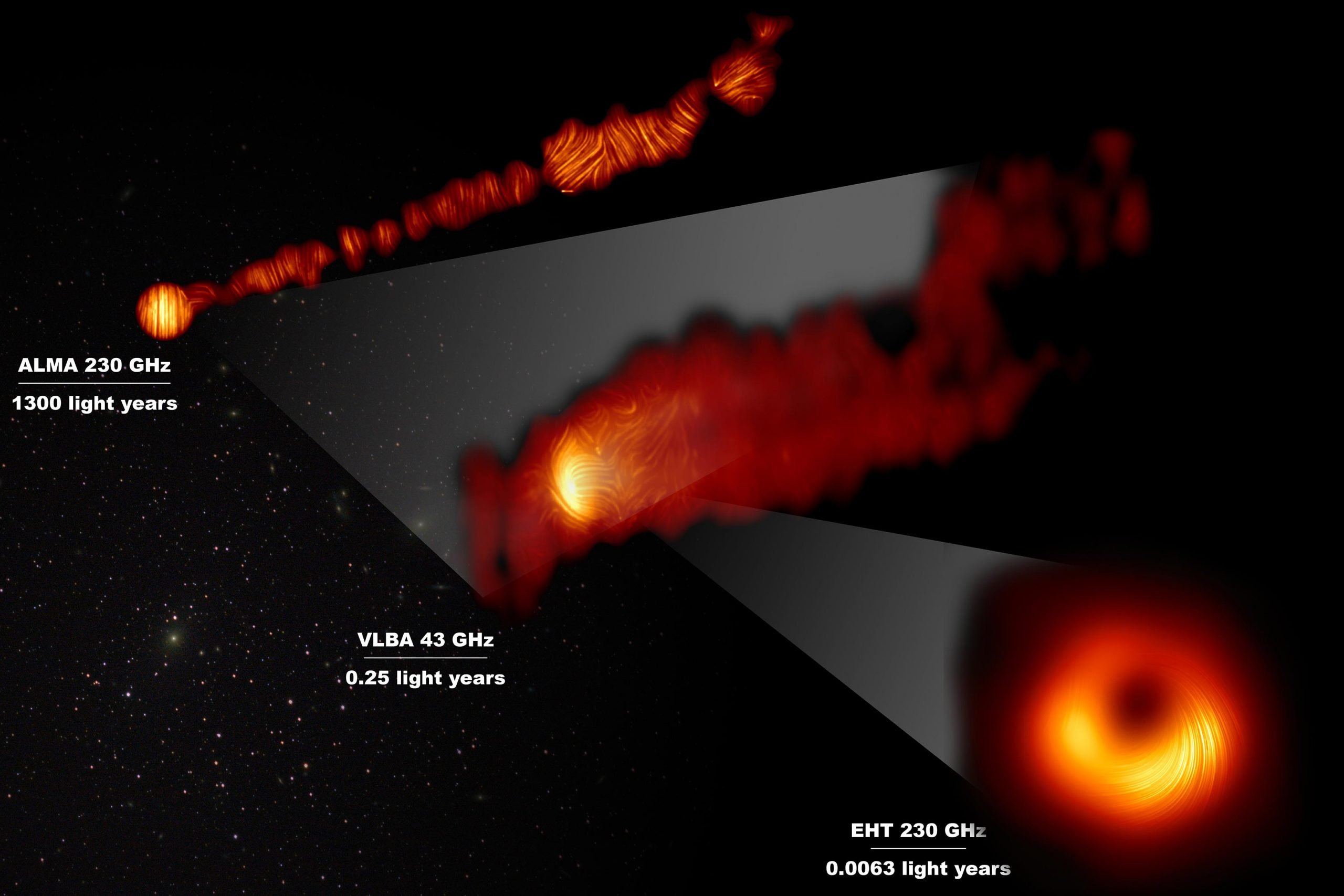
Polarized images from the EHT show that magnetic fields near M87’s black hole help shape its jets and regulate infalling gas, offering rare insight into black hole behavior.
A new view of the region closest to the supermassive black hole at the center of the galaxy Messier 87 (M87) has shown important details of the magnetic fields close to the black hole and hints about how powerful jets of material can originate in that region.
A worldwide team of astronomers using the Event Horizon Telescope, a collection of eight telescopes, including the Atacama Large Millimeter/submillimeter Array (ALMA) in Chile, measured a signature of magnetic fields — called polarization — around the black hole. Polarization is the orientation of the electric fields in light and radio waves and it can indicate the presence and alignment of magnetic fields.
“We are now seeing the next crucial piece of evidence to understand how magnetic fields behave around black holes, and how activity in this very compact region of space can drive powerful jets,” said Monika Mościbrodzka, Coordinator of the EHT Polarimetry Working Group and Assistant Professor at Radboud University in the Netherlands.
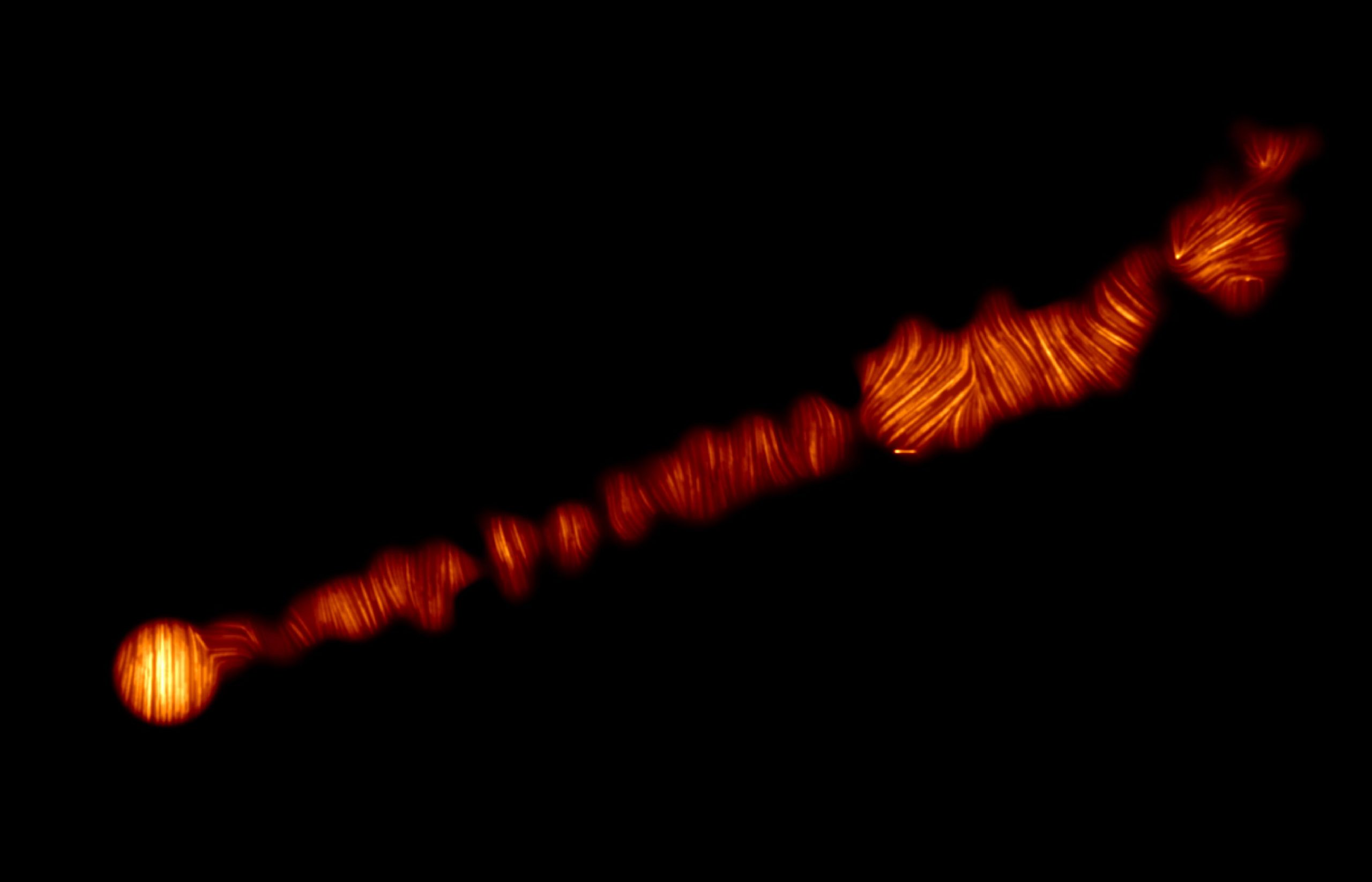
New images with the EHT and ALMA allowed scientists to map magnetic field lines near the edge of M87’s black hole. That same black hole is the first ever to be imaged — by the EHT in 2019. That image revealed a bright ring-like structure with a dark central region — the black hole’s shadow. The newest images are a key to explaining how M87, 50 million light-years from Earth, can launch energetic jets from its core.
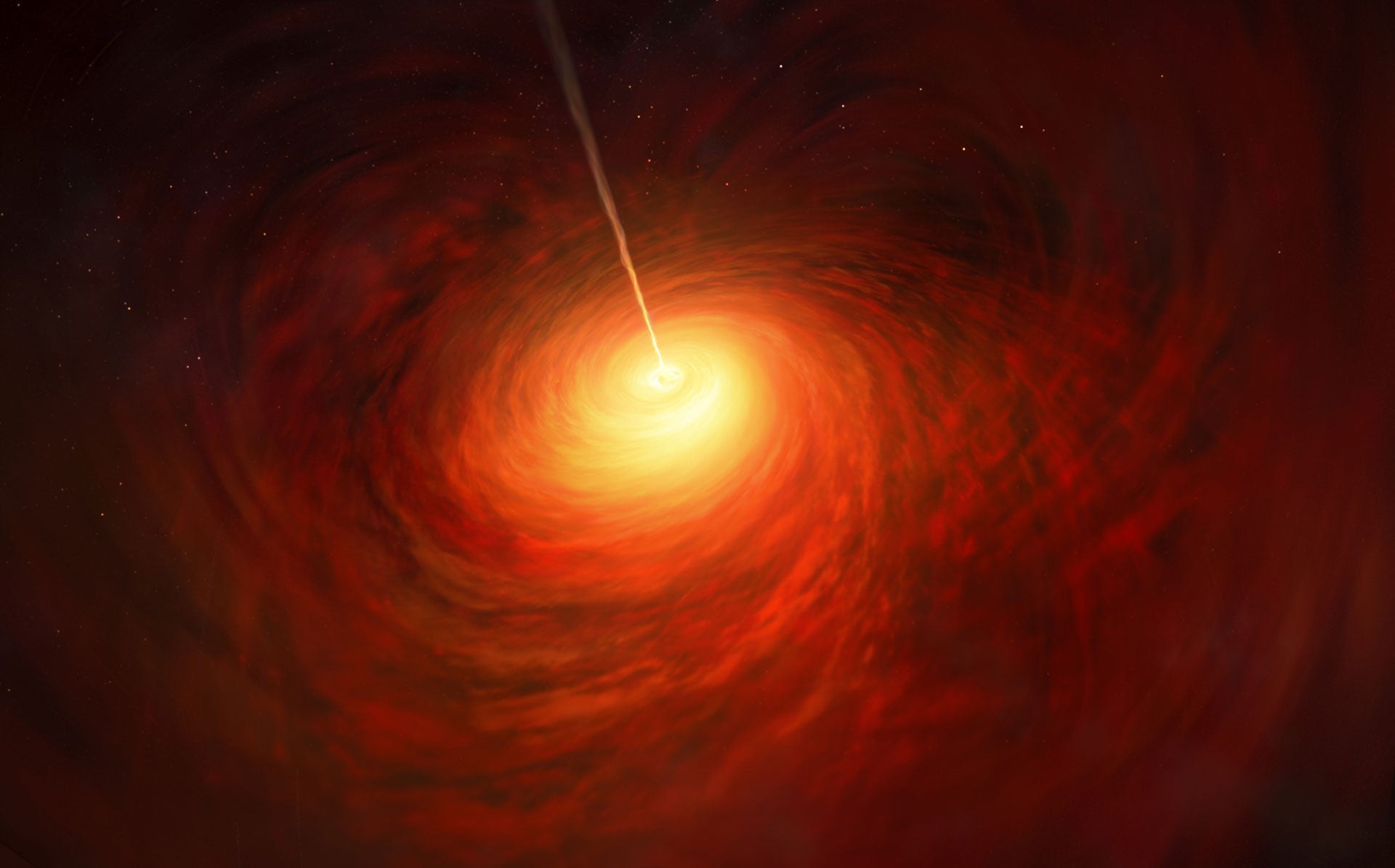
The black hole at M87’s center is more than 6 billion times more massive than the Sun. Material drawn inward forms a rotating disk — called an accretion disk — closely orbiting the black hole. Most of the material in the disk falls into the black hole, but some surrounding particles escape and are ejected far out into space in jets moving at nearly the speed of light.
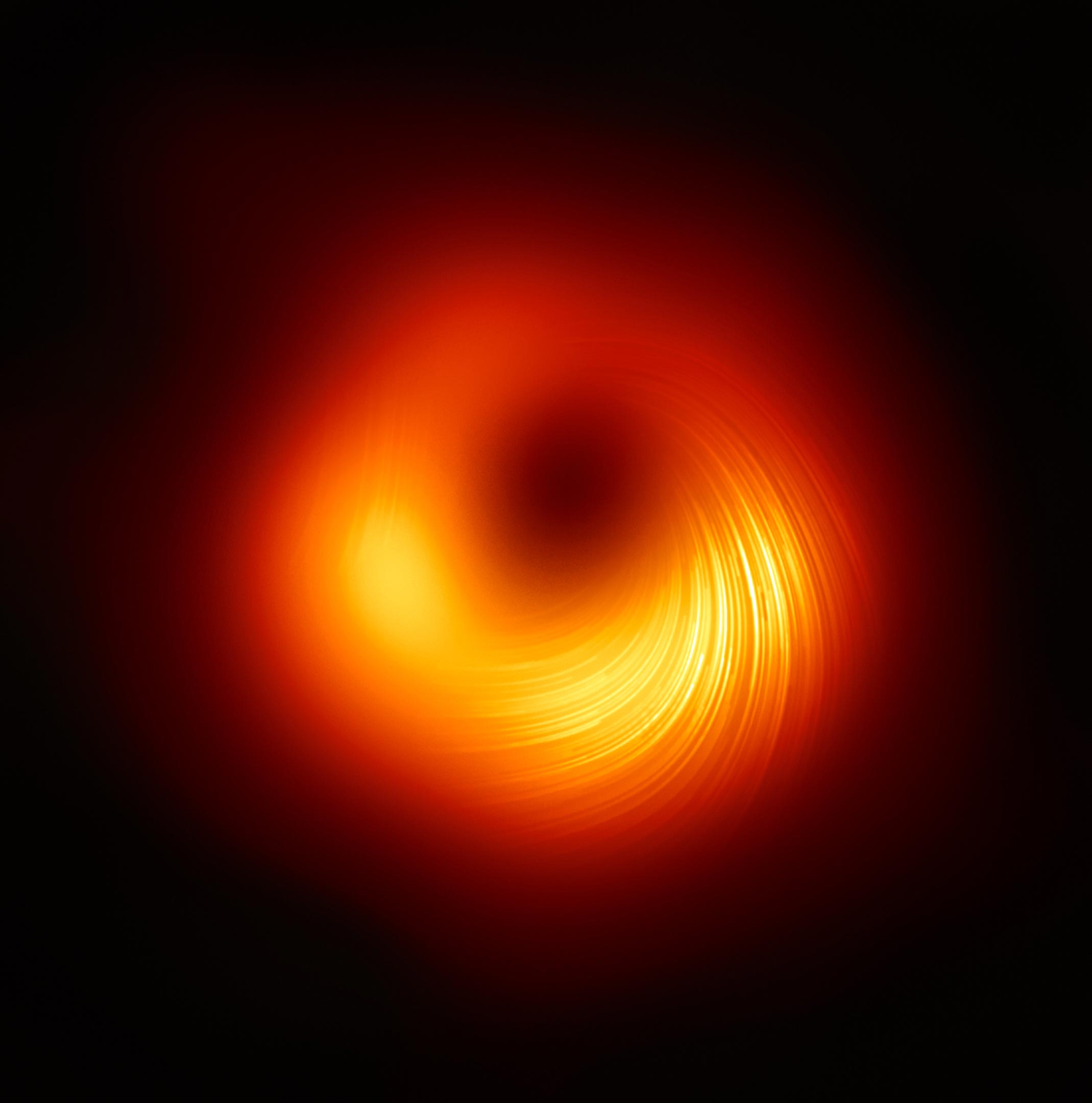
“The newly published polarized images are key to understanding how the magnetic field allows the black hole to ‘eat’ matter and launch powerful jets,” said Andrew Chael, a NASA Hubble Fellow at the Princeton Center for Theoretical Science and the Princeton Gravity Initiative in the U.S.
The scientists compared the new images that showed the magnetic field structure just outside the black hole with computer simulations based on different theoretical models. They found that only models featuring strongly magnetized gas can explain what they are seeing at the event horizon.
“The observations suggest that the magnetic fields at the black hole’s edge are strong enough to push back on the hot gas and help it resist gravity’s pull. Only the gas that slips through the field can spiral inwards to the event horizon,” explained Jason Dexter, Assistant Professor at the University of Colorado Boulder and Coordinator of the EHT Theory Working Group.
To make the new observations, the scientists linked eight telescopes around the world — including ALMA — to create a virtual Earth-sized telescope, the EHT. The impressive resolution obtained with the EHT is equivalent to that needed to measure the length of a credit card on the surface of the Moon.
This resolution allowed the team to directly observe the black hole shadow and the ring of light around it, with the new image clearly showing that the ring is magnetized. The results are published in two papers in the Astrophysical Journal Letters by the EHT collaboration. The research involved more than 300 researchers from multiple organizations and universities worldwide.
A third paper also was published in the same volume of the Astrophysical Journal Letters, based on data from ALMA, lead by Ciriaco Goddi, a scientist at Radboud University and Leiden Observatory, the Netherlands.
“The combined information from the EHT and ALMA allowed scientists to investigate the role of magnetic fields from the vicinity of the event horizon to far beyond the core of the galaxy, along its powerful jets extending thousands of light-years,” Goddi said.
More on this research:
- Event Horizon Telescope Images Magnetic Fields at the Edge of M87’s Supermassive Black Hole
- Powerful Magnetic Fields Surrounding Black Hole Are Strong Enough to Resist Gravity
- Astronomers’ Polarized Image Shows Magnetic Fields at the Edge of M87’s Black Hole
References:
“First M87 Event Horizon Telescope Results. VII. Polarization of the Ring” by The Event Horizon Telescope Collaboration, Kazunori Akiyama, Juan Carlos Algaba, Antxon Alberdi, Walter Alef, Richard Anantua, Keiichi Asada, Rebecca Azulay, Anne-Kathrin Baczko, David Ball, et al., 24 March 2021, The Astrophysical Journal Letters.
DOI: 10.3847/2041-8213/abe71d
“First M87 Event Horizon Telescope Results. VIII. Magnetic Field Structure near The Event Horizon” by The Event Horizon Telescope Collaboration, Kazunori Akiyama, Juan Carlos Algaba, Antxon Alberdi, Walter Alef, Richard Anantua, Keiichi Asada, Rebecca Azulay, Anne-Kathrin Baczko, David Ball, et al., 24 March 2021, The Astrophysical Journal Letters.
DOI: 10.3847/2041-8213/abe4de
“Polarimetric Properties of Event Horizon Telescope Targets from ALMA” by Ciriaco Goddi, Iván Martí-Vidal, Hugo Messias, Geoffrey C. Bower, Avery E. Broderick, Jason Dexter, Daniel P. Marrone, Monika Moscibrodzka, Hiroshi Nagai, Juan Carlos Algaba, et al., 24 March 2021, The Astrophysical Journal Letters.
DOI: 10.3847/2041-8213/abee6a
The National Radio Astronomy Observatory is a facility of the National Science Foundation, operated under cooperative agreement by Associated Universities, Inc.
The EHT collaboration involves more than 300 researchers from Africa, Asia, Europe, North and South America. The international collaboration is working to capture the most detailed black hole images ever obtained by creating a virtual Earth-sized telescope. Supported by considerable international investment, the EHT links existing telescopes using novel systems — creating a fundamentally new instrument with the highest angular resolving power that has yet been achieved.
The individual telescopes involved are: ALMA, APEX, the Institut de Radioastronomie Millimetrique (IRAM) 30-meter Telescope, the IRAM NOEMA Observatory, the James Clerk Maxwell Telescope (JCMT), the Large Millimeter Telescope (LMT), the Submillimeter Array (SMA), the Submillimeter Telescope (SMT), the South Pole Telescope (SPT), the Kitt Peak Telescope, and the Greenland Telescope (GLT).
The EHT consortium consists of 13 stakeholder institutes: the Academia Sinica Institute of Astronomy and Astrophysics, the University of Arizona, the University of Chicago, the East Asian Observatory, Goethe-Universitaet Frankfurt, Institut de Radioastronomie Millimétrique, Large Millimeter Telescope, Max Planck Institute for Radio Astronomy, MIT Haystack Observatory, National Astronomical Observatory of Japan, Perimeter Institute for Theoretical Physics, Radboud University and the Smithsonian Astrophysical Observatory.
The Atacama Large Millimeter/submillimeter Array (ALMA), an international astronomy facility, is a partnership of ESO, the U.S. National Science Foundation (NSF) and the National Institutes of Natural Sciences (NINS) of Japan in cooperation with the Republic of Chile. ALMA is funded by ESO on behalf of its Member States, by NSF in cooperation with the National Research Council of Canada (NRC) and the Ministry of Science and Technology (MOST) and by NINS in cooperation with the Academia Sinica (AS) in Taiwan and the Korea Astronomy and Space Science Institute (KASI). ALMA construction and operations are led by ESO on behalf of its Member States; by the National Radio Astronomy Observatory (NRAO), managed by Associated Universities, Inc. (AUI), on behalf of North America; and by the National Astronomical Observatory of Japan (NAOJ) on behalf of East Asia. The Joint ALMA Observatory (JAO) provides the unified leadership and management of the construction, commissioning and operation of ALMA.
Never miss a breakthrough: Join the SciTechDaily newsletter.
Follow us on Google and Google News.
4 Comments
This is an obvious finding magnetic structure near SMBH of galaxy M87.Another façt noteworthy is extension of this structure to depth of SMBH where gravity exists.Thus the observation strongly supports with proper demonstration of light and electromagnetic wave from the gravity of SMBH.Thanks to the authors and for true observation can be a text matter.
This is an obvious finding magnetic structure near SMBH of galaxy M87.Another façt noteworthy is extension of this structure to depth of SMBH where gravity exists.Thus the observation strongly supports with proper demonstration of light and electromagnetic wave from the gravity of SMBH.Thanks to the authors and for true observation can be a text matter.
Henceforth,this can be granted that from the total exercise of gravity by a SMBH,oñe fraction is evolved as such can be used in calculation via general relativity following perfect space time.
This is an obvious finding magnetic structure near SMBH of galaxy M87.Another façt noteworthy is extension of this structure to depth of SMBH where gravity exists.Thus the observation strongly supports with proper demonstration of light and electromagnetic wave from the gravity of SMBH.Thanks to the authors and for true observation can be a text matter.
Henceforth,this can be granted that from the total exercise of gravity by a SMBH,oñe fraction is evolved as such can be used in calculation via general relativity following perfect space time.As this phenomena is associated with measurable aspect like light and so on,the process is simple.Total gravity of SMBH is proportional to such phenomena.
Cool!