
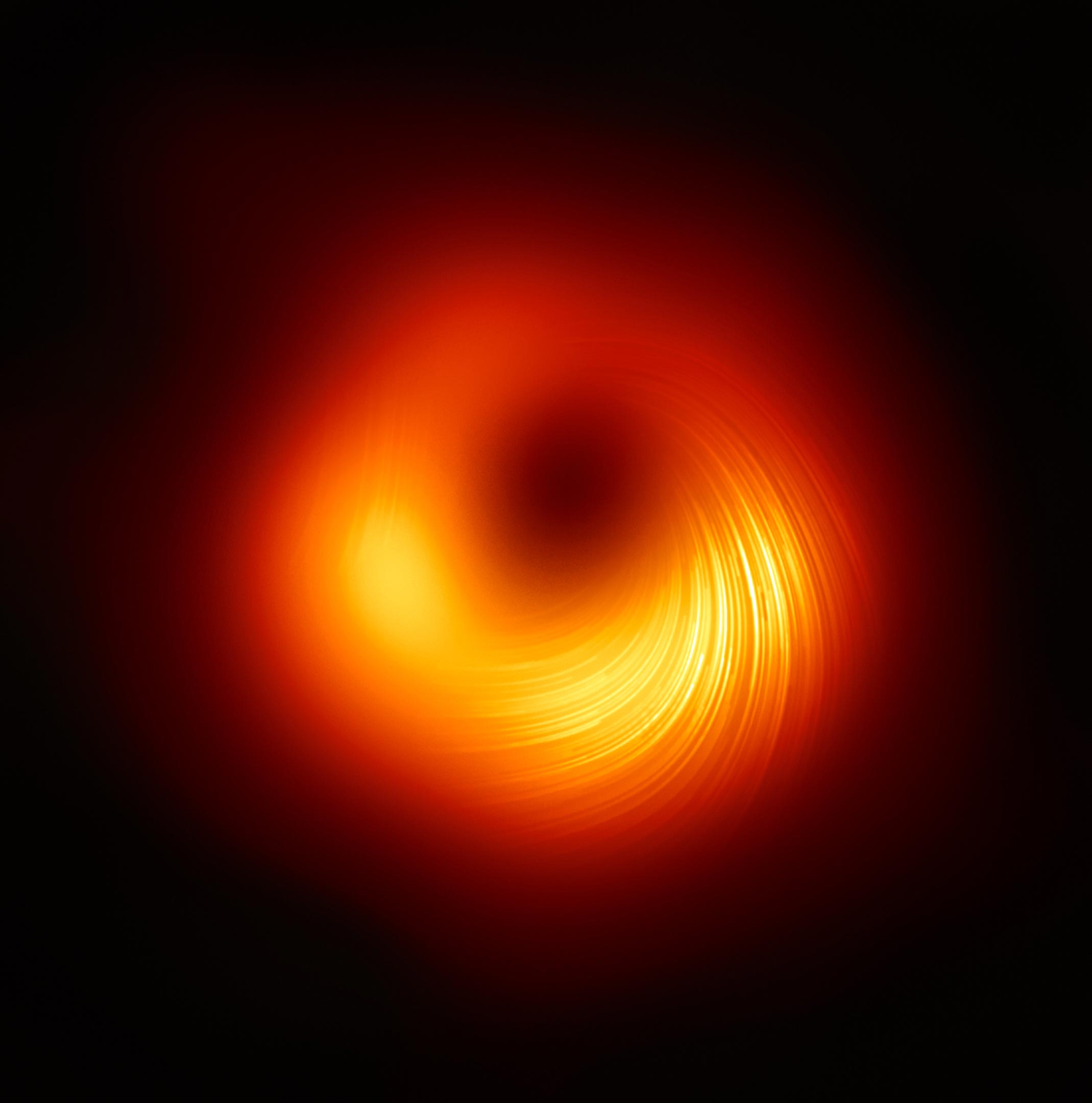
New image of M87 reveals how it looks in polarized light.
MIT Haystack Observatory is one of the 13 stakeholder institutions that constitute the Event Horizon Telescope (EHT) collaboration, which produced the first-ever image of a black hole. The EHT revealed today a new view of the massive object at the center of the M87 galaxy: how it looks in polarized light. This is the first time astronomers have been able to measure polarization, a signature of magnetic fields, this close to the edge of a black hole. The observations are key to explaining how the M87 galaxy, located 55 million light-years away, is able to launch energetic jets from its core.
Haystack Research Scientist Vincent Fish says “Hundreds of people around the world in the EHT collaboration, including scientists and engineers at Haystack, have worked very hard to investigate the role of magnetic fields in shaping jets around black holes. Can magnetic fields build up and dominate over the intense pull of gravity? Our data provide an answer.”
On April 10, 2019, scientists released the first-ever image of a black hole, revealing a bright ring-like structure with a dark central region — the black hole’s shadow. Since then, the EHT collaboration has delved deeper into the data on the supermassive object at the heart of the M87 galaxy collected in 2017. They have revealed that the famous ring of light at the edge of the M87 black hole was polarized across the ring.
“Astronomers have obtained a new tool to study the magnetism of a black hole with the direct imaging of the polarization of light,” explains Kazunori Akiyama, a coordinator of the EHT Imaging Working Group and research scientist at Haystack Observatory. “This remarkable feat by the Event Horizon Telescope was truly achieved by years of international efforts to develop the state-of-the-art techniques in every single stage of the complex signal processing, from the telescopes to the images.”
Light becomes polarized when it goes through certain filters, like the lenses of polarized sunglasses, or when it is emitted in hot regions of space that are magnetized. In the same way polarized sunglasses only transmit a specific orientation of the electric field from the sun’s light rays, astronomers can obtain information about the electric-field orientation of light coming from outer space, by using polarizers installed in their telescopes. Specifically, polarization allows astronomers to map the magnetic field lines present at the inner edge of the black hole.
“Polarization is a powerful tool available to astronomers to probe the physical conditions in one of the most extreme environments in the universe. It can provide clues not only to the strength and orientation of magnetic fields, but also how well-ordered those fields are, and possibly even something about the otherwise invisible material that lies between us and the material that is emitting the radio waves” says Colin Lonsdale, director of MIT Haystack Observatory and chair of the Event Horizon Telescope Board.
Jets of Energy and the Mystery of Ejection
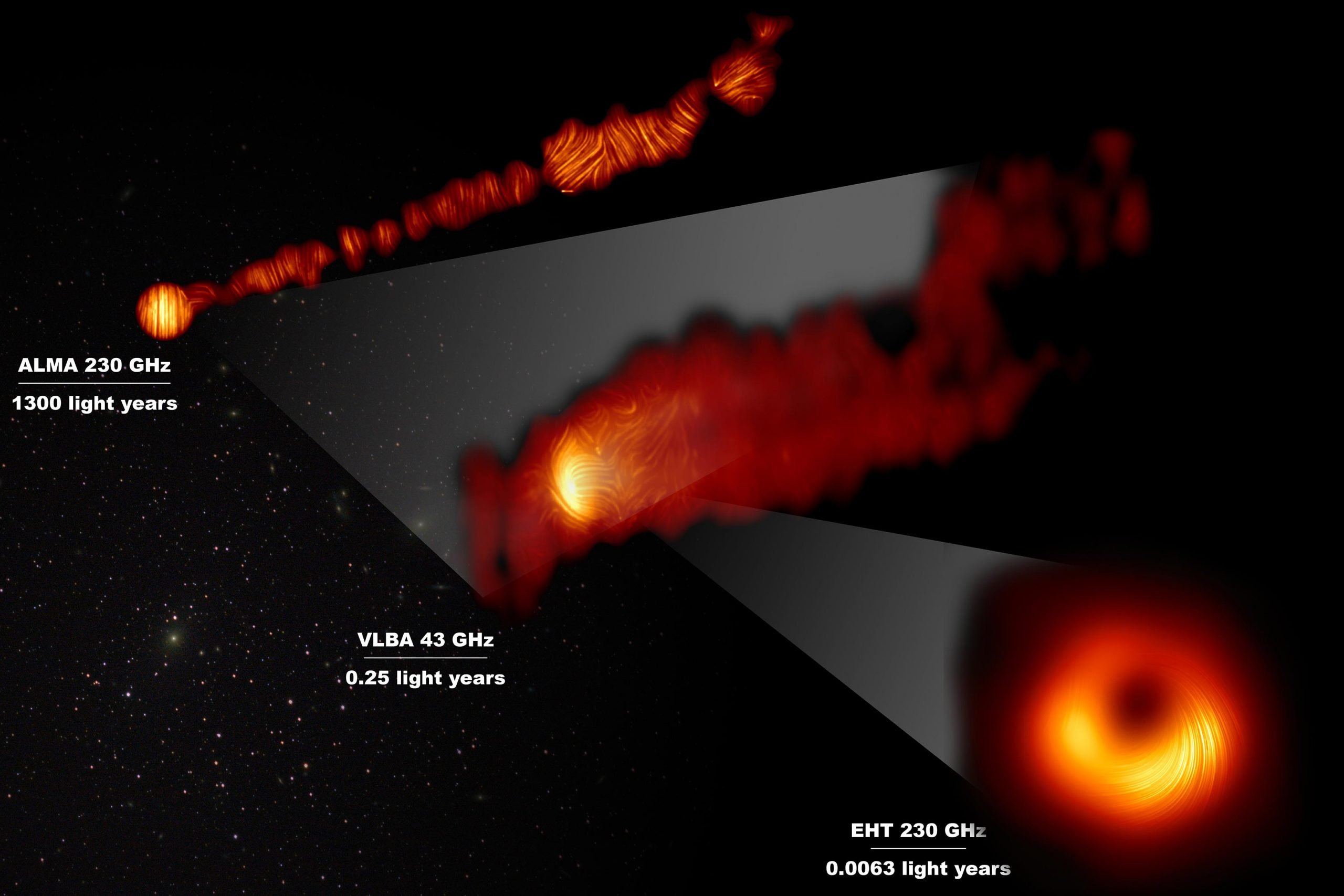
The bright jets of energy and matter that emerge from M87’s core and extend at least 5,000 light-years from its center are one of the galaxy’s most mysterious and energetic features. Most matter lying close to the edge of a black hole falls in. However, some of the surrounding particles escape moments before capture and are blown far out into space in the form of jets.
Astronomers have relied on different models of how matter behaves near the black hole to better understand this process. But they still don’t know exactly how jets larger than the galaxy are launched from its central region, which is as small in size as the solar system, or exactly how matter falls into the black hole. With the new EHT image of the black hole and its shadow in polarized light, astronomers managed for the first time to look into the region just outside the black hole, where this interplay between matter flowing in and being ejected out is happening.
The observations provide new information about the structure of the magnetic fields just outside the black hole. The team found that only theoretical models featuring strongly magnetized gas can explain what they are seeing at the event horizon.
Strong Magnetic Fields Shape Jet Formation
“New polarization images suggest that the powerful jet is formed by plasma flow arrested by aligned magnetic fields in the vicinity of the black hole, resisting its strong gravitational pull,” explains Kotaro Moriyama, an overseas postdoc fellow of the Japan Society for the Promotion of Science at Haystack Observatory.
To observe the heart of the M87 galaxy, the collaboration linked eight telescopes around the world, including ALMA (the Atacama Large Millimeter/submillimeter Array) and APEX (the Atacama Pathfinder Experiment) in northern Chile, to create a virtual Earth-sized telescope, the EHT. The impressive resolution obtained with the EHT is equivalent to that needed to measure the length of a credit card on the surface of the moon.
“ALMA plays a central role in the entire process: it is centrally located to tie the EHT array together, and it is also the most sensitive telescope in the array, so it is crucial to making the most of the EHT data,” says Geoff Crew, Haystack research scientist. “In addition, the years of work on the ALMA polarimetry analysis has delivered far more than we imagined.”
The Event Horizon Telescope (EHT) collaboration, who produced the first-ever image of a black hole, has today revealed a new view of the massive object at the center of the Messier 87 galaxy: how it looks in polarized light. This is the first time astronomers have been able to measure polarization, a signature of magnetic fields, this close to the edge of a black hole. This video summarizes the discovery.
This resolution allowed the team to directly observe the black hole shadow and the ring of light around it, with the new polarized-light image clearly showing that the ring is magnetized. The results are published today in two separate papers in The Astrophysical Journal Letters by the EHT collaboration. The research involved over 300 researchers from multiple organizations and universities worldwide.
A third paper, “Polarimetric properties of Event Horizon Telescope targets from ALMA,” was also published in the Astrophysical Journal Letters, led by Ciriaco Goddi, a scientist at Radboud University and Leiden Observatory, the Netherlands, and including Haystack research scientists Geoff Crew and Lynn Matthews, and based on data from ALMA.
Goddi says, “The ALMA data were acquired simultaneously with the VLBI observations conducted in April 2017 with the EHT (and the GMVA); in this sense, they are a ‘byproduct’ of the VLBI operations. ALMA data were crucial to calibrate, image, and interpret the EHT polarization observations, providing tight constraints on the theoretical models that explain how matter behaves near the black hole event horizon. This data also provides a description of the magnetic field structure along the powerful relativistic jets that extend far beyond the M87 galaxy. The combined information from the EHT and ALMA allows scientists to investigate the role of magnetic fields from the vicinity of the event horizon to far beyond the M87 galaxy along its powerful relativistic jets (on scales of thousands of light-years).”
Crew adds, “ALMA bridges the gap in resolution between the ultra-high resolution of the VLBI arrays and that obtained with other measurement techniques. In combination, this wealth of new polarimetry data should allow us to make progress on understanding this fascinating object.”
More on this research:
- Event Horizon Telescope Images Magnetic Fields at the Edge of M87’s Supermassive Black Hole
- Powerful Magnetic Fields Surrounding Black Hole Are Strong Enough to Resist Gravity
References:
“First M87 Event Horizon Telescope Results. VII. Polarization of the Ring” by The Event Horizon Telescope Collaboration, Kazunori Akiyama, Juan Carlos Algaba, Antxon Alberdi, Walter Alef, Richard Anantua, Keiichi Asada, Rebecca Azulay, Anne-Kathrin Baczko, David Ball, et al., 24 March 2021, Astrophysical Journal Letters.
DOI: 10.3847/2041-8213/abe71d
“First M87 Event Horizon Telescope Results. VIII. Magnetic Field Structure near The Event Horizon” by The Event Horizon Telescope Collaboration, Kazunori Akiyama, Juan Carlos Algaba, Antxon Alberdi, Walter Alef, Richard Anantua, Keiichi Asada, Rebecca Azulay, Anne-Kathrin Baczko, David Ball, et al., 24 March 2021, Astrophysical Journal Letters.
DOI: 10.3847/2041-8213/abe4de
“Polarimetric Properties of Event Horizon Telescope Targets from ALMA” by Ciriaco Goddi, Iván Martí-Vidal, Hugo Messias, Geoffrey C. Bower, Avery E. Broderick, Jason Dexter, Daniel P. Marrone, Monika Moscibrodzka, Hiroshi Nagai, Juan Carlos Algaba, et al., 24 March 2021, Astrophysical Journal Letters.
DOI: 10.3847/2041-8213/abee6a
More information
The EHT collaboration involves more than 300 researchers from Africa, Asia, Europe, and North and South America. The international collaboration is working to capture the most detailed black hole images ever obtained by creating a virtual Earth-sized telescope. Supported by considerable international investment, the EHT links existing telescopes using novel systems — creating a fundamentally new instrument with the highest angular resolving power that has yet been achieved.
The individual telescopes involved are ALMA, APEX, the IRAM 30-meter Telescope, the IRAM NOEMA Observatory, the James Clerk Maxwell Telescope, the Large Millimeter Telescope, the Submillimeter Array, the Submillimeter Telescope, the South Pole Telescope, the Kitt Peak Telescope, and the Greenland Telescope.
The EHT consortium consists of 13 stakeholder institutes: the Academia Sinica Institute of Astronomy and Astrophysics, the University of Arizona, the University of Chicago, the East Asian Observatory, Goethe-Universitaet Frankfurt, Institut de Radioastronomie Millimétrique, Large Millimeter Telescope, Max Planck Institute for Radio Astronomy, MIT Haystack Observatory, National Astronomical Observatory of Japan, Perimeter Institute for Theoretical Physics, Radboud University, and the Smithsonian Astrophysical Observatory.
This article is adapted from an announcement by the Event Horizon Telescope.
Never miss a breakthrough: Join the SciTechDaily newsletter.
Follow us on Google and Google News.
4 Comments
This is a lot more interesting than the press releases lets on.
First, the polarization measurement is severely suppressed by Faraday rotation scrambling, which explains the partial and fuzzy images – we are lucky to see anything at all.
Second, the general relativistic magnetohydrodynamic simulations suggest that the magnetic field around the disk is poloidal with magnetic field bunching up against the event horizon of the black hole, while the poloidal field and the accretion disk could drive jets through the Blandford−Znajek process [“Blandford–Znajek process”, Wikipedia].
The first process would not depend much on the black hole spin.
The second process is driven by the black hole spin.
From the analysis paper:
“The EVPA [ the electric-vector position angle] patterns in these images do not show a strong dependence on the black hole spin.”
“Relativistic jets launched in GRMHD simulations (defined here as in EHTC V, with a cutoff of βγ > 1) are fully consistent with being produced via the Blandford−Znajek process (e.g., McKinney & Gammie 2004; McKinney 2006).”
From the Wikipedia article on the possible jet launching process:
“As the ergosphere causes the magnetosphere inside it to rotate, the outgoing flux of angular momentum results in extraction of energy from the black hole.
The Blandford–Znajek process requires an accretion disc with a strong poloidal magnetic field around a spinning black hole.”
If anyone wonders what the suggested black hole environment poloidal field topology looks like, the last figure here shows it: https://aasnova.org/2021/03/24/event-horizon-telescope-traces-magnetic-fields-around-a-black-hole/ .
… can we kill a graviton …
M87 galaxy is supported and feeded by a magnetic field with a jet having specific oriention.This phenomena also describes growth of the galaxy and surroundings.Emission of X-ray even tell us something new.
M87 galaxy has a magnetic ring with a jet supporting growth of the galaxy with surrounding.The jet has specific orìentation emitting radio wave added by yet electric field can provide new astrophenomena