
Researchers have discovered how pressure can unlock hidden superconducting properties in a complex quantum material.
Applying intense pressure to an unusual quantum material can transform how it conducts electricity, allowing superconductivity to spread throughout its three-dimensional structure at temperatures roughly three times higher than normal. Researchers also found a sevenfold increase in the number of electrons participating in superconductivity.
The discovery comes from a team led by Zurab Guguchia at the Paul Scherrer Institute (PSI) in Switzerland. Their findings, published in Nature Communications, provide new insight into how superconductivity might be strengthened and eventually achieved under more practical conditions.
A Quantum Material With Opposing Properties
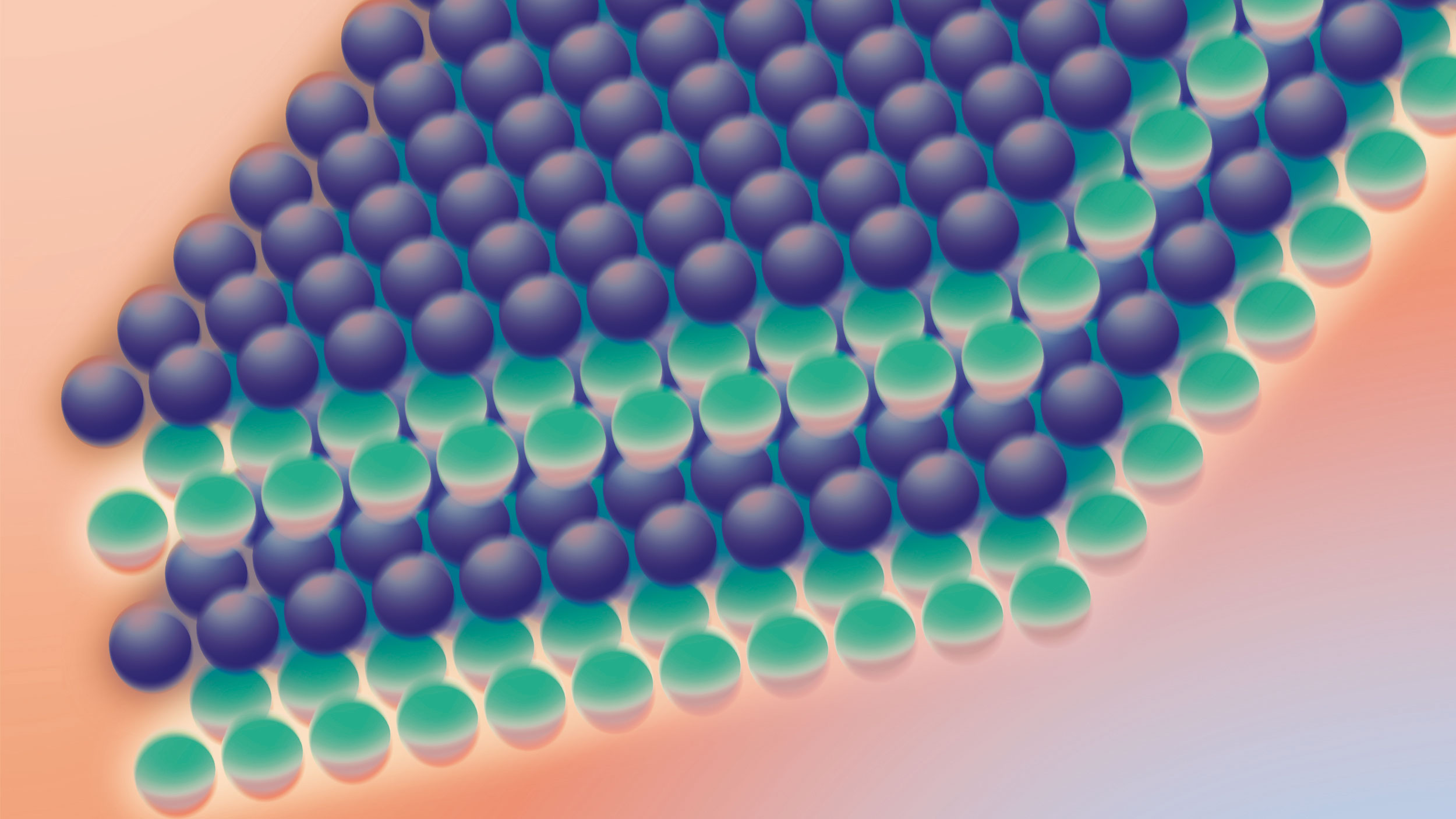
Tantalum disulfide has a simple chemical composition but a remarkably complex electronic structure. It consists of extremely thin atomic layers that behave differently as temperatures fall.
“Its chemical formula sounds very simple: for every tantalum atom there are two sulfur atoms,” says Guguchia. “But inside it is an enormously complex material with almost paradoxical properties.”
When produced in a particular way, the material contains alternating layers with two distinct atomic arrangements. Both conduct electricity at higher temperatures, but cooling causes one to become an insulator while the other becomes superconducting, carrying current without electrical resistance. “This means that the electronic properties of these two layers behave in completely opposite ways,” Guguchia explains.
When the Entire Crystal Becomes Superconducting
Initially, superconductivity remains confined to individual conducting layers because the insulating layers obstruct electron movement between them. But cooling the material to just over 1 kelvin (about −458°F) produces a dramatic change.
“Suddenly the entire material becomes superconducting, so the insulating layers also become conductive and take part in superconductivity,” Guguchia says. Instead of remaining restricted to separate planes, superconductivity extends throughout the crystal in three dimensions.
Scientists knew that applying pressure could raise the temperature at which this transition occurs, but the underlying mechanisms were unclear. The PSI team investigated how compression affects the material’s electrons and the interactions between its layers.
How Pressure Strengthens Superconductivity
The researchers subjected tantalum disulfide to pressures several hundred times greater than those inside a typical car tire. Compression brought the superconducting layers closer together, reducing the disruptive effect of the insulating layers. It also allowed previously localized electrons within the insulating layers to participate in superconductivity.
“Due to these effects, high pressure causes tantalum disulfide to become superconducting in all three dimensions at temperatures approximately three times higher.” Measurements also revealed a sevenfold increase in the number of electrons participating in superconductivity.
“So, pressure not only raises the temperature at which superconductivity can occur, but also changes the very nature of the superconducting state,” the researcher explained. “It alters the way electrons pair up and move together through the material, resulting in a more robust form of superconductivity.”
Using Muons to Investigate Electron Behavior
To investigate these changes, the team used muon spin spectroscopy, a technique that detects magnetic conditions inside materials. Muons are elementary particles similar to electrons but approximately 200 times heavier. Although they survive for only a few millionths of a second, their sensitivity to local magnetic fields makes them especially useful for studying superconductors.
“Since muons are exceptionally sensitive probes for magnetic and superconducting properties, we can gain unique insights into quantum materials here at PSI,” Guguchia says.
PSI operates the Swiss Muon Source SμS, the world’s most powerful muon source. By combining muon measurements with other techniques, the researchers examined how pressure changes electron behavior at extremely low temperatures.
Toward Superconductors That Work at Higher Temperatures
Superconductors carry electricity without resistance, eliminating conduction losses and associated waste heat. However, the extreme cooling requirements of most superconducting materials have limited their applications. They are currently used in specialized systems, including the powerful magnets at CERN’s Large Hadron Collider.
“Currently, research is being conducted worldwide on novel, unconventional superconductors that exhibit robust superconductivity even at higher temperatures or in strong external magnetic fields,” Guguchia says.
Although tantalum disulfide still requires extremely low temperatures, the findings demonstrate how pressure can alter electron pairing and strengthen superconductivity. These insights could help researchers develop materials that operate closer to room temperature and under ordinary atmospheric pressure.
“By investigating important quantum materials, we want to uncover the fundamental mechanisms underlying superconductivity,” Guguchia says. “This will allow us to find ways to optimize the temperatures at which superconductivity occurs.”
More Powerful Experiments Ahead
Future experiments at PSI could provide even more detailed measurements. Through the planned IMPACT project (IMPACT stands for: Isotope and Muon Production using Advanced Cyclotron and Target technologies), the institute expects to develop muon beams hundreds of times more powerful than those currently available. Together with the Muoniverse research initiative, the upgrade will expand opportunities to investigate superconducting quantum materials.
“We are already looking forward to the new perspectives these two developments will offer,” Guguchia concludes. “Especially for work on superconducting quantum materials, this opens up unimagined experimental possibilities.”
Reference: “Competing quantum orders in 6R-TaS2 revealed by pressure” by V. Sazgari, J. N. Graham, S. S. Islam, A. Achari, P. Král, O. Gerguri, J. N. Tangermann, J. A. Krieger, H. Gopakumar, G. Simutis, M. Janoschek, M. Bartkowiak, J.-X. Yin, R. Khasanov, H. Luetkens, F. O. von Rohr, R. R. Nair and Z. Guguchia, 30 April 2026, Nature Communications.
DOI: 10.1038/s41467-026-72136-x
Never miss a breakthrough: Join the SciTechDaily newsletter.
Follow us on Google and Google News.