

Close Menu
    Facebook X (Twitter) Instagram
    SciTechDaily
    • Biology
    • Chemistry
    • Earth
    • Health
    • Physics
    • Science
    • Space
    • Technology
    Facebook X (Twitter) Pinterest YouTube RSS
    SciTechDaily
    Home»Health»Less Sugar in Early Life Could Protect Your Mental Health Decades Later
    Health

    Less Sugar in Early Life Could Protect Your Mental Health Decades Later

    By Shanghai Jiao Tong University Journal CenterNovember 5, 2026No Comments4 Mins Read
    Facebook Twitter Pinterest Telegram LinkedIn WhatsApp Email Reddit
    Share
    Facebook Twitter LinkedIn Pinterest Telegram Email Reddit
    Woman Rejecting Stop Eating Sugar
    A natural experiment involving sugar restrictions suggests that our earliest nutritional environments may influence mental health far into adulthood. Credit: Shutterstock

    An observational study links sugar rationing in early life to lower adult anxiety and depression risks, raising the possibility that our earliest diets have lasting mental health implications.

    Could the amount of sugar we consume before birth and during infancy influence our mental health decades later? An experiment rooted in postwar Britain suggests that the effects of our earliest diets may extend far beyond childhood.

    During World War II and the years that followed, the United Kingdom strictly rationed sugar, limiting how much families could purchase. When those restrictions ended in September 1953, sugar consumption surged, creating a rare opportunity for scientists to examine how early-life exposure to sugar might shape long-term health.

    A study published in General Psychiatry found that exposure to rationing during early life was associated with a 17% lower risk of anxiety and a 14% lower risk of depression compared with no exposure. The researchers analyzed data from 66,223 UK Biobank participants born around the policy change, linking the timing of their earliest years to health records later in life.

    Sugar rationing offers a natural experiment

    Because the availability of other foods remained relatively stable when sugar consumption increased, the end of rationing offered a natural experiment. Researchers could compare people who experienced different periods of restricted sugar availability at the start of life. They estimated exposure using birth dates relative to the policy change, with exposure ranging from before birth only to periods extending through about age two.
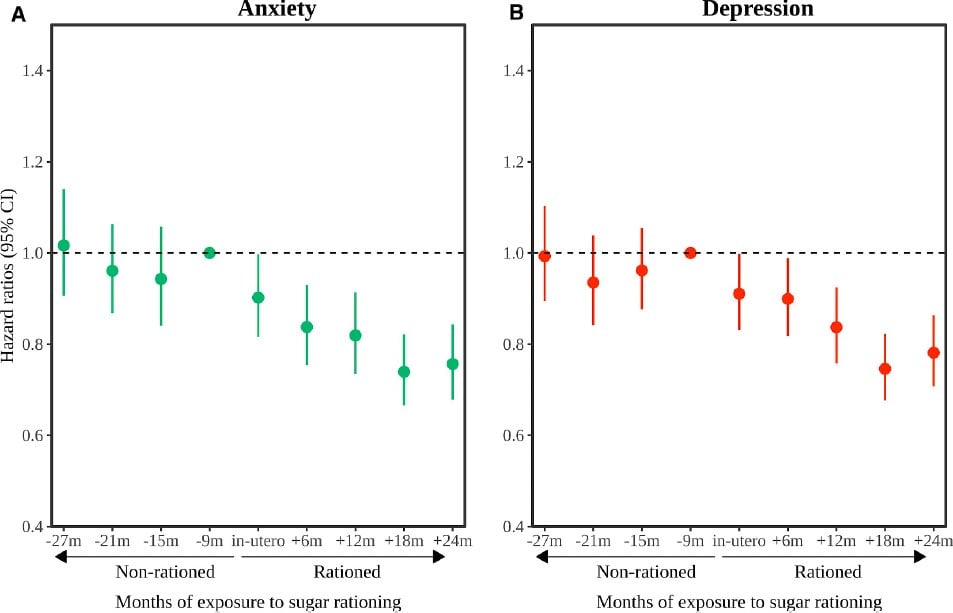
    Charts Showing Anxiety and Depression Risk Following Sugar Rationing
    Associations of sugar rationing with the risk of anxiety and depression. (A) Anxiety; (B) depression. Credit: Xiuping Dou, Yang Su, Yao Huang, Man He, Bingying Zhang, Xuejin Li, Hualiang Lin, Yin Yang

    That approach tracked exposure to a national policy, rather than measuring what individual mothers or children ate. The researchers did not have individual childhood food records, and unmeasured factors, including other aspects of maternal diet, may have influenced the results. The findings therefore cannot establish that lower sugar intake caused the differences in mental health.

    Longer rationing, lower anxiety and depression risks

    The strongest associations appeared among people exposed to rationing throughout the first 1,000 days after conception, spanning pregnancy and roughly the first two years after birth. Compared with people without early exposure, this group had approximately 24% lower relative risk of anxiety and 21% lower relative risk of depression. Across the analysis, the association generally strengthened with longer exposure to rationing.

    For participants exposed throughout those first 1,000 days, diagnoses also appeared later in their health records. The first recorded anxiety diagnosis occurred about two years later, and the first recorded depression diagnosis about four years later, than among participants with no early exposure. These findings concern when diagnoses were first recorded, rather than necessarily when symptoms began.

    Early nutrition could potentially influence later mental health through its effects on stress regulation, inflammation, and brain development. The authors drew these possible explanations from previous research, but did not directly test the mechanisms in the UK Biobank analysis. Further studies that measure individual diets and examine other populations will help clarify how dietary conditions during pregnancy and infancy relate to mental health across the life course, and what that relationship could mean for public health.

    Reference: “Sugar restriction during the first 1000 days after conception and its association with decreased risk of anxiety and depression” by Xiuping Dou, Yang Su, Yao Huang, Man He, Bingying Zhang, Xuejin Li, Hualiang Lin and Yin Yang, 7 July 2026, General Psychiatry.
    DOI: 10.1002/gps3.70038

    Never miss a breakthrough: Join the SciTechDaily newsletter.
    Follow us on Google and Google News.

    Anxiety Disorders Children Mental Health Nutrition Pregnancy
    Share. Facebook Twitter Pinterest LinkedIn Email Reddit

    Related Articles

    Could Sugary Drinks Be Fueling the Rise in Teen Anxiety?

    Brain on Fat: Study Reveals How Diet May Drive Anxiety

    Expecting With MS? Discover the Unexpected Mental Health Challenges

    Yogurt’s Hidden Superpower Uncovered: A Natural Guard Against Depression and Anxiety

    Pregnancy Diet Matters: How What You Eat Impacts Your Child’s Neurodevelopment

    Skipping Breakfast May Increase a Child’s Risk of Psychosocial Health Problems

    Forget Vegetables: Research Shows Eating Fruit More Frequently Could Reduce Depression

    COVID Lockdown Wellbeing: Children Who Spent More Time in Nature Fared Best

    Energy Drinks Significantly Increase Hyperactivity and Inattention in Children

    Leave A Reply Cancel Reply

    • Facebook
    • Twitter
    • Pinterest
    • YouTube

    Don't Miss a Discovery

    Subscribe for the Latest in Science & Tech!

    Trending News

    A Woman Who Lived 30,000 Years Ago Is Changing What We Know About Ice Age Europe

    A Rare Radioactive Element Reveals a Hidden Secret About the Heaviest Atoms

    Breakthrough Cancer Treatment Wipes Out Deadly Brain Tumors in Every Mouse Tested

    Something Remarkable Is Happening to Dogs Living Near Chernobyl’s Nuclear Plant

    Hubble Uncovers a Mysterious 93-Billion-Mile Structure Hiding in a Nearby Star System

    Earth’s Oceans Were Slowly Suffocating Millions of Years Before a Devastating Mass Extinction

    Why Are Men Twice As Likely To Develop Parkinson’s? Scientists Discover a Hidden Clue in the Brain

    Scientists Finally Identify Mysterious Creature Nearly 90 Years After It Was First Found

    Follow SciTechDaily
    • Facebook
    • Twitter
    • YouTube
    • Pinterest
    • Newsletter
    • RSS
    SciTech News
    • Biology News
    • Chemistry News
    • Earth News
    • Health News
    • Physics News
    • Science News
    • Space News
    • Technology News
    Recent Posts
    • Less Sugar in Early Life Could Protect Your Mental Health Decades Later
    • Animal vs. Plant Protein: New Study Reveals Unexpected Testosterone Differences
    • Scientists Unlock a Hidden Superconducting Power Inside a Strange Quantum Material
    • A Hidden Star May Be Plowing Through Betelgeuse’s Giant Atmosphere
    • A Black Hole Could Split in Two, According to a Surprising New Theory
    Copyright © 1998 - 2026 SciTechDaily. All Rights Reserved.
    • Science News
    • About
    • Contact
    • Editorial Board
    • Privacy Policy
    • Terms of Use

    Type above and press Enter to search. Press Esc to cancel.