
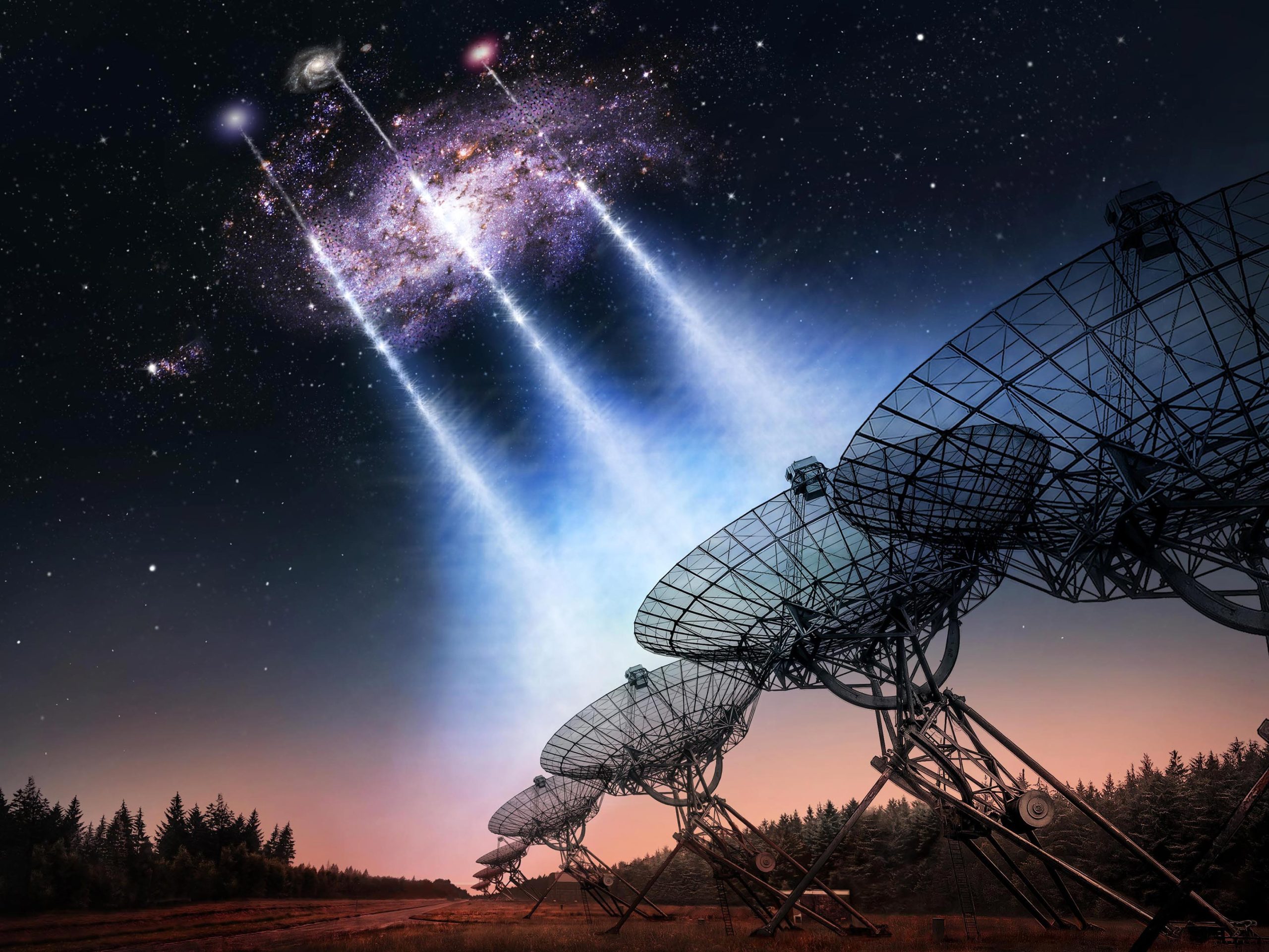
After upgrading the radio telescope array at Westerbork, The Netherlands, astronomers have found five new Fast Radio Bursts. The telescope images, much sharper than previously possible, revealed that multiple bursts had pierced our neighboring Triangulum Galaxy. This allowed the astronomers to determine the maximum number of otherwise invisible atoms in this galaxy for the first time.
Fast Radio Bursts, FRBs, are among the brightest explosions in the universe. The bursts mainly emit radio waves. The flashes are so powerful that radio telescopes can detect them even from over four billion (!) light years away. That continued visibility over such vast distances means the bursts contain immense amounts of energy. When it goes off, a single FRB contains ten trillion (ten million times a million) times the annual energy consumption of the entire world population.
This gigantic energy generation makes FRBs highly interesting. Many astronomers think they are emitted by neutron stars. The density and magnetic field strength of those extremely compact stars is unique in the universe. By investigating the flashes, astronomers aim to better understand the fundamental properties of the matter that makes up the universe. But studying these flashes is difficult. No one knows where in the sky the next burst will go off. And an FRB lasts only a millisecond: if you blink, you will miss it.
Powered by new receivers and a new supercomputer (the Apertif Radio Transient System, ARTS), Westerbork has now discovered five new FRBs. It also immediately pinpointed them, says principal investigator Joeri van Leeuwen (ASTRON): “We now have an instrument with both a very wide field of view and very sharp vision. And all this live. That is new and exciting.”
Previously, radio telescopes such as Westerbork detected FRBs as with the compound eyes of a fly. Flies can see in all directions, but blurred. The Westerbork upgrade is like cross breeding the eyes of a fly with that of an eagle. The ARTS supercomputer continuously combines the images from twelve Westerbork dishes to create a sharp picture over a massive field of view. “One cannot just go buy the complex electronics you need for this,” says system architect Eric Kooistra (ASTRON). “We designed most of the system ourselves, with a large team. That resulted in a state-of-the-art machine, one of the most powerful in the world.”
Skewering Galaxies
Astronomers want to understand how and why FRBs get to be so bright. But the flashes are also interesting because on their way to Earth they pierce other galaxies. Electrons in those galaxies, normally mostly invisible, distort the flashes. Tracking down invisible electrons, and their accompanying atoms, is important because most of the matter in the universe is dark and we still know little about it. Previously, radio telescopes could only roughly indicate where an FRB occurred. The ARTS supercomputer now enables Westerbork to indicate the exact location of an FRB very accurately. Van Leeuwen: “We demonstrated that three of the FRBs we discovered had skewered our neighbor, the Triangulum Galaxy! We were thus able to count how many invisible electrons that galaxy contains at most, for the first time. A fantastic result.”
Reference: “The Apertif Radio Transient System (ARTS): Design, commissioning, data release, and detection of the first five fast radio bursts” by Joeri van Leeuwen, Eric Kooistra, Leon Oostrum, Liam Connor, Jonathan E. Hargreaves, Yogesh Maan, Inés Pastor-Marazuela, Emily Petroff, Daniel van der Schuur, Alessio Sclocco, Samayra M. Straal, Dany Vohl, Stefan J. Wijnholds, Elizabeth A. K. Adams, Björn Adebahr, Jisk Attema, Cees Bassa, Jeanette E. Bast, Anna Bilous, Willem J. G. de Blok, Oliver M. Boersma, Wim A. van Cappellen, Arthur H. W. M. Coolen, Sieds Damstra, Helga Dénes, Ger N. J. van Diepen, David W. Gardenier, Yan G. Grange, André W. Gunst, Kelley M. Hess, Hanno Holties, Thijs van der Hulst, Boudewijn Hut, Alexander Kutkin, G. Marcel Loose, Danielle M. Lucero, Ágnes Mika, Klim Mikhailov, Raffaella Morganti, Vanessa A. Moss, Henk Mulder, Menno J. Norden, Tom A. Oosterloo, Emaneula Orrú, Zsolt Paragi, Jan-Pieter R. de Reijer, Arno P. Schoenmakers, Klaas J. C. Stuurwold, Sander ter Veen, Yu-Yang Wang, Alwin W. Zanting and Jacob Ziemke, 12 April 2023, Astronomy & Astrophysics.
DOI: 10.1051/0004-6361/202244107
Never miss a breakthrough: Join the SciTechDaily newsletter.
Follow us on Google and Google News.
5 Comments
“That continued visibility over such vast distances [4 Billion Light Years] means the bursts contain immense amounts of energy.”
…AND vast distances of TIME.
Yet ANOTHER over-valued insight!
… and yet, again… I’d settle for good, old-fashioned, 10¢ certainty of relevant application.
10cents the time n distance could be shorter. Or longer. The certain point is shorter could be fried earth the burst fried the earth or melt away blank gone. Trillion time more the coronal mass ejection. Baseball hit in stadium could land anywhere, right certain will be somewhere 🤔
The relevant application is in modeling galaxy matter content.
No, it isn’t over-valued, it is a useful data point of an entirely new phenomena (experiment). “We were thus able to count how many invisible electrons that galaxy contains at most, for the first time. A fantastic result.”
thats awesome detecting point of origin. The light n flash 📸 ✨ ⚡⚡⚡ Galactic ×4 = +1= we see n heard something.
Do these immense radio energy bursts carry enough energy to sterilize the ‘possible life’ on those planets it hits? What happens when one hits our tiny insignificant ball of mud?