
Close Menu
    Facebook X (Twitter) Instagram
    SciTechDaily
    • Biology
    • Chemistry
    • Earth
    • Health
    • Physics
    • Science
    • Space
    • Technology
    Facebook X (Twitter) Pinterest YouTube RSS
    SciTechDaily
    Home»Space»Galaxy Cluster Abell 2256 Undergoing Collisions
    Space

    Galaxy Cluster Abell 2256 Undergoing Collisions

    By ASTRON, Astronomy institute Netherlands Institute for Radio AstronomyMay 24, 2012No Comments3 Mins Read
    Facebook Twitter Pinterest Telegram LinkedIn WhatsApp Email Reddit
    Share
    Facebook Twitter LinkedIn Pinterest Telegram Email Reddit
    Colliding galaxy cluster unravelled
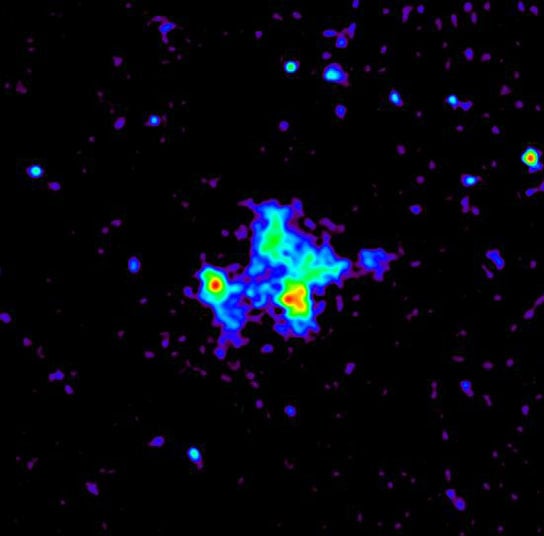
    An international team of astronomers has used the International LOFAR Telescope from ASTRON, the Netherlands Institute for Radio Astronomy, to study the formation of the galaxy cluster Abell 2256. Credit: ASTRON, Astronomy institute Netherlands Institute for Radio Astronomy

    A large group of scientists is using radio images from the International LOFAR Telescope to study Abell 2256 and the collisions that this cluster, which is 800 million light-years away, is undergoing.

    An international team of astronomers has used the International LOFAR Telescope from ASTRON, the Netherlands Institute for Radio Astronomy, to study the formation of the galaxy cluster Abell 2256. Abell 2256 is a cluster containing hundreds of galaxies at a distance of 800 million light-years. “The structure we see in the radio images made with LOFAR provides us with information about the origin of this cluster,” explains lead author Dr. Reinout van Weeren (Leiden University and ASTRON). The study will be published in the scientific journal Astronomy & Astrophysics. The research involved a large team of scientists from 26 different universities and research institutes.

    LOFAR has made the first images of Abell 2256 in the frequency range of 20 to 60 MHz. What came as a surprise to scientists was that the cluster of galaxies was brighter and more complex than expected. Dr. van Weeren: “We think that galaxy clusters form by mergers and collisions of smaller clusters.” Abell 2256 is a prime example of a cluster that is currently undergoing a collision. The radio emission is produced by tiny elementary particles that move nearly at the speed of light. With LOFAR it is possible to study how these particles get accelerated to such speeds. “In particular, we will learn how this acceleration takes place in regions measuring more than 10 million light-years across,” says Dr. Gianfranco Brunetti from IRA-INAF in Bologna, Italy, who together with Prof. Marcus Brüggen from the Jacobs University in Bremen, coordinates the LOFAR work on galaxy clusters.

    LOFAR was built by a large international consortium led by the Netherlands and which includes Germany, France, the United Kingdom, and Sweden. One of the main goals of LOFAR is to survey the entire northern sky at low radio frequencies, with a sensitivity and resolution about 100 times better than what has been previously done. Scientists believe that this survey will discover more than 100 million objects in the distant Universe. “Soon we will start our systematic surveys of the sky that will lead to great discoveries,” says Prof. Huub Röttgering from Leiden University and Principal Investigator of the “LOFAR Survey Key Project.”

    Never miss a breakthrough: Join the SciTechDaily newsletter.
    Follow us on Google and Google News.

    ASTRON Astronomy Astrophysics Galaxy Telescope
    Share. Facebook Twitter Pinterest LinkedIn Email Reddit

    Related Articles

    AI Discovers Secret Equation for “Weighing” Colossal Clusters of Galaxies

    Researchers Measure Size-Luminosity Relation of Galaxies Less Than a Billion Years After Big Bang

    Remarkable Similarities – New Analysis Reveals Links Between Galaxies Near and Far

    The Hunt for Cosmic Dawn: HERA Doubles Sensitivity to Unlock the Secrets of the Early Universe

    Astronomers Suggest More Galaxies Were Formed in the Early Universe Than Previously Thought

    The Most Extraordinary Example Yet – Tiny, Hidden Galaxy Provides a Portal Into the Distant Past

    The First Galaxies Unveiled: Non-Detection of Key Signal Reveals Key Information Regarding the Early Universe

    Ultra-Sensitive Deep Radio Images Reveal Thousands of Star-Forming Galaxies in Early Universe

    Puzzling Periodicity of a Fast Radio Burst Probed by Two of the Biggest Radio Telescopes in the World

    Leave A Reply Cancel Reply

    • Facebook
    • Twitter
    • Pinterest
    • YouTube

    Don't Miss a Discovery

    Subscribe for the Latest in Science & Tech!

    Trending News

    Bone-Strengthening Discovery Could Reverse Osteoporosis

    Scientists Uncover Hidden Trigger Behind Stem Cell Aging

    Scientists Find Way to Reverse Fatty Liver Disease Without Changing Diet

    Could Humans Regrow Limbs? New Study Reveals Promising Genetic Pathway

    Scientists Reveal Eating Fruits and Vegetables May Increase Your Risk of Lung Cancer

    Scientists Reverse Brain Aging With Simple Nasal Spray

    Scientists Uncover Potential Brain Risks of Popular Fish Oil Supplements

    Scientists Discover a Surprising Way To Make Bread Healthier and More Nutritious

    Follow SciTechDaily
    • Facebook
    • Twitter
    • YouTube
    • Pinterest
    • Newsletter
    • RSS
    SciTech News
    • Biology News
    • Chemistry News
    • Earth News
    • Health News
    • Physics News
    • Science News
    • Space News
    • Technology News
    Recent Posts
    • Cancer’s Secret Weapon? Scientists Reveal How Tumors “Learn” To Survive Treatment
    • Millions Take This Popular Supplement – Scientists Discover a Concerning Link to Heart Failure
    • What Makes Rubber So Strong? Scientists Finally Solve 100-Year-Old Mystery
    • Scientists Decode Mysterious Magnetic “Maze Domains” To Boost EV Efficiency
    • Scientists Say This Fungus Could Survive the Trip to Mars
    Copyright © 1998 - 2026 SciTechDaily. All Rights Reserved.
    • Science News
    • About
    • Contact
    • Editorial Board
    • Privacy Policy
    • Terms of Use

    Type above and press Enter to search. Press Esc to cancel.