
Close Menu
    Facebook X (Twitter) Instagram
    SciTechDaily
    • Biology
    • Chemistry
    • Earth
    • Health
    • Physics
    • Science
    • Space
    • Technology
    Facebook X (Twitter) Pinterest YouTube RSS
    SciTechDaily
    Home»Space»Researchers Measure Size-Luminosity Relation of Galaxies Less Than a Billion Years After Big Bang
    Space

    Researchers Measure Size-Luminosity Relation of Galaxies Less Than a Billion Years After Big Bang

    By Kavli Institute for the Physics and Mathematics of the UniverseFebruary 24, 2023No Comments4 Mins Read
    Facebook Twitter Pinterest Telegram LinkedIn WhatsApp Email Reddit
    Share
    Facebook Twitter LinkedIn Pinterest Telegram Email Reddit
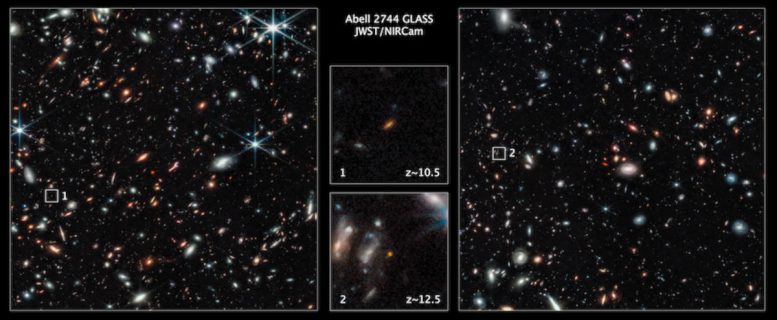
    Two Exceptionally Bright Galaxies
    Figure 1. Two exceptionally bright galaxies were captured in GLASS-JWST program. These galaxies existed approximately 450 and 350 million years after the Big Bang (with a redshift of approximately 10.5 and 12.5, respectively), and sizes are roughly 500 parsecs and 170 parsecs, respectively. Credit: NASA, ESA, CSA, Tommaso Treu (UCLA)

    Researchers using JWST have measured the size and luminosity of galaxies from the early universe, providing unprecedented insights into their properties and the epoch of reionization.

    An international team of researchers, including those from the Kavli Institute for the Physics and Mathematics of the Universe (Kavli IPMU), have published a new study in The Astrophysical Journal Letters that examines the relationship between the size and luminosity of some of the earliest galaxies in the universe, as captured by the recently launched James Webb Space Telescope (JWST) – less than a billion years after the Big Bang.

    The findings are part of the Grim Lens-Amplified Survey from Space (GLASS) Early-Release Science Program, led by Professor Tommaso Treu from the University of California, Los Angeles. The program’s aim is to study the early universe when the first stars and galaxies ignited, leading to the ionization of neutral gas and the emergence of light, known as the epoch of reionization.

    However, details of reionization have remained unknown because telescopes until today have not been capable of observing galaxies in this period of the universe’s history in detail. Finding out more about the epoch of reionization would help researchers understand how stars and galaxies have evolved to create today’s universe as we see it.
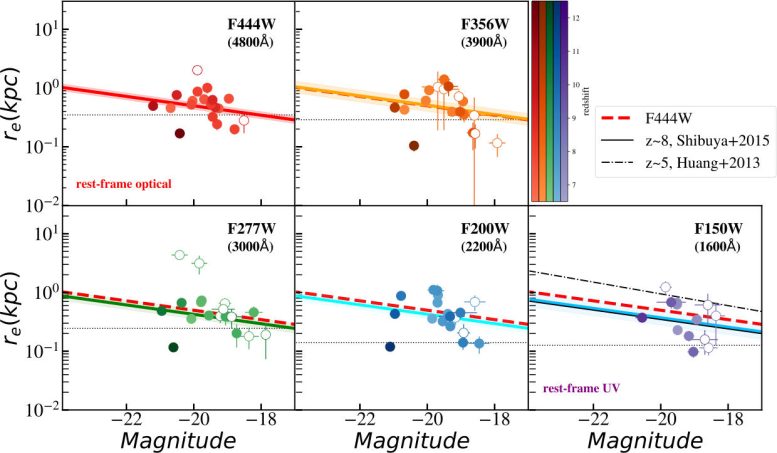
    Size–Luminosity Relationships of Galaxies Observed in Five Wavelength Bands With Fixed Slope Owing to Limited Data
    Figure 2: Size–luminosity relationships of galaxies observed in five wavelength bands with fixed slope owing to limited data. The black solid and dashed–dotted lines in the F150W panel show the relation derived from HST data by Shibuya et al. (2015; z ∼ 8) and Huang et al. (2013; z ∼ 5) at a similar rest-frame wavelength, respectively. Credit: Yang et al.

    One study, led by Kavli IPMU JSPS Fellow Lilan Yang, and including Project Researcher Xuheng Ding, used multiband NIRCAM imaging data from the GLASS-JWST program to measure galaxy size and luminosity to figure out the morphology and the size-luminosity relation from rest-frame optical to UV.

    “It’s the first time that we can study the galaxy’s properties in rest-frame optical at a redshift larger than 7 with JWST, and the size-luminosity is important for determining the shape of luminosity function which indicates the primary sources responsible for the cosmic reionization, i.e., numerous faint galaxies or relatively less bright galaxies.

    “The original wavelength of light will shift to a longer wavelength when it travels from the early universe to us. Thus, the rest-frame wavelength is used to clarify their intrinsic wavelength, rather than the observed wavelength.

    Previously, with Hubble Space Telescope, we know the properties of galaxies only in the rest-frame UV band. Now, with JWST, we can measure longer wavelength than UV,” said first author Yang.

    The researchers found the first rest-frame optical size-luminosity relation of galaxies at a redshift larger than 7, or roughly 800 million years after the Big Bang, allowing them to study the size as a function of wavelength. They found the median size at the reference luminosity is roughly 450-600 parsecs and decreased slightly from rest-frame optical to UV. But was this expected?

    “The answer is we don’t know what to expect. Previous simulation studies give a range of predictions,” said Yang.

    The team also found the slope of the size–luminosity relationship was somewhat steeper in the shortest wavelength band when allowing the slope to vary.

    “That would suggest higher surface brightness density at shorter wavelength, hence less observational incompleteness correction when estimating luminosity function, but the result is not conclusive. We don’t want to over-interpret here,” said Yang.

    Reference: “Early Results from GLASS-JWST. V: The First Rest-frame Optical Size–Luminosity Relation of Galaxies at z > 7” by L. Yang, T. Morishita, N. Leethochawalit, M. Castellano, A. Calabrò, T. Treu, A. Bonchi, A. Fontana, C. Mason, E. Merlin, D. Paris, M. Trenti, G. Roberts-Borsani, M. Bradac, E. Vanzella, B. Vulcani, D. Marchesini, X. Ding, T. Nanayakkara, S. Birrer, K. Glazebrook, T. Jones, K. Boyett, P. Santini, V. Strait and X. Wang, 18 October 2022, The Astrophysical Journal Letters.
    DOI: 10.3847/2041-8213/ac8803

    Never miss a breakthrough: Join the SciTechDaily newsletter.
    Follow us on Google and Google News.

    Astronomy Astrophysics Galaxy James Webb Space Telescope Kavli Institute UCLA
    Share. Facebook Twitter Pinterest LinkedIn Email Reddit

    Related Articles

    Rethinking the Cosmos: Hunt for Luminous Galaxies Could Upend Dark Matter Theories

    Peering Into the Cosmic Dawn: Researchers Detect the Host Galaxies of Quasars in the Early Universe

    Unveiling the Cosmos: Maisie’s Galaxy Confirmed as One of the Universe’s Oldest

    Astrophysicists Spot a Cosmic Whisper: The Faintest Galaxy in the Early Universe

    The Earliest Quiescent – Researchers Reveal Traits of Ancient Galaxy 25 Billion Light-Years Away

    Astrophysicists Uncover the First Bubble in an Intergalactic Stew

    Remarkable Similarities – New Analysis Reveals Links Between Galaxies Near and Far

    Astronomers Suggest More Galaxies Were Formed in the Early Universe Than Previously Thought

    Webb Space Telescope Reveals Breathtaking Cosmic Fireballs – How Universe Became Transparent

    Leave A Reply Cancel Reply

    • Facebook
    • Twitter
    • Pinterest
    • YouTube

    Don't Miss a Discovery

    Subscribe for the Latest in Science & Tech!

    Trending News

    Millions of People Have Osteopenia Without Realizing It – Here’s What You Need To Know

    Researchers Discover Boosting a Single Protein Helps the Brain Fight Alzheimer’s

    World-First Study Reveals Human Hearts Can Regenerate After a Heart Attack

    Why Your Dreams Feel So Real Sometimes and So Strange Other Times

    This Simple Home Device May Boost Brain Power in Adults Over 40

    Enormous Prehistoric Insects Puzzle Scientists

    Scientists Develop Bioengineered Chewing Gum That Could Help Fight Oral Cancer

    After 37 Years, the World’s Longest-Running Soil Warming Experiment Uncovers a Startling Climate Secret

    Follow SciTechDaily
    • Facebook
    • Twitter
    • YouTube
    • Pinterest
    • Newsletter
    • RSS
    SciTech News
    • Biology News
    • Chemistry News
    • Earth News
    • Health News
    • Physics News
    • Science News
    • Space News
    • Technology News
    Recent Posts
    • Researchers Identify the Most Common Recessive Neurodevelopmental Disorder Ever Discovered
    • This Is What Makes You Irresistible to Mosquitoes
    • Shockingly Powerful Giant Octopuses Ruled the Seas 100 Million Years Ago
    • After 100 Years, Scientists Uncover Hidden Rule Governing Cosmic Rays
    • The Milky Way Has a Hidden Edge and Scientists Finally Mapped It
    Copyright © 1998 - 2026 SciTechDaily. All Rights Reserved.
    • Science News
    • About
    • Contact
    • Editorial Board
    • Privacy Policy
    • Terms of Use

    Type above and press Enter to search. Press Esc to cancel.