
Close Menu
    Facebook X (Twitter) Instagram
    SciTechDaily
    • Biology
    • Chemistry
    • Earth
    • Health
    • Physics
    • Science
    • Space
    • Technology
    Facebook X (Twitter) Pinterest YouTube RSS
    SciTechDaily
    Home»Space»Astronomers Suggest More Galaxies Were Formed in the Early Universe Than Previously Thought
    Space

    Astronomers Suggest More Galaxies Were Formed in the Early Universe Than Previously Thought

    By University of MissouriJanuary 30, 2023No Comments5 Mins Read
    Facebook Twitter Pinterest Telegram LinkedIn WhatsApp Email Reddit
    Share
    Facebook Twitter LinkedIn Pinterest Telegram Email Reddit
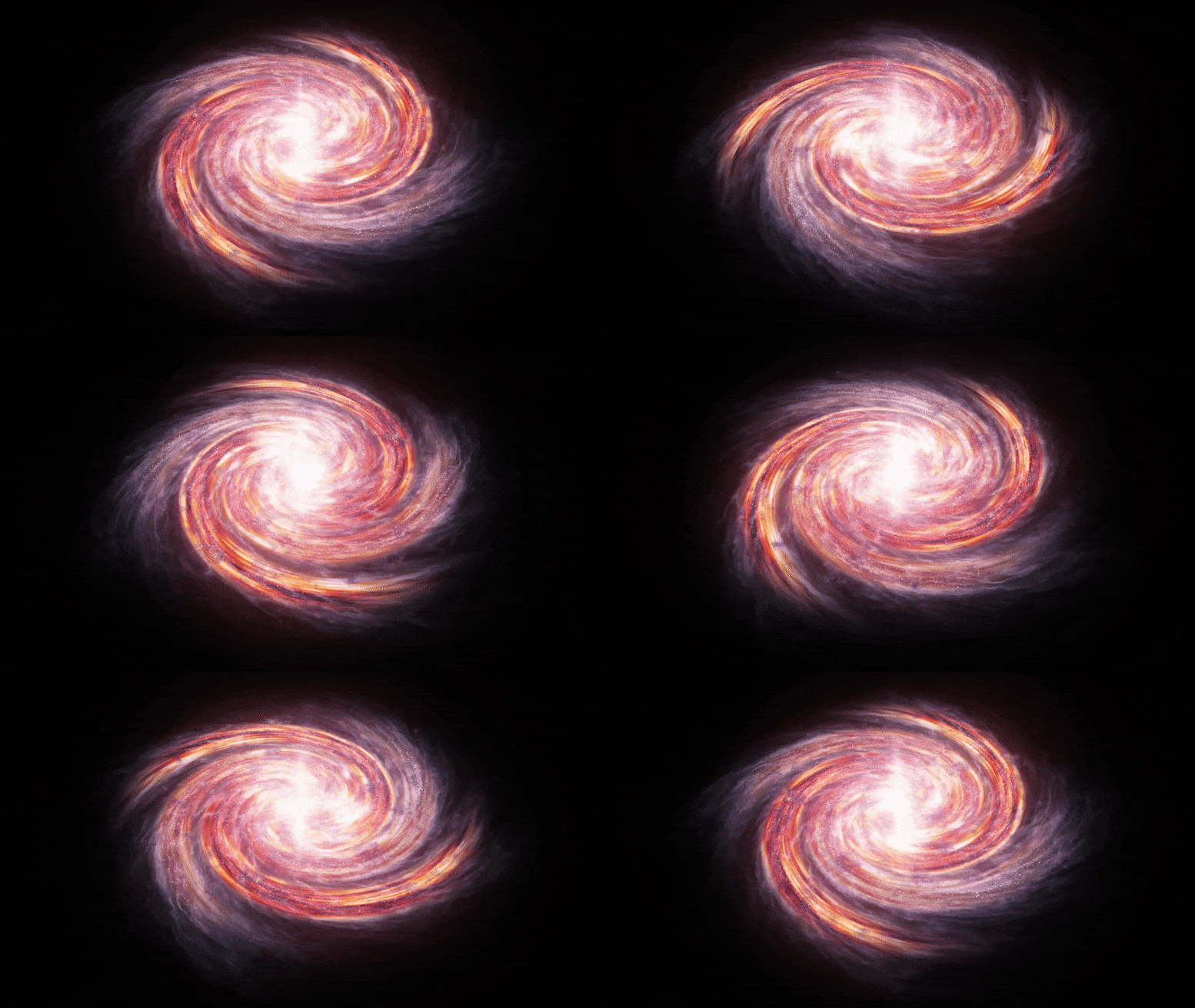
    Spiral Galaxy Animation
    The discovery of such a vast number of galaxies in the early universe suggests a potential revision of prior knowledge on galaxy formation.

    Exploring the Universe’s Earliest Galaxies With NASA’s New Space Telescope

    A team of astronomers, headed by Haojing Yan at the University of Missouri, have used NASA’s James Webb Space Telescope (JWST) Early Release Observations and discovered 87 galaxies that could be the earliest known galaxies in the universe.

    The discovery brings the astronomers closer to determining the appearance of galaxies in the universe, estimated to be 200-400 million years after the Big Bang, according to Yan, lead author and associate professor of physics and astronomy at MU.

    “Finding such a large number of galaxies in the early parts of the universe suggests that we might need to revise our previous understanding of galaxy formation,” Yan said. “Our finding gives us the first indication that a lot of galaxies could have been formed in the universe much earlier than previously thought.”
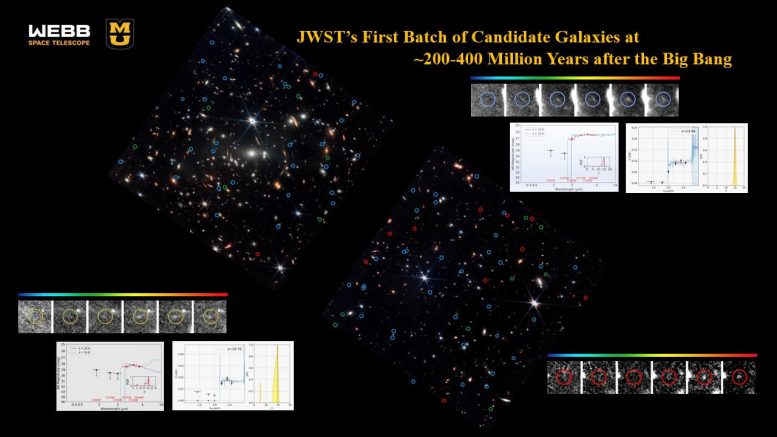
    A Pair of Color Composite Images From the Galaxy Cluster SMACS 0723–27
    A pair of color composite images from the galaxy cluster SMACS 0723-27 and its surrounding area taken by NASA’s James Webb Space Telescope through its Early Release Observations (ERO). A team of astronomers led by Haojing Yan at the University of Missouri used the data from these images to identify the objects of interest for their study. These include galaxies that could be the earliest known galaxies in the universe — about 200-400 million years after the Big Bang. The location of each object of interest is indicated by one of three different colored circles — blue, green, or red — on the color images. These colors correspond with the range of redshifts where they were found — high (blue), very high (green), or extremely high (red). Graphic by Haojing Yan and Bangzheng Sun. Credit: NASA, European Space Agency, Canadian Space Agency, and the Space Telescope Science Institute.

    Understanding Redshifts and Galaxy Formation

    In the study, the astronomers searched for potential galaxies at “very high redshifts.” Yan said the concept of redshifts in astronomy allows astronomers to measure how far away distant objects are in the universe — like galaxies — by looking at how the colors change in the waves of light that they emit.

    Haojing Yan
    Haojing Yan. Credit: University of Missouri

    “If a light-emitting source is moving toward us, the light is being ‘squeezed,’ and that shorter wavelength is represented by blue light, or blueshift,” Yan said. “But if that source [of light] is moving away from us, the light it produces is being ‘stretched,’ and changes to a longer wavelength that is represented by red light, or redshift.”

    Yan said Edwin Hubble’s discovery in the late 1920s that our universe is ever-expanding is key to understanding how redshifts are used in astronomy.

    “Hubble confirmed that galaxies external to our Milky Way galaxy are moving away from us, and the more distant they are, the faster they are moving away,” Yan said. “This relates to redshifts through the notion of distances — the higher the redshift an object is at, such as a galaxy, the further away it is from us.”

    Therefore, Yan said the search for galaxies at very high redshifts gives astronomers a way to construct the early history of the universe.

    Reconstructing the Early Universe

    “The speed of light is finite, so it takes time for light to travel over a distance to reach us,” Yan said. “For example, when we look at the sun, we aren’t looking at it as what it looks like in the present, but rather what it looked like some eight minutes ago. That’s because that’s how long it takes for the sun’s radiation to reach us. So, when we are looking at galaxies which are very far away, we are looking at their images from a long time ago.”

    Using this concept, Yan’s team analyzed the infrared light captured by the JWST to identify the galaxies.

    “The higher the redshift a galaxy is at, the longer it takes for the light to reach us, so a higher redshift corresponds to an earlier view of the universe,” Yan said. “Therefore, by looking at galaxies at higher redshifts, we are getting earlier snapshots of what the universe looked like a long time ago.”

    The JWST was critical to this discovery because objects in space like galaxies that are located at high redshifts — 11 and above — can only be detected by infrared light, according to Yan. This is beyond what NASA’s Hubble Space Telescope can detect because the Hubble telescope only sees from ultraviolet to near-infrared light.

    “JWST, the most powerful infrared telescope, has the sensitivity and resolution for the job,” Yan said. “Up until these first JWST data sets were released [in mid-July 2022], most astronomers believed that the universe should have very few galaxies beyond redshift 11. At the very least, our results challenge this view. I believe this discovery is just the tip of the iceberg because the data we used only focused on a very small area of the universe. After this, I anticipate that other teams of astronomers will find similar results elsewhere in the vast reaches of space as JWST continues to provide us with a new view of the deepest parts of our universe.”

    Reference: “First Batch of z ≈ 11–20 Candidate Objects Revealed by the James Webb Space Telescope Early Release Observations on SMACS 0723-73” by Haojing Yan, Zhiyuan Ma, Chenxiaoji Ling, Cheng Cheng and Jia-Sheng Huang, 28 December 2022, The Astrophysical Journal Letters.
    DOI: 10.3847/2041-8213/aca80c

    Never miss a breakthrough: Join the SciTechDaily newsletter.
    Follow us on Google and Google News.

    Astronomy Astrophysics Galaxy James Webb Space Telescope NASA University of Missouri
    Share. Facebook Twitter Pinterest LinkedIn Email Reddit

    Related Articles

    Remarkable Similarities – New Analysis Reveals Links Between Galaxies Near and Far

    NASA’s Webb Space Telescope to Explore a Neighboring, Dusty Planetary System

    NASA’s Webb Telescope Will Look Back in Time, Use Quasars to Unlock the Secrets of the Early Universe

    NASA’s Webb Space Telescope to Study How Massive Stars’ Blasts of Radiation Influence Their Environments

    NASA’s Webb Space Telescope to Probe the Outer Realm of Exoplanetary Systems, Hunt for New Worlds

    First James Webb Space Telescope General Observer Scientific Programs Selected

    NASA’s Webb Telescope Will Be the World’s Premier Space Science Observatory – Here’s What Those Powerful Capabilities Mean for Astronomy

    Back to the Spectacular Firestorm of Star Birth at the Beginning of the Universe: Probing the First Galaxies With Webb

    The Cosmic Dust in Your Bones – NASA’s Webb Telescope Will Investigate the Intertwined Origins of Dust and Life

    Leave A Reply Cancel Reply

    • Facebook
    • Twitter
    • Pinterest
    • YouTube

    Don't Miss a Discovery

    Subscribe for the Latest in Science & Tech!

    Trending News

    Scientists Discover How Coffee Impacts Memory, Mood, and Gut Health

    Why Did the Neanderthals Disappear? Scientists Reveal Humans Had a Hidden Advantage

    Physicists Propose Strange Experiment Where Time Goes Quantum

    Magnesium Magic: New Drug Melts Fat Even on a High-Fat, High-Sugar Diet

    Weight-Loss Drugs Like Ozempic May Come With an Unexpected Cost

    Mezcal “Worm” in a Bottle Mystery: DNA Testing Reveals a Surprise

    New Research Reveals That Your Morning Coffee Activates an Ancient Longevity Switch

    This Is What Makes You Irresistible to Mosquitoes

    Follow SciTechDaily
    • Facebook
    • Twitter
    • YouTube
    • Pinterest
    • Newsletter
    • RSS
    SciTech News
    • Biology News
    • Chemistry News
    • Earth News
    • Health News
    • Physics News
    • Science News
    • Space News
    • Technology News
    Recent Posts
    • Harvard Scientists Reveal Secret Structure Behind How You Smell
    • Scientists Just Discovered the Hidden Trick That Keeps Your Cells Alive
    • This Simple Movement Could Be Secretly Cleaning Your Brain
    • Male Birth Control Breakthrough: Scientists Find Way To Turn Sperm Production Off and Back On
    • A Common Vitamin Could Hold the Key to Treating Fatty Liver Disease
    Copyright © 1998 - 2026 SciTechDaily. All Rights Reserved.
    • Science News
    • About
    • Contact
    • Editorial Board
    • Privacy Policy
    • Terms of Use

    Type above and press Enter to search. Press Esc to cancel.