
A Window into the Early Universe
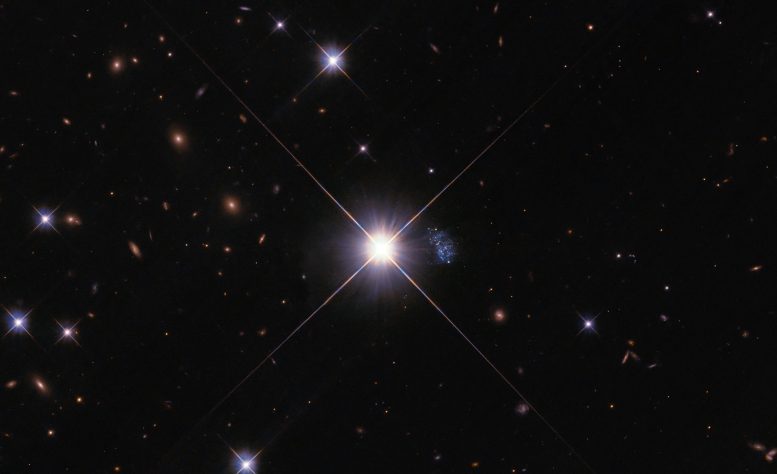
Astronomers have discovered a nearby galaxy that is similar to galaxies in the distant, early universe by looking past the bright light of a foreground star. This is the most extraordinary example of this type of galaxy found to date.
Dubbed “Peekaboo,” the tiny HIPASS J1131–31 galaxy has only been visible to astronomers for the past 50-100 years due to its emergence from behind the glare of a fast-moving star. The galaxy is only 1,200 light-years in size.
The discovery is a combined effort of telescopes on the ground and in space, including confirmation by NASA’s Hubble Space Telescope. Together the research shows tantalizing evidence that the Peekaboo Galaxy is the nearest example of the galaxy formation processes that commonly took place not long after the big bang, 13.8 billion years ago.
“Uncovering the Peekaboo Galaxy is like discovering a direct window into the past, allowing us to study its extreme environment and stars at a level of detail that is inaccessible in the distant, early universe,” said astronomer Gagandeep Anand of the Space Telescope Science Institute in Baltimore, Maryland, co-author of the new study on Peekaboo’s intriguing properties.
Metal-Poor Galaxies and Their Cosmic Significance
Astronomers describe galaxies like Peekaboo as “extremely metal-poor” (XMP). In astronomy, “metals” refers to all elements heavier than hydrogen and helium. The very early universe was almost entirely made up of primordial hydrogen and helium, elements forged in the big bang. Heavier elements were forged by stars over the course of cosmic history, building up to the generally metal-rich universe humans find ourselves in today. Life as we know it is made from heavier element “building blocks” like carbon, oxygen, iron, and calcium.
While the universe’s earliest galaxies were XMP by default, similarly metal-poor galaxies have also been found in the local universe. Peekaboo caught astronomers’ attention because, not only is it an XMP galaxy without a substantial older stellar population, but at only 20 million light-years from Earth it is located at least half the distance of the previously known young XMP galaxies.
Peekaboo was first detected as a region of cold hydrogen more than 20 years ago with the Australian Parkes radio telescope Murriyang, in the HI Parkes All Sky Survey by professor Bärbel Koribalski, who is an astronomer at Australia’s national science agency CSIRO and co-author of the latest research study on Peekaboo’s metallicity. Far-ultraviolet observations by NASA’s space-based Galaxy Evolution Explorer mission showed it to be a compact blue dwarf galaxy.
“At first we did not realize how special this little galaxy is,” Koribalski said of Peekaboo. “Now with combined data from the Hubble Space Telescope, the Southern African Large Telescope (SALT), and others, we know that the Peekaboo Galaxy is one of the most metal-poor galaxies ever detected.”
Young Stars and Uncommon Properties
NASA’s Hubble Space Telescope was able to resolve about 60 stars in the tiny galaxy, almost all of which appear to be a few billion years old or younger. Measurements of Peekaboo’s metallicity by SALT completed the picture. Together, these findings underline the major difference between Peekaboo and other galaxies in the local universe, which typically have ancient stars that are many billions of years old. Peekaboo’s stars indicate that it is one of the youngest and least-chemically-enriched galaxies ever detected in the local universe. This is very unusual, as the local universe has had about 13 billion years of cosmic history to develop.
However, the picture is still a shallow one, Anand says, as the Hubble observations were made as part of a “snapshot” survey program called The Every Known Nearby Galaxy Survey – an effort to get Hubble data of as many neighboring galaxies as possible. The research team plans to use Hubble and the James Webb Space Telescope to do further research on Peekaboo, to learn more about its stellar populations and their metal-makeup.
“Due to Peekaboo’s proximity to us, we can conduct detailed observations, opening up possibilities of seeing an environment resembling the early universe in unprecedented detail,” Anand said.
Reference: “Peekaboo: the extremely metal poor dwarf galaxy HIPASS J1131-31” by I D Karachentsev, L N Makarova, B S Koribalski, G S Anand, R B Tully and A Y Kniazev, 12 November 2022, Monthly Notices of the Royal Astronomical Society.
DOI: 10.1093/mnras/stac3284
The Hubble Space Telescope is a project of international cooperation between NASA and ESA. NASA’s Goddard Space Flight Center in Greenbelt, Maryland, manages the telescope. The Space Telescope Science Institute (STScI) in Baltimore conducts Hubble science operations. STScI is operated for NASA by the Association of Universities for Research in Astronomy, in Washington, D.C.
Never miss a breakthrough: Join the SciTechDaily newsletter.
Follow us on Google and Google News.
1 Comment
Please don’t keep lengthening these articles by multiple virtual repetition.
The content is very interesting …. once