
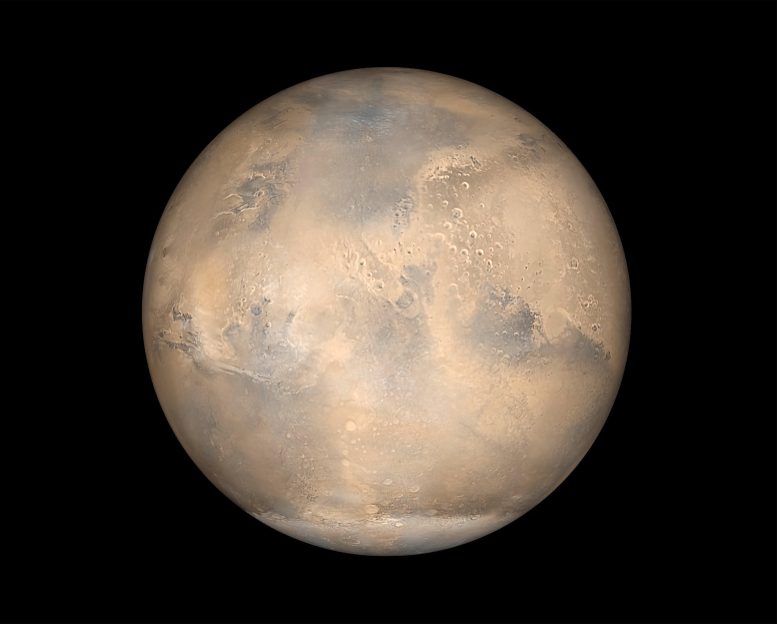
A New Study Has Found That Mars Was Covered by 300-Meter-Deep Oceans
Mars is known for its reddish hue, but it is believed that the planet was once blue and covered in water. The fact that Mars may have had water in the past brings us closer to understanding whether or not the planet could have supported life.
There is a general consensus among researchers that there was water on Mars at some point in the planet’s history, but the extent and duration of that water is still a topic of debate.
According to a recent study from the University of Copenhagen, it is believed that Mars was once covered in a 300-meter-deep ocean of water around 4.5 billion years ago.
“At this time, Mars was bombarded with asteroids filled with ice. It happened in the first 100 million years of the planet’s evolution. Another interesting angle is that the asteroids also carried organic molecules that are biologically important for life,” says Professor Martin Bizzarro from the Centre for Star and Planet Formation.
In addition to water, the icy asteroids also brought biologically relevant molecules such as amino acids to the Red Planet. Amino acids are used when DNA and RNA form bases that contain everything a cell needs.
The study was published in the renowned journal Science Advances.
Mars May Have Had the Conditions for Life Before Earth
The new study indicates that the oceans that covered the entire planet in water were at least 300 meters deep. They may have been up to one kilometer deep. In comparison, there is actually very little water on Earth, explains Martin Bizzarro.
“This happened within Mars’s first 100 million years. After this period, something catastrophic happened for potential life on Earth. It is believed that there was a gigantic collision between the Earth and another Mars-sized planet. It was an energetic collision that formed the Earth-Moon system and, at the same time, wiped out all potential life on Earth,” says Martin Bizzarro.
Therefore, the researchers have really strong evidence that conditions allowing the emergence of life were present on Mars long before Earth.
Billion-Year-Old Meteorite
It was by means of a meteorite that is billions of years old that the researchers have been able to look into Mars’s past history. The meteorite was once part of Mars’s original crust and offers a unique insight into what happened at the time when the solar system was formed.
The whole secret is hiding in the way Mars’s surface has been created – and of which the meteorite was once a part – because it is a surface that does not move. On Earth it is the opposite. The tectonic plates are in perpetual motion and recycled in the planet’s interior.
“Plate tectonics on Earth erased all evidence of what happened in the first 500 million years of our planet’s history. The plates constantly move and are recycled back and destroyed into the interior of our planet. In contrast, Mars does not have plate tectonics such that the planet’s surface preserves a record of the earliest history of the planet,” explains Martin Bizzarro.
Reference: “Late delivery of exotic chromium to the crust of Mars by water-rich carbonaceous asteroids” by Ke Zhu, Martin Schiller, Lu Pan, Nikitha Susan Saji, Kirsten K. Larsen, Elsa Amsellem, Courtney Rundhaug, Paolo Sossi, Ingo Leya, Frederic Moynier and Martin Bizzarro, 16 November 2022, Science Advances.
DOI: 10.1126/sciadv.abp8415
Never miss a breakthrough: Join the SciTechDaily newsletter.
Follow us on Google and Google News.
1 Comment
Did astronemers ever considered the possibility of centrifugal force in our Solar System? That Mars could once be in Earth’s orbit millions of years ago. But due to centrifugal force, it moved away from the Sun. Hence, it will then be possible for Venus to move outward and into Earth’s orbit and become the next habitable planet?