
Close Menu
    Facebook X (Twitter) Instagram
    SciTechDaily
    • Biology
    • Chemistry
    • Earth
    • Health
    • Physics
    • Science
    • Space
    • Technology
    Facebook X (Twitter) Pinterest YouTube RSS
    SciTechDaily
    Home»Space»Highly Eccentric Black Hole Merger Detected for the First Time
    Space

    Highly Eccentric Black Hole Merger Detected for the First Time

    By Rochester Institute of TechnologyJanuary 24, 2022No Comments3 Mins Read
    Facebook Twitter Pinterest Telegram LinkedIn WhatsApp Email Reddit
    Share
    Facebook Twitter LinkedIn Pinterest Telegram Email Reddit
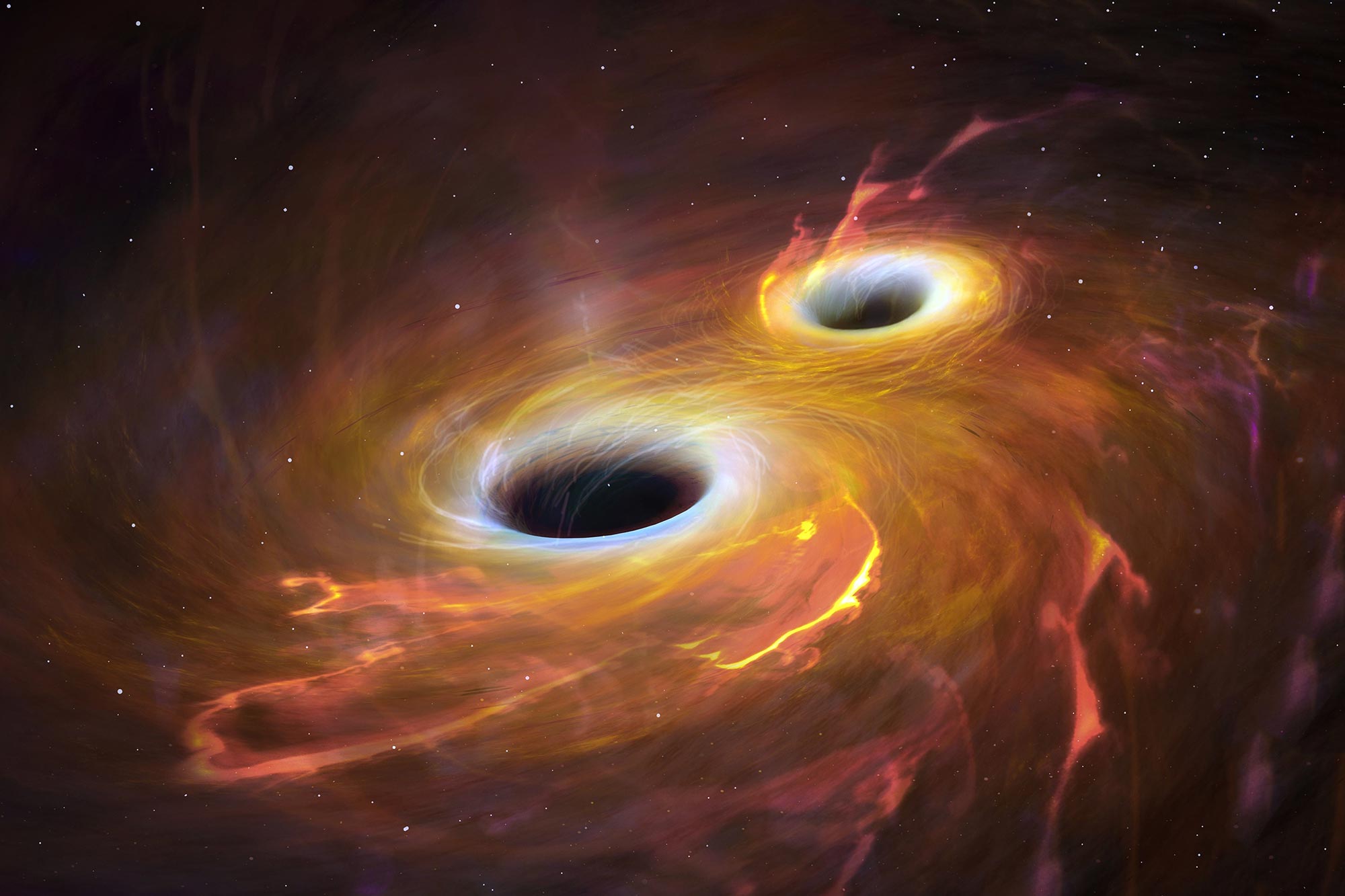
    Two Black Holes Collide Merge
    An artist’s impression of two black holes about to collide and merge.

    Findings by the Center for Computational Relativity and Gravitation published in Nature Astronomy.

    For the first time, scientists believe they have detected a merger of two black holes with eccentric orbits. According to a paper published in Nature Astronomy by researchers from Rochester Institute of Technology’s Center for Computational Relativity and Gravitation and the University of Florida, this can help explain how some of the black hole mergers detected by LIGO Scientific Collaboration and the Virgo Collaboration are much heavier than previously thought possible.

    Eccentric orbits are a sign that black holes could be repeatedly gobbling up others during chance encounters in areas densely populated with black holes such as galactic nuclei. The scientists studied the most massive gravitational wave binary observed to date, GW190521, to determine if the merger had eccentric orbits.

    “The estimated masses of the black holes are more than 70 times the size of our sun each, placing them well above the estimated maximum mass predicted currently by stellar evolution theory,” said Carlos Lousto, a professor in the School of Mathematical Sciences and a member of the CCRG. “This makes an interesting case to study as a second generation binary black hole system and opens up to new possibilities of formation scenarios of black holes in dense star clusters.”

    Binary Black Holes About to Collide
    Artist’s impression of binary black holes about to collide. Credit: Mark Myers, ARC Centre of Excellence for Gravitational Wave Discovery (OzGrav)

    A team of RIT researchers including Lousto, Research Associate James Healy, Jacob Lange ’20 Ph.D. (astrophysical sciences and technology), Professor and CCRG Director Manuela Campanelli, Associate Professor Richard O’Shaughnessy, and collaborators from the University of Florida formed to give a fresh look at the data to see if the black holes had highly eccentric orbits before they merged. They found the merger is best explained by a high-eccentricity, precessing model. To achieve this, the team performed hundreds of new full numerical simulations in local and national lab supercomputers, taking nearly a year to complete.

    “This represents a major advancement in our understanding of how black holes merge,” said Campanelli. “Through our sophisticated supercomputer simulations and the wealth of new data provided by LIGO and Virgo’s rapidly advancing detectors, we are making new discoveries about the universe at astonishing rates.”

    An extension of this analysis by the same RIT and UFL team used a possible electromagnetic counterpart observed by the Zwicky Transient Facility to compute independently the cosmological Hubble constant with GW150521 as an eccentric binary black hole merger. They found excellent agreement with the expected values and recently published the work in the Astrophysical Journal.

    Reference: “Eccentricity estimate for black hole mergers with numerical relativity simulations” by V. Gayathri, J. Healy, J. Lange, B. O’Brien, M. Szczepanczyk, Imre Bartos, M. Campanelli, S. Klimenko, C. O. Lousto and R. O’Shaughnessy, 20 January 2022, Nature Astronomy.
    DOI: 10.1038/s41550-021-01568-w

    Never miss a breakthrough: Join the SciTechDaily newsletter.
    Follow us on Google and Google News.

    Astronomy Astrophysics Black Hole Gravitational Waves Popular Rochester Institute of Technology
    Share. Facebook Twitter Pinterest LinkedIn Email Reddit

    Related Articles

    Massive, Spinning Black Holes Could Be the Result of ‘Pac-Man-Like’ Mergers

    Further Evidence That Outskirts of Spiral Galaxies Host Massive Black Holes

    LIGO and Virgo Detect Gravitational Waves from Binary Black Hole Merger

    LIGO Detects Merging Ripples in Space and Time

    Did LIGO Find Dark Matter?

    LIGO Detects Gravitational Waves Again

    New Research Shows LIGO’s Twin Black Holes Might Have Been Born Inside a Single Star

    Simulations Re-Create the Complex Dynamics Near a Black Hole

    NASA Study Bridges the Gap Between Theory and Black Hole Observations

    Leave A Reply Cancel Reply

    • Facebook
    • Twitter
    • Pinterest
    • YouTube

    Don't Miss a Discovery

    Subscribe for the Latest in Science & Tech!

    Trending News

    Monster Storms on Jupiter Unleash Lightning Beyond Anything on Earth

    Scientists Create “Liquid Gears” That Spin Without Touching

    The Simple Habit That Could Help Prevent Cancer

    Millions Take These IBS Drugs, But a New Study Finds Serious Risks

    Scientists Unlock Hidden Secrets of 2,300-Year-Old Mummies Using Cutting-Edge CT Scanner

    Bread Might Be Making You Gain Weight Even Without Eating More Calories

    Scientists Discover Massive Magma Reservoir Beneath Tuscany

    Europe’s Most Active Volcano Just Got Stranger – Here’s Why Scientists Are Rethinking It

    Follow SciTechDaily
    • Facebook
    • Twitter
    • YouTube
    • Pinterest
    • Newsletter
    • RSS
    SciTech News
    • Biology News
    • Chemistry News
    • Earth News
    • Health News
    • Physics News
    • Science News
    • Space News
    • Technology News
    Recent Posts
    • Simple Blood Test May Predict Alzheimer’s Years Before Brain Scans Show Signs
    • Scientists Say Adding This Unusual Seafood to Your Diet Could Reverse Signs of Aging
    • U.S. Waste Holds $5.7 Billion Worth of Crop Nutrients
    • Scientists Say a Hidden Structure May Exist Inside Earth’s Core
    • Doctors Surprised by the Power of a Simple Drug Against Colon Cancer
    Copyright © 1998 - 2026 SciTechDaily. All Rights Reserved.
    • Science News
    • About
    • Contact
    • Editorial Board
    • Privacy Policy
    • Terms of Use

    Type above and press Enter to search. Press Esc to cancel.