
Close Menu
    Facebook X (Twitter) Instagram
    SciTechDaily
    • Biology
    • Chemistry
    • Earth
    • Health
    • Physics
    • Science
    • Space
    • Technology
    Facebook X (Twitter) Pinterest YouTube RSS
    SciTechDaily
    Home»Space»Massive, Spinning Black Holes Could Be the Result of ‘Pac-Man-Like’ Mergers
    Space

    Massive, Spinning Black Holes Could Be the Result of ‘Pac-Man-Like’ Mergers

    By Rochester Institute of TechnologyNovember 8, 20192 Comments3 Mins Read
    Facebook Twitter Pinterest Telegram LinkedIn WhatsApp Email Reddit
    Share
    Facebook Twitter LinkedIn Pinterest Telegram Email Reddit
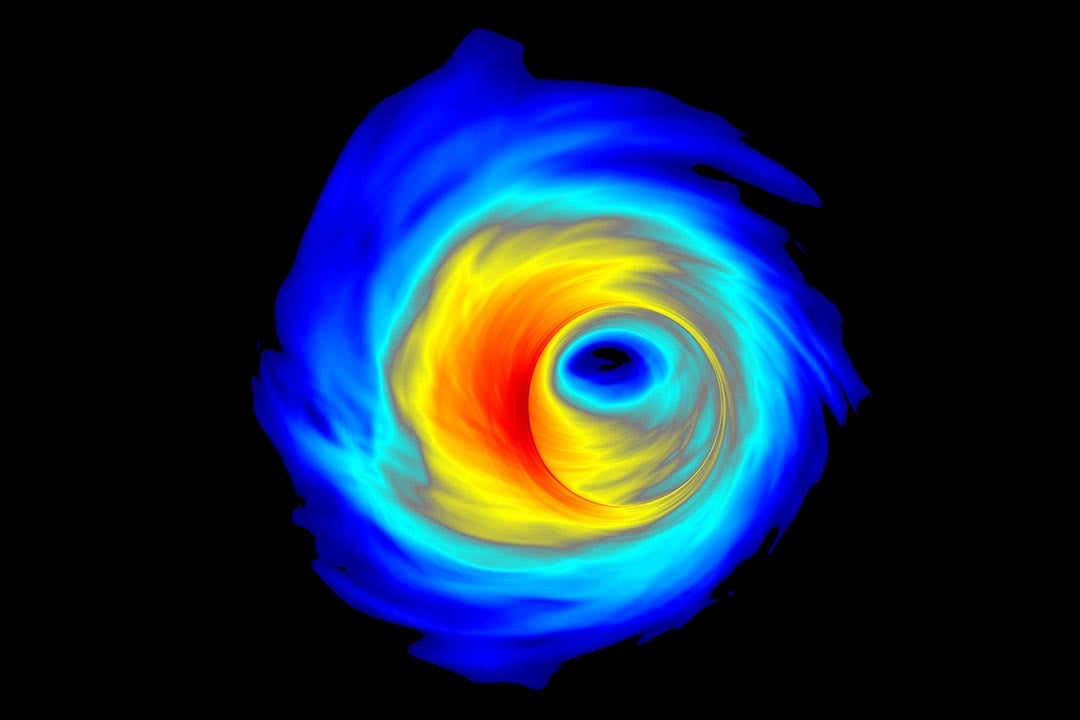
    Accretion Disk Surrounding Supermassive Black Hole
    This is a simulation of an accretion disk surrounding a supermassive black hole. Credit: Scott C. Noble

    Scientists have reported detecting gravitational waves from 10 black hole mergers to date, but they are still trying to explain the origins of those mergers. The largest merger detected so far seems to have defied previous models because it has a higher spin and mass than the range thought possible. A group of researchers, including Rochester Institute of Technology Assistant Professor Richard O’Shaughnessy, has created simulations that could explain how the merger happened.

    In a new paper published in Physical Review Letters published on November 1, 2019, the researchers suggest that such large mergers could happen just outside supermassive black holes at the center of active galactic nuclei. Gas, stars, dust, and black holes become caught in a region surrounding supermassive black holes known as the accretion disk. The researchers suggest that as black holes circle around in the accretion disk, they eventually collide and merge to form a bigger black hole, which continues to devour smaller black holes, becoming increasingly large in what O’Shaughnessy calls “Pac-Man-like” behavior.

    “This is a very tantalizing prospect for those of us who work in this field,” said O’Shaughnessy, a member of RIT’s Center for Computational Relativity and Gravitation (CCRG). “It offers a natural way to explain high mass, high spin binary black hole mergers and to produce binaries in parts of parameter space that the other models cannot populate. There is no way to get certain types of black holes out of these other formation channels.”

    As the LIGO and Virgo collaboration continue to hunt for gravitational waves, O’Shaughnessy and his fellow researchers hope to find signatures of large, spinning black holes that could help confirm their models. If their assumptions are correct, it could help us better understand how the cosmic web of galaxies assembles.

    “This could be a unique way of probing the physics around these supermassive black holes in a way that could not be probed in any other way,” said O’Shaughnessy. “It offers unique insight into how the centers of galaxies grow, which is of course essential to understanding how galaxies as a whole grow, which explains most of the structure in the universe.”

    ###

    Reference: “Hierarchical Black Hole Mergers in Active Galactic Nuclei” by Y. Yang, I. Bartos, V. Gayathri, K. E. S. Ford, Z. Haiman, S. Klimenko, B. Kocsis, S. Márka, Z. Márka, B. McKernan and R. O’Shaughnessy, 1 November 2019, Physical Review Letters.
    DOI: 10.1103/PhysRevLett.123.181101

    RIT’s CCRG has a large and active group of 18 faculty, students and postdoctoral researchers involved in the LIGO Scientific Collaboration.

    Never miss a breakthrough: Join the SciTechDaily newsletter.
    Follow us on Google and Google News.

    Astronomy Astrophysics Black Hole Gravitational Waves Popular Rochester Institute of Technology
    Share. Facebook Twitter Pinterest LinkedIn Email Reddit

    Related Articles

    Highly Eccentric Black Hole Merger Detected for the First Time

    Pulsar Timing Array Explores Mystery Gravitational Waves From Supermassive Black Holes

    Astrophysicists on the Hunt for “Hierarchical” Black Holes

    Hawking’s Black Hole Theorem Confirmed Observationally for the First Time

    A New Type of Cataclysmic Event in the Cosmos: Astrophysicists Detect First Black Hole-Neutron Star Mergers

    “Heaviest Black Hole Collision” Detected by Gravitational Waves Might Actually Be a Boson Star Merger

    Massive Stellar Triples Leading to Sequential Binary Black-Hole Mergers

    Wealth of Discoveries From Gravitational-Wave Data Leads to Most Detailed Black Hole “Family Portrait”

    Ripples in the Fabric of Space and Time Offer New Clues to the Shape of Black Holes

    2 Comments

    1. raj srinivasan on November 11, 2019 10:30 am

      good to know. is there a free to read link, say on arxiv.org available. for the paper published in Physical Review Letters

      Reply
      • raj srinivasan on November 11, 2019 10:32 am

        never mind, previously there was an error looking for it. here is the link-> https://arxiv.org/abs/1906.09281

        Reply
    Leave A Reply Cancel Reply

    • Facebook
    • Twitter
    • Pinterest
    • YouTube

    Don't Miss a Discovery

    Subscribe for the Latest in Science & Tech!

    Trending News

    This Deadly Disease Was Wiping Out Humans 5,500 Years Ago

    Beyond DNA: Scientists Discover Inheritance That Breaks the Rules of Genetics

    Scientists Just Discovered the Eye Defies a Long-Held Rule of Vision

    What if Time Isn’t Fundamental? Physicists Just Tested the Idea in the Lab

    Scientists Say We’ve Been Wrong About the Aging Brain

    68 Quadrillion Miles: Scientists Map Earth’s Vast Hidden Fungal Network for the First Time

    Hidden Damage From Youth May Explode Into Disease Later in Life

    Climate Models May Be Wrong About How Trees Store Carbon

    Follow SciTechDaily
    • Facebook
    • Twitter
    • YouTube
    • Pinterest
    • Newsletter
    • RSS
    SciTech News
    • Biology News
    • Chemistry News
    • Earth News
    • Health News
    • Physics News
    • Science News
    • Space News
    • Technology News
    Recent Posts
    • US and UK Veterans Who Volunteered in Ukraine Return Home With Hidden Health Crises
    • Scientists Discover Troubling Link Between Processed Foods and Preschool Behavior
    • This “Fake” Pill Improved Memory and Physical Performance in Just 3 Weeks
    • Scientists Rediscover Rare Island Fox Not Seen for More Than 20 Years
    • The Amazon’s Mysterious “Ghost Dog” Has Been Hiding a Big Secret
    Copyright © 1998 - 2026 SciTechDaily. All Rights Reserved.
    • Science News
    • About
    • Contact
    • Editorial Board
    • Privacy Policy
    • Terms of Use

    Type above and press Enter to search. Press Esc to cancel.