
Close Menu
    Facebook X (Twitter) Instagram
    SciTechDaily
    • Biology
    • Chemistry
    • Earth
    • Health
    • Physics
    • Science
    • Space
    • Technology
    Facebook X (Twitter) Pinterest YouTube RSS
    SciTechDaily
    Home»Space»Doubling Planets: TESS Science Office at MIT Hits Milestone of 5,000 Exoplanet Candidates
    Space

    Doubling Planets: TESS Science Office at MIT Hits Milestone of 5,000 Exoplanet Candidates

    By MIT Kavli Institute for Astrophysics and Space ResearchJanuary 24, 20221 Comment3 Mins Read
    Facebook Twitter Pinterest Telegram LinkedIn WhatsApp Email Reddit
    Share
    Facebook Twitter LinkedIn Pinterest Telegram Email Reddit
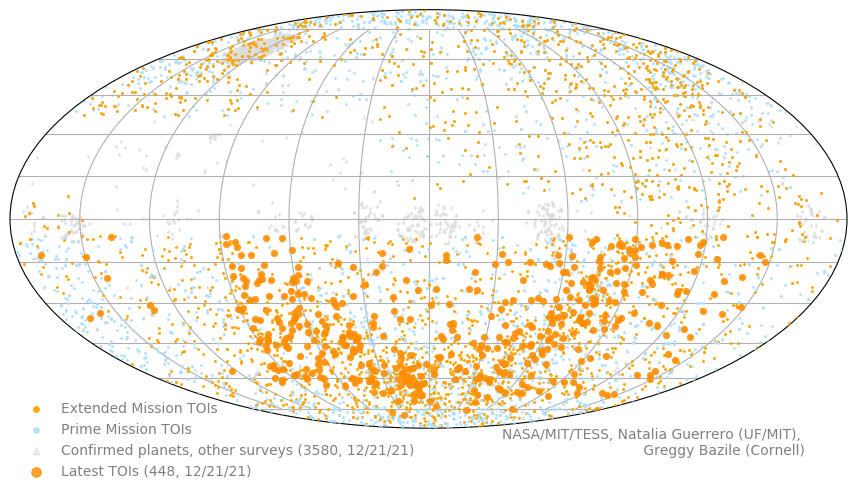
    TESS Objects of Interest 5K
    A map of the sky is now crowded with over 5,000 exoplanet candidates from NASA’s TESS mission. The TESS Science Office at MIT released the most recent batch of TESS Objects of Interest (large orange points on the map) on December 21, boosting the catalog to this 5,000-count milestone. Credit: Image courtesy of NASA/MIT/TESS

    Catalog of Planet Candidates Nearly Doubles in Size During 2020–21

    TESS has cataloged over 5,000 planet candidates and is in an extended mission phase, observing previously covered and new regions, with a plan for ongoing discovery and confirmation of new planets until 2025 and potentially beyond.

    The catalog of planet candidates found with NASA’s Transiting Exoplanet Survey Satellite (TESS) recently passed 5,000 TOIs, or TESS Objects of Interest.

    The catalog has been growing steadily since the start of the mission in 2018, and the batch of TOIs boosting the catalog to over 5,000 come mostly from the Faint Star Search led by MIT postdoc Michelle Kunimoto.

    Kunimoto reflects, “This time last year, TESS had found just over 2,400 TOIs. Today, TESS has reached more than twice that number — a huge testament to the mission and all the teams scouring the data for new planets. I’m excited to see thousands more in the years to come!”

    Now in its extended mission, TESS is observing the Northern Hemisphere and ecliptic plane, including regions of the sky previously observed by the Kepler and K2 missions. The TOIs added in late December are from the third year of the TESS mission, which ran from July 2020 to June 2021. TESS re-observed the sky visible in the Earth’s Southern Hemisphere, revisiting stars it had first observed at the mission’s start in 2018.

    TOI manager Katharine Hesse remarks, “With data from the first year of the extended mission, we have found dozens of additional candidates to TOIs found during the prime mission. I am excited to see how many multi-planet systems we can find during the rest of the extended mission and in upcoming years with TESS.” Planned extensions of the TESS mission to 2025 and beyond should unveil many more new planet candidates.

    Discovering more planet candidates and adding them to the TESS Objects of Interest Catalog is the first step. In the coming months, astronomers around the world will study each of these TOIs to confirm whether they are bona fide planets, and the catalog of confirmed exoplanets from the TESS mission (175 as of December 20) will continue to grow.

    TESS is a NASA Astrophysics Explorer mission led and operated by MIT in Cambridge, Massachusetts, and managed by NASA’s Goddard Space Flight Center. Additional partners include Northrop Grumman, based in Falls Church, Virginia; NASA’s Ames Research Center in California’s Silicon Valley; the Center for Astrophysics | Harvard and Smithsonian in Cambridge, Massachusetts; MIT’s Lincoln Laboratory; and the Space Telescope Science Institute in Baltimore. More than a dozen universities, research institutes, and observatories worldwide are participants in the mission.

    Never miss a breakthrough: Join the SciTechDaily newsletter.
    Follow us on Google and Google News.

    Astronomy Exoplanet MIT
    Share. Facebook Twitter Pinterest LinkedIn Email Reddit

    Related Articles

    Astronomers Discover the Last Three Planets NASA’s Kepler Space Telescope Observed Before Going Dark

    Astronomers Witness a Star Devouring a Planet – “We Are Seeing the Future of the Earth”

    MIT Warns: Astronomers Risk Misinterpreting Planetary Signals in Webb Space Telescope Data

    Astronomers Discover a Nearby Multiplanet System With Two Earth-Sized Planets

    Rooting Out Planetary Imposters: Three “Exoplanets” Turn Out To Be Stars

    A “Hot Jupiter’s” Dark Side Is Revealed: Iron Clouds, Titanium Rain, and Extreme Winds

    Sub-Earth Planet Discovered by Astronomers: Boiling New World Is Ultra-Light and Super-Fast

    Newly Discovered Extreme “Ultrahot Jupiter” Blitzes Around Its Star – One Year Is Just 16 Hours Long

    Evidence of a Giant Impact in Nearby Star System Stripping the Atmosphere From a Planet

    1 Comment

    1. Ralph Johnson on January 23, 2024 3:53 am

      How closely does astrology investigate the milky way system, seeing that earth exists in the system should there be more in a stable galaxy, maybe across the disk cloud to a arm of stellar formation, we could use a optical view of our milky way, possible through lensing.

      Reply
    Leave A Reply Cancel Reply

    • Facebook
    • Twitter
    • Pinterest
    • YouTube

    Don't Miss a Discovery

    Subscribe for the Latest in Science & Tech!

    Trending News

    Largest-Ever Study Finds Medicinal Cannabis Ineffective for Anxiety, Depression, PTSD

    250-Million-Year-Old Egg Solves One of Evolution’s Biggest Mysteries

    Living With Roommates Might Be Changing Your Gut Microbiome Without You Knowing

    Century-Old Cleaning Chemical Linked to 500% Increased Risk of Parkinson’s Disease

    What if Your Memories Never Happened? Physicists Take a New Look at the Boltzmann Brain Paradox

    One of the Universe’s Largest Stars May Be Getting Ready To Explode

    Scientists Discover Enzyme That Could Supercharge Ozempic-Like Weight Loss Drugs

    Popular Sweetener Linked to DNA Damage – “It’s Something You Should Not Be Eating”

    Follow SciTechDaily
    • Facebook
    • Twitter
    • YouTube
    • Pinterest
    • Newsletter
    • RSS
    SciTech News
    • Biology News
    • Chemistry News
    • Earth News
    • Health News
    • Physics News
    • Science News
    • Space News
    • Technology News
    Recent Posts
    • The Most Elusive Number in Physics Just Got Even More Mysterious
    • Scientists Uncover Hidden Trigger Behind Stem Cell Aging
    • Scientists Discover Coral Reefs Are Teeming With Previously Unknown Life
    • Scientists Find Way to Reverse Fatty Liver Disease Without Changing Diet
    • Could Humans Regrow Limbs? New Study Reveals Promising Genetic Pathway
    Copyright © 1998 - 2026 SciTechDaily. All Rights Reserved.
    • Science News
    • About
    • Contact
    • Editorial Board
    • Privacy Policy
    • Terms of Use

    Type above and press Enter to search. Press Esc to cancel.