
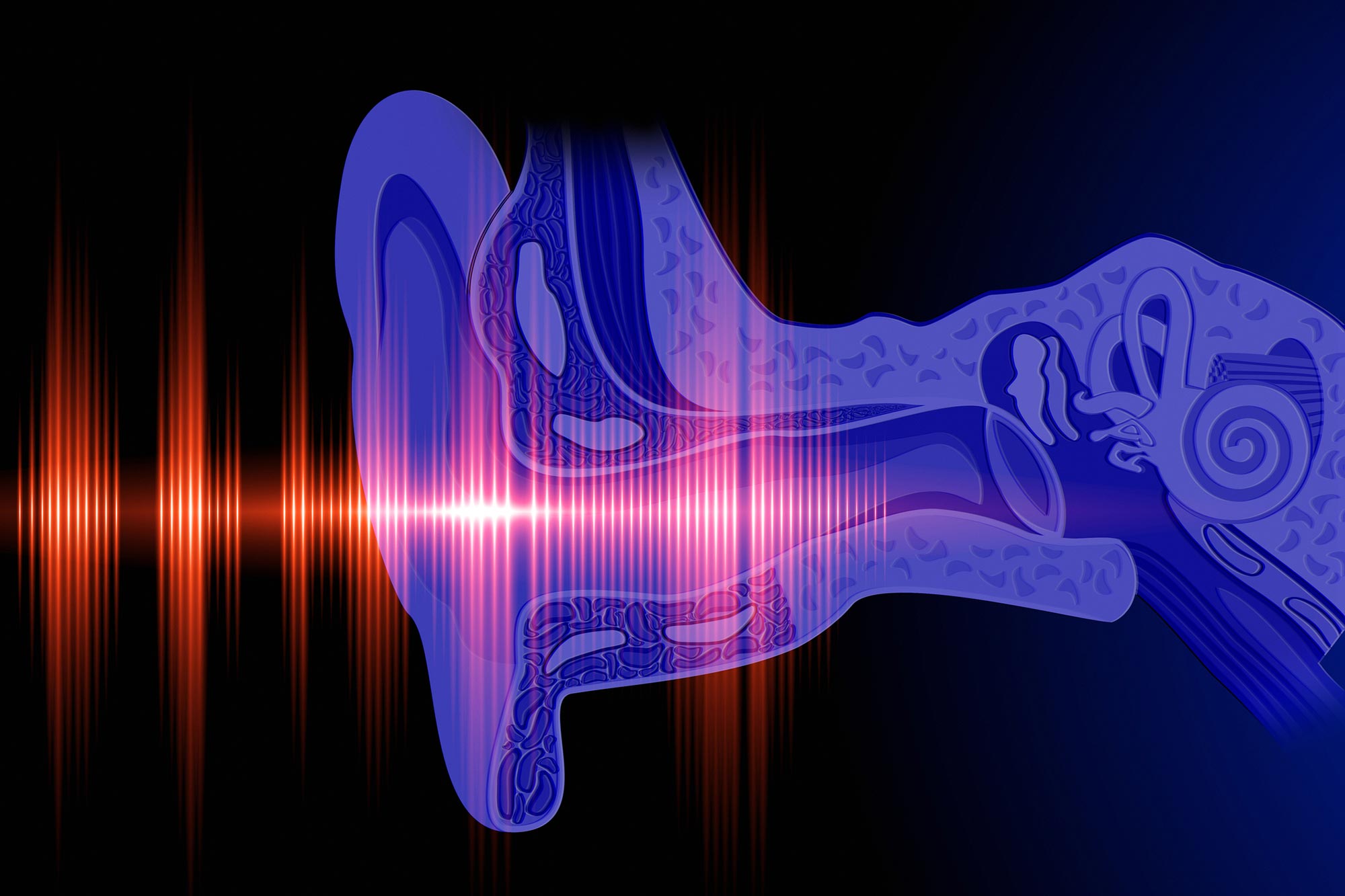
Squid have hundreds more sensory cells than scientists realized, with hair bundles that may help explain how human hearing works and breaks down.
Water flowing over a squid’s head and arms brushes tiny past bundles of hair-like projections that help the animal sense movement around it. Scientists have known about these sensory structures for years, but they had only a partial picture of how widely this equipment was spread across the squid’s body.
Brian McDermott and his colleagues at Case Western Reserve University have now found hundreds more of the cells carrying these bundles, extending across the animal’s entire surface. Their research, published in Current Biology, includes the first complete map of squid lateral lines, arrays of sensory cells known as hair cells. The newly revealed network could give researchers another way to investigate the delicate structures that make human hearing possible.
Hearing depends on delicate hair bundles
Inside a human ear, sound vibrations reach the cochlea, a snail-shaped organ lined with thousands of hair cells. Each cell carries a bundle of tiny projections called stereocilia, which move in response to those vibrations. The cells send signals through the nervous system to the brain, where that movement becomes meaningful sound.
“Often, when a child is born deaf or a hearing person loses their hearing, it is the hair bundle that has been damaged,” said McDermott, an associate professor at the Case Western Reserve School of Medicine. “So, studying the squid’s hair bundle holds promise for understanding how hearing loss occurs.”
Laser light reveals squid’s hidden sensors
McDermott’s team, which included graduate and undergraduate students, conducted part of the research at the Marine Biological Laboratory in Woods Hole, Massachusetts, through a three-year fellowship program focused on how squid hear. Working with them was Carsten Wolff, the laboratory’s associate director of Imaging Service and Imaging Scholar.
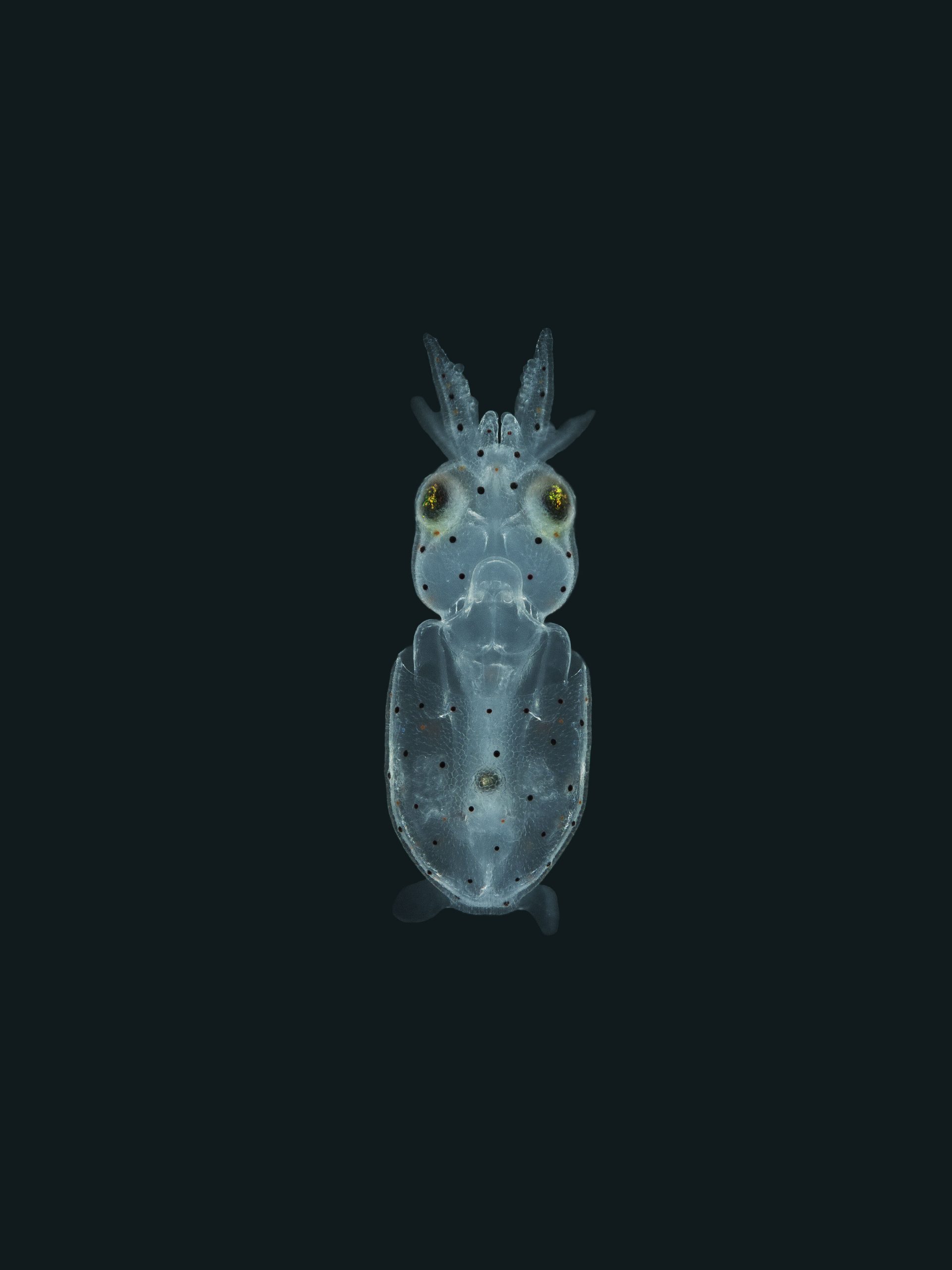
A thin sheet of laser light illuminated the squid tissue one plane at a time, allowing the researchers to assemble detailed, three-dimensional images while minimizing tissue damage. This technique, called light sheet microscopy, brought the previously unknown hair cells into view and allowed the team to trace the sensory network across the body.
“Squid are cephalopods with a diverse population of hair cells on the surface of their bodies, which may yield insights not only into how these fascinating animals detect water movement to survive, but also into how hearing and deafness occur in humans,” McDermott said.
Squid skin may work like an ear
The squid’s hair bundles also varied in length, a finding that strengthens the comparison with human hearing. In the human cochlea, taller bundles occur where low pitches are detected, while shorter bundles occur where high pitches are detected. Those differences help tune the cells to particular sound frequencies.
Fish lateral lines have hair bundles that do not vary in length, according to the researchers, making the squid’s varying bundles a potentially useful distinction. McDermott’s team interprets that variation as a sign that squid may regulate bundle length to detect different frequencies of water movement, much as human hair cells respond to different pitches. In that sense, the researchers suggest, a squid’s skin may function something like an ear.
The tiny bundles brushed by water across a squid’s body could therefore offer more than clues to how it senses its surroundings. They give researchers a newly mapped place to investigate how fragile sensory structures work, and how damage to their counterparts deep inside our ears can take sound away.
Reference: “An anatomical map of squid lateral lines” by Haoming Wang, Carsten Wolff, Nicolas Pintozzi, Anna-Maria Petriv and Brian M. McDermott, , Current Biology.
DOI: 10.1016/j.cub.2026.07.056
This work was supported by an MBL Whitman Fellowship (BM) and additional support from the CWRU Tissue Resources Core Facility, CWRU SOM Light Microscopy Core Facility, SCSAM Center, and NIH Grant S10-OD024996.
Never miss a breakthrough: Join the SciTechDaily newsletter.
Follow us on Google and Google News.