
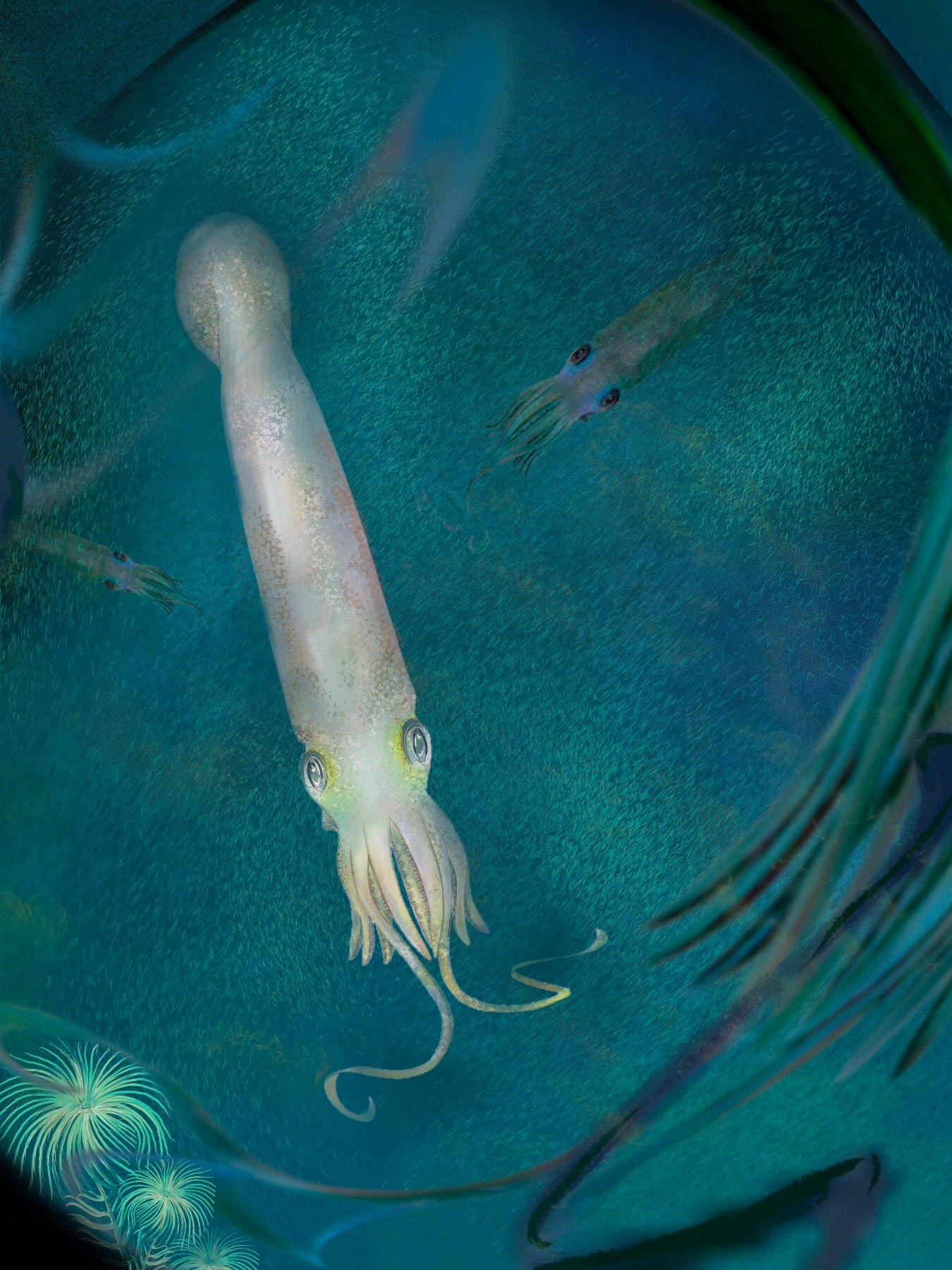
Description of exceptionally preserved fossil pushes back age of Vampyropoda by nearly 82 million years.
New research led by scientists at the American Museum of Natural History and Yale shows that the oldest ancestors of the group of animals that includes octopuses and vampire squids had not eight but 10 arms. The study, which describes a new species of vampyropod based on a 328-million-year-old fossil that had not been previously described, pushes back the age of the group by nearly 82 million years. The details were published on March 8, 2022, in the journal Nature Communications.
“This is the first and only known vampyropod to possess 10 functional appendages,” said lead author Christopher Whalen, a postdoctoral researcher in the Museum’s Division of Paleontology and a National Science Foundation postdoctoral fellow in Yale’s Department of Earth & Planetary Sciences.
Vampyropods are soft-bodied cephalopods typically characterized by eight arms and an internalized chitinous shell or fin supports. Because they lack hard structures, Vampyropoda are not well represented in the fossil record. The new study is based on an exceptionally well-preserved vampyropod fossil from the collections of the Royal Ontario Museum (ROM). Originally discovered in what is now Montana and donated to ROM in 1988.
A New Genus and Species: Syllipsimopodi bideni
Whalen and coauthor Neil Landman, a curator emeritus in the Museum’s Division of Paleontology, identified the fossil specimen as a completely new genus and species that dates to about 328 million years old, making it the oldest known vampyropod and extending the fossil record of the group by about 82 million years. In the new study, they also describe its 10 arms—all with preserved suckers—corroborating previous scientific arguments that the common ancestor of vampyropods had 10 arms as well.
“The arm count is one of the defining characteristics separating the 10-armed squid and cuttlefish line (Decabrachia) from the eight-armed octopus and vampire squid line (Vampyropoda). We have long understood that octopuses achieve the eight-arm count through elimination of the two filaments of vampire squid, and that these filaments are vestigial arms,” said Whalen. “However, all previously reported fossil vampyropods preserving the appendages only have 8 arms, so this fossil is arguably the first confirmation of the idea that all cephalopods ancestrally possessed ten arms.”
Two of the cephalopod’s arms appear to have been elongated relative to the other eight arms, and its torpedo-shaped body is reminiscent of today’s squids. The fossil was given the name Syllipsimopodi bideni. The genus name is derived from the Greek word “syllípsimos” for “prehensile” and “pódi” for “foot”—because this is the oldest known cephalopod to develop suckers, allowing the arms, which are modifications of the molluscan foot, to better grasp prey and other objects. The species name is to honor the recently inaugurated (at the time of paper submission) 46th President of the United States, Joseph R. Biden.
Syllipsimopodi’s Ecological Niche
“Syllipsimopodi may have filled a niche more similar to extant squids, a midlevel aquatic predator,” said Landman. “It is not inconceivable that it might have used its sucker-laden arms to pry small ammonoids out of their shells or ventured more inshore to prey on brachiopods, bivalves, or other shelled marine animals.”
Based on the age, characters, and phylogenetic position, the fossil challenges the predominant arguments for vampyropod origins, and the authors propose a new model for coleoid (internally shelled cephalopod) evolution.
For more on this discovery, see New Species of Extinct Vampire-Squid-Like Cephalopod With 10 Arms Named After Biden.
Reference: “Fossil coleoid cephalopod from the Mississippian Bear Gulch Lagerstätte sheds light on early vampyropod evolution” by Christopher D. Whalen and Neil H. Landman, 8 March 2022, Nature Communications.
DOI: 10.1038/s41467-022-28333-5
This study was supported in part by the U.S. National Science Foundation Postdoctoral Fellowship in Biology Program (#2010822) and the Paleontological Society Student Research Grants Elis L. Yochelson Award.
Never miss a breakthrough: Join the SciTechDaily newsletter.
Follow us on Google and Google News.