
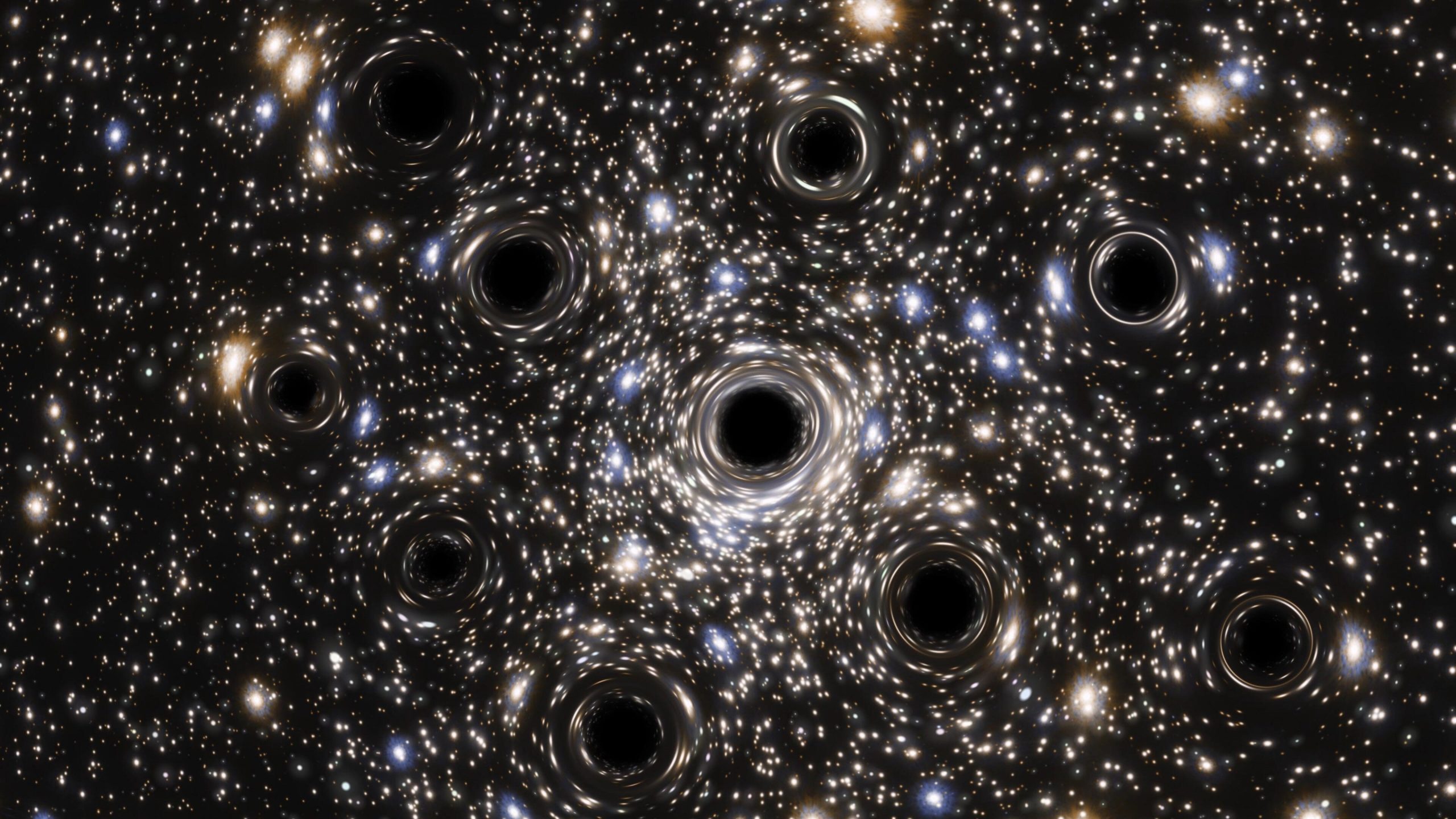
A dense core of black holes in Palomar 5 may explain its tidal stream and structure, helping scientists understand how star clusters dissolve and contribute to galaxy formation.
Palomar 5 is a unique star cluster. This is first because it is one of the “fluffiest” clusters in the halo of our Galaxy, with the average distance between the stars being a few light-years, comparable to the distance from the Sun to the nearest star. Secondly, it has a specular stellar stream associated with it that spans more than 20 degrees across the sky. In a paper published on July 5, 2021, in Nature Astronomy, an international team of astronomers and astrophysicists led by the University of Barcelona show that both distinguishing features of Palomar 5 are likely the result of an oversized black hole population of more than 100 black holes in the center of the cluster.
“The number of black holes is roughly three times larger than expected from the number of stars in the cluster, and it means that more than 20% of the total cluster mass is made up of black holes. They each have a mass of about 20 times the mass of the Sun, and they formed in supernova explosions at the end of the lives of massive stars, when the cluster was still very young,” says Prof Mark Gieles, from the Institute of Cosmos Sciences of the University of Barcelona (ICCUB) and lead author of the paper.
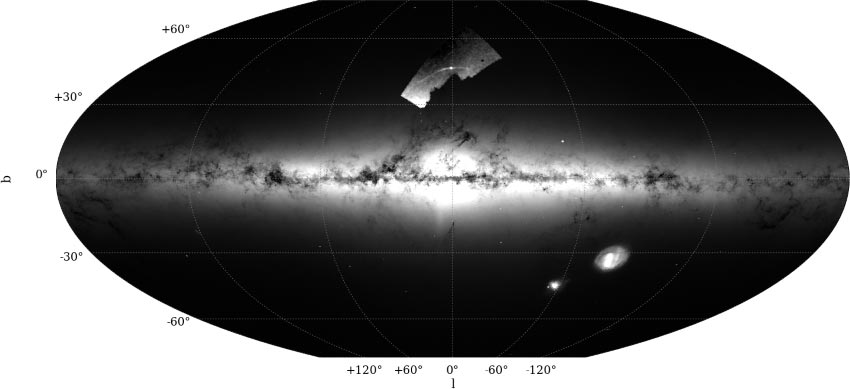
Stellar Streams and the Galactic Halo Mystery
Tidal streams are streams of stars that were ejected from disrupting star clusters or dwarf galaxies. In the last few years, nearly thirty thin streams have been discovered in the Milky Way halo. “We do not know how these streams form, but one idea is that they are disrupted star clusters. However, none of the recently discovered streams have a star cluster associated with them, hence we can not be sure. So, to understand how these streams formed, we need to study one with a stellar system associated with it. Palomar 5 is the only case, making it a Rosetta Stone for understanding stream formation and that is why we studied it in detail,” explains Gieles.
The authors simulate the orbits and the evolution of each star from the formation of the cluster until the final dissolution. They varied the initial properties of the cluster until a good match with observations of the stream and the cluster was found. The team finds that Palomar 5 formed with a lower black hole fraction, but stars escaped more efficiently than black holes, such that the black hole fraction gradually increased. The black holes dynamically puffed up the cluster in gravitational slingshot interactions with stars, which led to even more escaping stars and the formation of the stream. Just before it completely dissolves — roughly a billion years from now — the cluster will consist entirely of black holes.

Gieles points out that in this paper “we have shown that the presence of a large black hole population may have been common in all the clusters that formed the streams.” This is important for our understanding of globular cluster formation, the initial masses of stars, and the evolution of massive stars. This work also has important implications for gravitational waves.
Simulation showing the formation of the tidal streams of the Palomar 5 cluster and the distribution of black holes. The stars are shown in yellow and the black holes in black.
Palomar 5 is a globular cluster discovered in 1950 by Walter Baade. It is in the Serpens constellation at a distance of about 65,000 light-years, and it is one of the roughly 150 globular clusters that orbit around the Milky Way. It is older than 10 billion years, like most other globular clusters, meaning that it formed in the earliest phases of galaxy formation. It is about 10 times less massive and 5 times more extended than a typical globular cluster and in the final stages of dissolution.
Reference: “A supra-massive population of stellar-mass black holes in the globular cluster Palomar 5” by Mark Gieles, Denis Erkal, Fabio Antonini, Eduardo Balbinot and Jorge Peñarrubia, 5 July 2021, Nature Astronomy.
DOI: 10.1038/s41550-021-01392-2
Never miss a breakthrough: Join the SciTechDaily newsletter.
Follow us on Google and Google News.
9 Comments
that is sooooo crazy
that is crazy
Whenever I see “The authors simulate” i don’t like to see them claiming discoveries as if they were facts. Of course there are simulations with more or less certainty, but I think it undermines science because it leaves less room or incentive to try to disprove the theory and they just go along with it, I think “the” scientific method is rarely applied really, the state of science is approaching a new level, garbage.
Tested discoveries *are* facts, despite your personal opinion.
We all know this has expanded science, so your opinion fails that test as well. What approaches garbage is voiced opinions among pop science readers, who may find science interesting but do not try to understand what it is and how it changes. For instance, forget simulations – ai is coming strong in all science fields and are perhaps even “fluffier” but also much more powerful.
It will likely be like how pop science comments mostly forgot to beef about black holes (which we now have images of shadows of) when dark matter and dark energy cane along and made cosmology a precision science (<~ 1 % uncertainty overall, and decreasing). They will forget their beef with simulations and cry "skynet & cgi" when ai takes over science.
And the rest of us will shrug our shoulders and read science for understanding.
High school thank-you. Of 😳earthnspace science 70s better video today 😊 🙏 thankyou.👽
…a black hole is just the remainder of a used roll of toilet paper…..
Star streams are fascinating – more so, if they depend on BH populations.
Preprint here: https://arxiv.org/pdf/2102.11348.pdf .
The abstract has the pity kernel:
“Initially denser clusters end up with lower black hole fractions, smaller sizes, and no observable tails. Black hole-dominated, extended star clusters are therefore the likely progenitors of the recently discovered thin stellar streams in the Galactic halo.”
The conclusion nevertheless ends with that more tests can be done:
“A multi-epoch observing campaign to obtain line-ofsight velocities is therefore needed to establish with high precision the central velocity dispersion and the properties of the binaries (see Methods for details). This would provide the critical test of the hypothesis that Pal 5 hosts >~ 2 × 10^3 M_Sun population of stellar-mass BH.”
Tidbits:
“About 10% of the Milky Way GCs have Reff & 10 pc,” i.e. are fluffy.
“[An quantitative estimate] supports the idea that the ∼ 30 known cold streams in the halo resulted from BH-rich, extended GCs that dissolved in the Milky Way halo.”
I don’t understand why anyone continues to use the phrase “10 times less” when what they really mean is 1/10th. Ten times less is one of the purest oxymorons found in science.
Those who shrink away from the truth and facts, avoid them. Avoid them like the plague. Lack of wisdom cannot suppress the truth from the Sun,
Moon and Dielectric Field. -\ Your* Welcome *(the welcome is yours’)