
NASA’s TESS mission discovered three large exoplanets orbiting a young, nearby star, offering valuable insight into the evolution of planetary atmospheres and early star systems.
Using observations from NASA’s Transiting Exoplanet Survey Satellite (TESS), an international team of astronomers has discovered a trio of hot worlds larger than Earth orbiting a much younger version of our Sun called TOI 451. The system resides in the recently discovered Pisces-Eridanus stream, a collection of stars less than 3% the age of our solar system that stretches across one-third of the sky.
The exoplanets were discovered in TESS images taken between October and December 2018. Follow-up studies of TOI 451 and its planets included observations made in 2019 and 2020 using NASA’s Spitzer Space Telescope, which has since been retired, as well as many ground-based facilities. Archival infrared data from NASA’s Near-Earth Object Wide-Field Infrared Survey Explorer (NEOWISE) satellite – collected between 2009 and 2011 under its previous moniker, WISE – suggests the system retains a cool disk of dust and rocky debris. Other observations show that TOI 451 likely has two distant stellar companions circling each other far beyond the planets.
A Young, Nearby Planetary System
“This system checks a lot of boxes for astronomers,” said Elisabeth Newton, an assistant professor of physics and astronomy at Dartmouth College in Hanover, New Hampshire, who led the research. “It’s only 120 million years old and just 400 light-years away, allowing detailed observations of this young planetary system. And because there are three planets between two and four times Earth’s size, they make especially promising targets for testing theories about how planetary atmospheres evolve.”
A paper reporting the findings was published on January 14, 2021, in The Astronomical Journal.
Stellar streams form when the gravity of our Milky Way galaxy tears apart star clusters or dwarf galaxies. The individual stars move out along the cluster’s original orbit, forming an elongated group that gradually disperses.
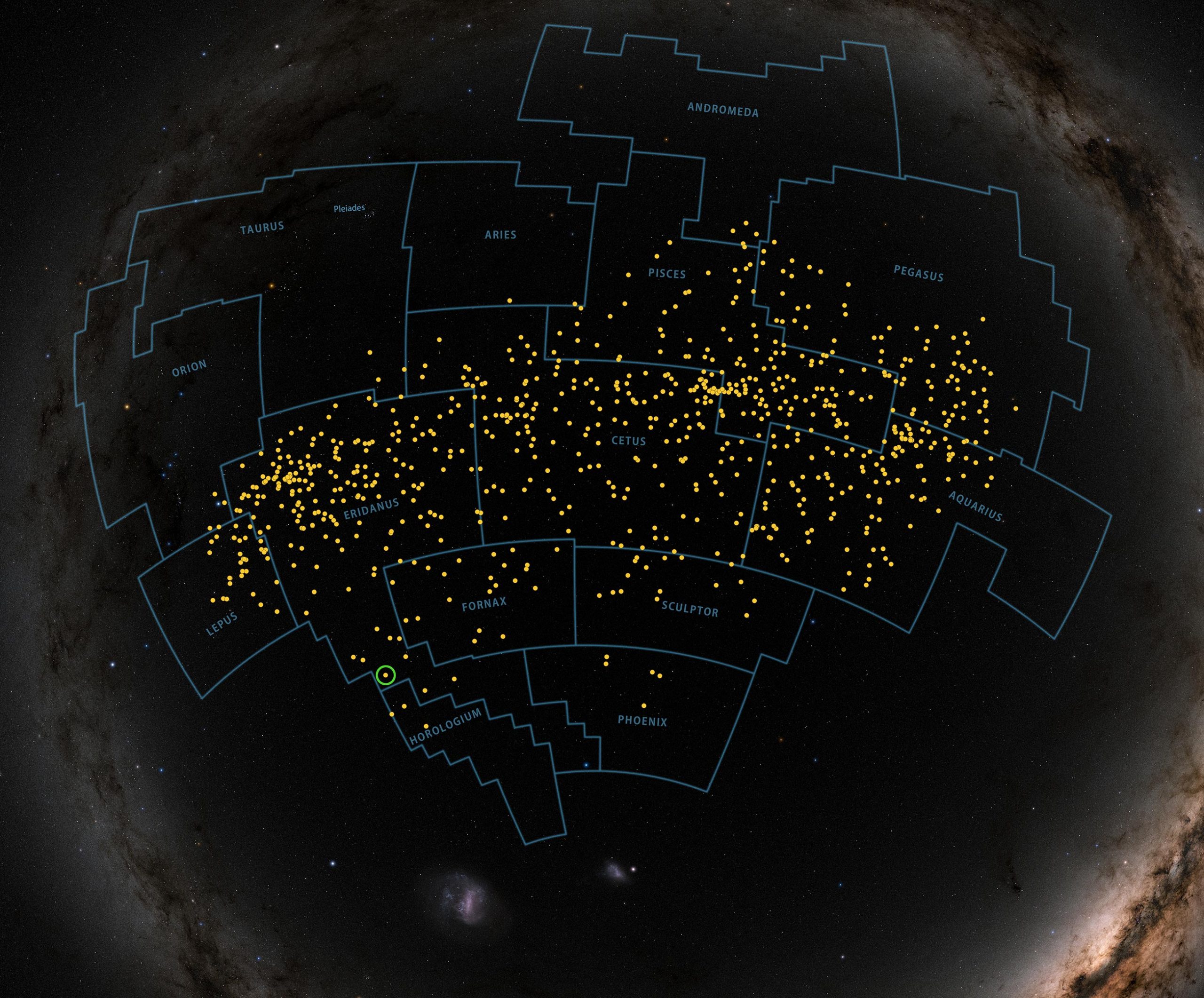
In 2019, a team led by Stefan Meingast at the University of Vienna used data from the European Space Agency’s Gaia mission to discover the Pisces-Eridanus stream, named for the constellations containing the greatest concentrations of stars. Stretching across 14 constellations, the stream is about 1,300 light-years long. However, the age initially determined for the stream was much older than we now think.
Later in 2019, researchers led by Jason Curtis at Columbia University in New York City analyzed TESS data for dozens of stream members. Younger stars spin faster than their older counterparts do, and they also tend to have prominent starspots – darker, cooler regions like sunspots. As these spots rotate in and out of our view, they can produce slight variations in a star’s brightness that TESS can measure.
The TESS measurements revealed overwhelming evidence of starspots and rapid rotation among the stream’s stars. Based on this result, Curtis and his colleagues found that the stream was only 120 million years old – similar to the famous Pleiades cluster and eight times younger than previous estimates. The mass, youth, and proximity of the Pisces-Eridanus stream make it an exciting fundamental laboratory for studying star and planet formation and evolution.
“Thanks to TESS’s nearly all-sky coverage, measurements that could support a search for planets orbiting members of this stream were already available to us when the stream was identified,” said Jessie Christiansen, a co-author of the paper and the deputy science lead at the NASA Exoplanet Archive, a facility for researching worlds beyond our solar system managed by Caltech in Pasadena, California. “TESS data will continue to allow us to push the limits of what we know about exoplanets and their systems for years to come.”
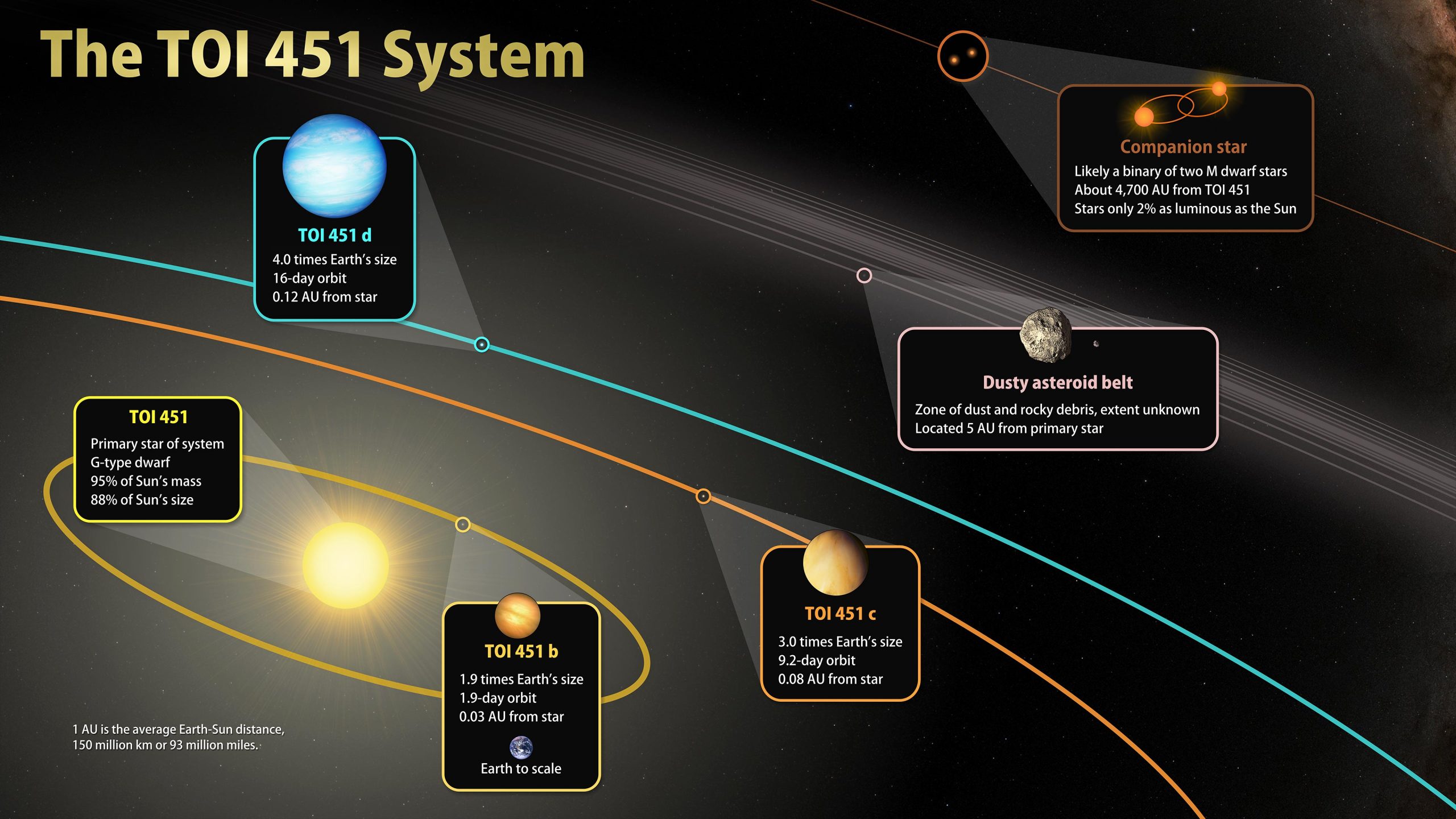
The young star TOI 451, better known to astronomers as CD-38 1467, lies about 400 light-years away in the constellation Eridanus. It has 95% of our Sun’s mass, but it is 12% smaller, slightly cooler, and emits 35% less energy. TOI 451 rotates every 5.1 days, which is more than five times faster than the Sun.
TESS spots new worlds by looking for transits, the slight, regular dimmings that occur when a planet passes in front of its star from our perspective. Transits from all three planets are evident in the TESS data. Newton’s team obtained measurements from Spitzer that supported the TESS findings and helped to rule out possible alternative explanations. Additional follow-up observations came from Las Cumbres Observatory – a global telescope network headquartered in Goleta, California – and the Perth Exoplanet Survey Telescope in Australia.
Evidence for a Debris Disk and Stellar Companions
Even TOI 451’s most distant planet orbits three times closer than Mercury ever approaches to the Sun, so all of these worlds are quite hot and inhospitable to life as we know it. Temperature estimates range from about 2,200 degrees Fahrenheit (1,200 degrees Celsius) for the innermost planet to about 840 F (450 C) for the outermost one.
TOI 451 b orbits every 1.9 days, is about 1.9 times Earth’s size, and its estimated mass ranges from two to 12 times Earth’s. The next planet out, TOI 451 c, completes an orbit every 9.2 days, is about three times larger than Earth, and holds between three and 16 times Earth’s mass. The farthest and largest world, TOI 451 d, circles the star every 16 days, is four times the size of our planet, and weighs between four and 19 Earth masses.
Astronomers expect planets as big as these to retain much of their atmospheres despite the intense heat from their nearby star. Different theories of how atmospheres evolve by the time a planetary system reaches TOI 451’s age predict a wide range of properties. Observing starlight passing through the atmospheres of these planets provides an opportunity to study this phase of development and could aid in constraining current models.
“By measuring starlight penetrating a planet’s atmosphere at different wavelengths, we can infer its chemical composition and the presence of clouds or high-altitude hazes,” said Elisa Quintana, an astrophysicist at NASA’s Goddard Space Flight Center in Greenbelt, Maryland. “TOI 451’s planets offer excellent targets for such studies with Hubble and the upcoming James Webb Space Telescope.”
Evidence for a Debris Disk and Stellar Companions
Observations from WISE show that the system is unusually bright in infrared light, which is invisible to human eyes, at wavelengths of 12 and 24 micrometers. This suggests the presence of a debris disk, where rocky asteroid-like bodies collide and grind themselves to dust. While Newton and her team cannot determine the extent of the disk, they envision it as a diffuse ring of rock and dust centered about as far from the star as Jupiter is from our Sun.
The researchers also investigated a faint neighboring star that appears about two pixels away from TOI 451 in TESS images. Based on Gaia data, Newton’s team determined this star to be a gravitationally bound companion located so far from TOI 451 that its light takes 27 days to get there. In fact, the researchers think the companion is likely a binary system of two M-type dwarf stars, each with about 45% of the Sun’s mass and emitting only 2% of its energy.
Reference: “TESS Hunt for Young and Maturing Exoplanets (THYME). IV. Three Small Planets Orbiting a 120 Myr Old Star in the Pisces–Eridanus Stream” by Elisabeth R. Newton, Andrew W. Mann, Adam L. Kraus, John H. Livingston, Andrew Vanderburg, Jason L. Curtis, Pa Chia Thao, Keith Hawkins, Mackenna L. Wood, Aaron C. Rizzuto, Abderahmane Soubkiou, Benjamin M. Tofflemire, George Zhou, Ian J. M. Crossfield, Logan A. Pearce, Karen A. Collins, Dennis M. Conti, Thiam-Guan Tan, Steven Villeneuva, Alton Spencer, Diana Dragomir, Samuel N. Quinn, Eric L. N. Jensen, Kevin I. Collins, Chris Stockdale, Ryan Cloutier, Coel Hellier, Zouhair Benkhaldoun, Carl Ziegler, César Briceño, Nicholas Law, Björn Benneke, Jessie L. Christiansen, Varoujan Gorjian, Stephen R. Kane, Laura Kreidberg, Farisa Y. Morales, Michael W Werner, Joseph D. Twicken, Alan M. Levine, David R. Ciardi, Natalia M. Guerrero, Katharine Hesse, Elisa V. Quintana, Bernie Shiao, Jeffrey C. Smith, Guillermo Torres, George R. Ricker, Roland Vanderspek, Sara Seager, Joshua N. Winn, Jon M. Jenkins and David W. Latham, 14 January 2021, The Astronomical Journal.
DOI: 10.3847/1538-3881/abccc6
TESS is a NASA Astrophysics Explorer mission led and operated by MIT in Cambridge, Massachusetts, and managed by NASA’s Goddard Space Flight Center. Additional partners include Northrop Grumman, based in Falls Church, Virginia; NASA’s Ames Research Center in California’s Silicon Valley; the Center for Astrophysics | Harvard & Smithsonian in Cambridge, Massachusetts; MIT’s Lincoln Laboratory; and the Space Telescope Science Institute in Baltimore. More than a dozen universities, research institutes, and observatories worldwide are participants in the mission.
NASA’s Jet Propulsion Laboratory in Southern California manages NEOWISE for NASA’s Science Mission Directorate in Washington. Ball Aerospace & Technologies Corp. of Boulder, Colorado, built the spacecraft. Science data processing takes place at IPAC at Caltech in Pasadena. Caltech manages JPL for NASA.
Never miss a breakthrough: Join the SciTechDaily newsletter.
Follow us on Google and Google News.