
Close Menu
    Facebook X (Twitter) Instagram
    SciTechDaily
    • Biology
    • Chemistry
    • Earth
    • Health
    • Physics
    • Science
    • Space
    • Technology
    Facebook X (Twitter) Pinterest YouTube RSS
    SciTechDaily
    Home»Space»See the Dramatic First Images NASA’s Juno Spacecraft Captured As It Sailed by the Icy Orb, Ganymede
    Space

    See the Dramatic First Images NASA’s Juno Spacecraft Captured As It Sailed by the Icy Orb, Ganymede

    By Jet Propulsion LaboratoryJune 9, 2021No Comments3 Mins Read
    Facebook Twitter Pinterest Telegram LinkedIn WhatsApp Email Reddit
    Share
    Facebook Twitter LinkedIn Pinterest Telegram Email Reddit
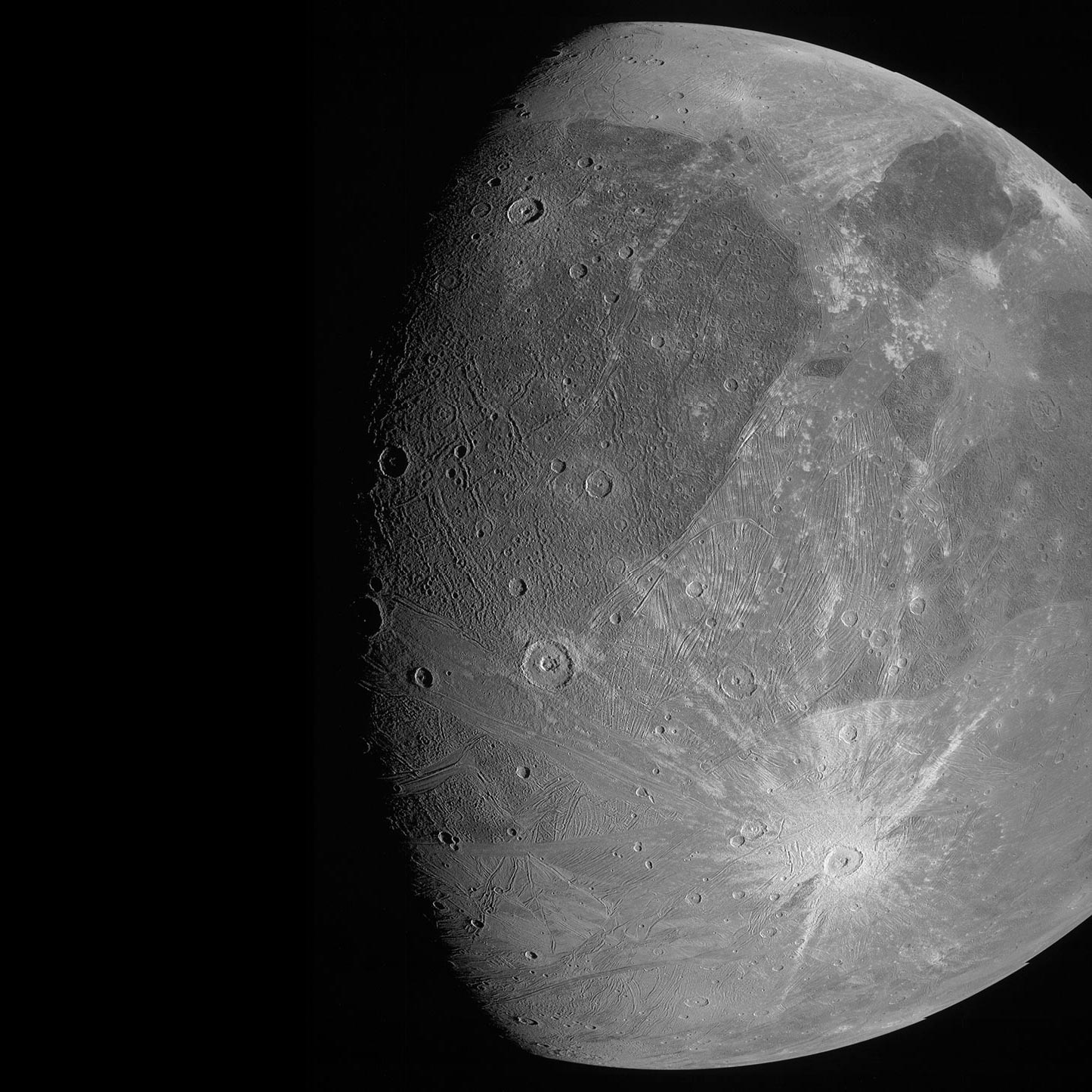
    Ganymede JunoCam Imager June 2021
    This image of Ganymede was obtained by the JunoCam imager during Juno’s June 7, 2021, flyby of the icy moon. Credit: NASA/JPL-Caltech/SwRI/MSSS

    The spacecraft flew closer to Jupiter’s largest moon than any other in more than two decades, offering dramatic glimpses of the icy orb.

    The first two images from NASA Juno’s June 7, 2021, flyby of Jupiter’s giant moon Ganymede have been received on Earth. The photos – one from the Jupiter orbiter’s JunoCam imager and the other from its Stellar Reference Unit star camera – show the surface in remarkable detail, including craters, clearly distinct dark and bright terrain, and long structural features possibly linked to tectonic faults.

    “This is the closest any spacecraft has come to this mammoth moon in a generation,” said Juno Principal Investigator Scott Bolton of the Southwest Research Institute in San Antonio. “We are going to take our time before we draw any scientific conclusions, but until then we can simply marvel at this celestial wonder.”

    Using its green filter, the spacecraft’s JunoCam visible-light imager captured almost an entire side of the water-ice-encrusted moon. Later, when versions of the same image come down incorporating the camera’s red and blue filters, imaging experts will be able to provide a color portrait of Ganymede. Image resolution is about 0.6 miles (1 kilometer) per pixel.

    In addition, Juno’s Stellar Reference Unit, a navigation camera that keeps the spacecraft on course, provided a black-and-white picture of Ganymede’s dark side (the side opposite the Sun) bathed in dim light scattered off Jupiter. Image resolution is between 0.37 to 0.56 miles (600 to 900 meters) per pixel.
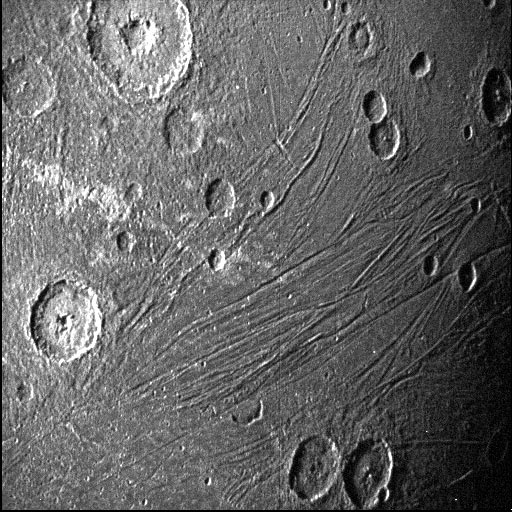
    Dark Side of Ganymede
    This image of the dark side of Ganymede was obtained by Juno’s Stellar Reference Unit navigation camera during its June 7, 2021, flyby of the moon. Credit: NASA/JPL-Caltech/SwRI

    “The conditions in which we collected the dark side image of Ganymede were ideal for a low-light camera like our Stellar Reference Unit,” said Heidi Becker, Juno’s radiation monitoring lead at JPL. “So this is a different part of the surface than seen by JunoCam in direct sunlight. It will be fun to see what the two teams can piece together.”

    The spacecraft will send more images from its Ganymede flyby in the coming days, with JunoCam’s raw images being made available here.

    The solar-powered spacecraft’s encounter with the Jovian moon is expected to yield insights into its composition, ionosphere, magnetosphere, and ice shell while also providing measurements of the radiation environment that will benefit future missions to the Jovian system.

    More About the Mission

    JPL, a division of Caltech in Pasadena, California, manages the Juno mission for the principal investigator, Scott J. Bolton, of the Southwest Research Institute in San Antonio. Juno is part of NASA’s New Frontiers Program, which is managed at NASA’s Marshall Space Flight Center in Huntsville, Alabama, for the agency’s Science Mission Directorate in Washington. Lockheed Martin Space in Denver built and operates the spacecraft.

    Never miss a breakthrough: Join the SciTechDaily newsletter.
    Follow us on Google and Google News.

    Ganymede JPL Jupiter Moons NASA Popular
    Share. Facebook Twitter Pinterest LinkedIn Email Reddit

    Related Articles

    NASA’s Juno Spacecraft Captures Stunning View of Jupiter’s Moons Io and Europa – And a Crater on Ganymede

    NASA’s Juno Spacecraft “Hears” Jupiter’s Moon Ganymede – Listen to the Dramatic Flyby of the Icy Orb

    NASA’s Juno Celebrates 10 Years With New Infrared View of Mammoth Jovian Moon Ganymede

    Hubble Finds First Evidence of Water Vapor in the Atmosphere of Jupiter’s Moon Ganymede

    Hear the Eerie Radio Emissions NASA’s Juno Spacecraft Recorded From Jupiter and Its Moon Io

    “Beautiful!” – Ride With NASA’s Juno Spacecraft As It Flies Past the Solar System’s Biggest Moon and Jupiter

    Close Encounters of the Jovian Kind: NASA’s Juno to Get a Close Look at Jupiter’s Moon Ganymede

    Jupiter’s Moon Europa May Have an Interior Hot Enough to Fuel Seafloor Volcanoes

    Jupiter’s Icy Moon Europa Glows in the Dark

    Leave A Reply Cancel Reply

    • Facebook
    • Twitter
    • Pinterest
    • YouTube

    Don't Miss a Discovery

    Subscribe for the Latest in Science & Tech!

    Trending News

    First-of-Its-Kind Discovery: Homer’s Iliad Found Embedded in a 1,600-Year-Old Egyptian Mummy

    Beyond Inflammation: Scientists Uncover New Cause of Persistent Rheumatoid Arthritis

    A Simple Molecule Could Unlock Safer, Easier Weight Loss

    Scientists Just Built a Quantum Battery That Charges Almost Instantly

    Researchers Unveil Groundbreaking Sustainable Solution to Vitamin B12 Deficiency

    Millions of People Have Osteopenia Without Realizing It – Here’s What You Need To Know

    Researchers Discover Boosting a Single Protein Helps the Brain Fight Alzheimer’s

    World-First Study Reveals Human Hearts Can Regenerate After a Heart Attack

    Follow SciTechDaily
    • Facebook
    • Twitter
    • YouTube
    • Pinterest
    • Newsletter
    • RSS
    SciTech News
    • Biology News
    • Chemistry News
    • Earth News
    • Health News
    • Physics News
    • Science News
    • Space News
    • Technology News
    Recent Posts
    • After Decades, MIT Researchers Capture the First 3D Atomic View of a Mysterious Material
    • Your Favorite Fishing Spot Is Turning Brown – and the Fish Are Changing
    • 380-Million-Year-Old Fish Fossil Reveals Secrets of Life’s First Steps Onto Land
    • Mezcal “Worm” in a Bottle Mystery: DNA Testing Reveals a Surprise
    • Scientists Turn Red Lettuce Green, Unlocking Hidden Nutrients
    Copyright © 1998 - 2026 SciTechDaily. All Rights Reserved.
    • Science News
    • About
    • Contact
    • Editorial Board
    • Privacy Policy
    • Terms of Use

    Type above and press Enter to search. Press Esc to cancel.