

ESA’s Cheops spotted a rare transit of planet d around Nu2 Lupi, revealing a water-rich, mild-temperature world perfect for detailed atmospheric studies.
While exploring two exoplanets in a bright nearby star system, ESA’s exoplanet-hunting Cheops satellite has unexpectedly spotted the system’s third known planet crossing the face of the star. This transit reveals exciting details about a rare planet “with no known equivalent,” say the researchers.
The discovery is one of the first results from ESA’s Cheops (CHaracterising ExOPlanet Satellite), and the first time an exoplanet with a period of over 100 days has been spotted transiting a star that is bright enough to be visible to the naked eye.
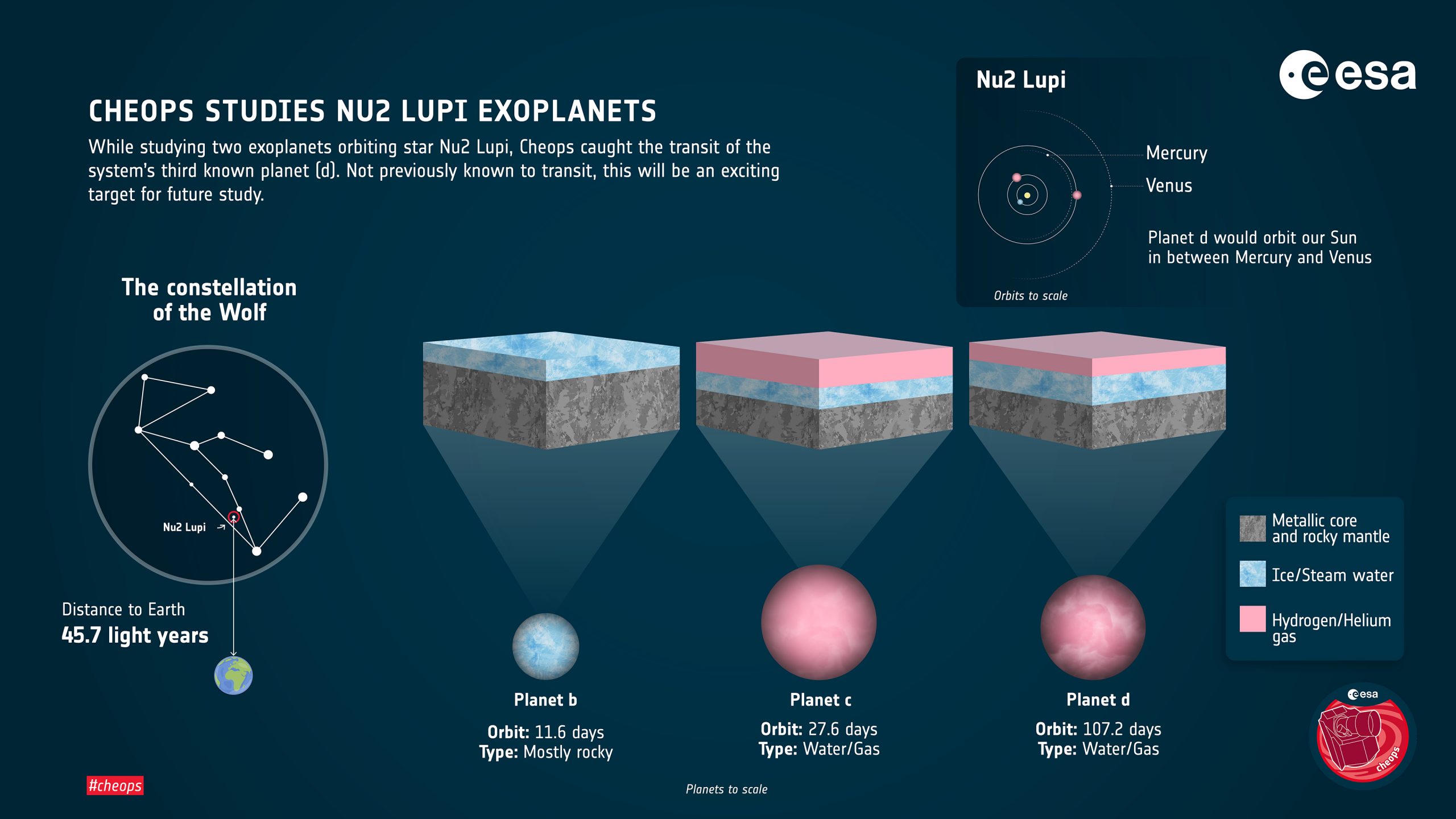
Named Nu2 Lupi, this bright, Sun-like star is located just under 50 light-years away from Earth in the constellation of Lupus (the Wolf). In 2019, the High Accuracy Radial velocity Planet Searcher (HARPS) at the ESO 3.6-meter telescope in Chile discovered three exoplanets (named ‘b’, ‘c’ and ‘d’, with the star deemed to be object ‘A’) in the system, with masses between those of Earth and Neptune and orbits lasting 11.6, 27.6 and 107.6 days. The innermost two of these planets – b and c – were subsequently found to transit Nu2 Lupi by NASA’s Transiting Exoplanet Survey Satellite (TESS), making it one of only three naked-eye stars known to host multiple transiting planets.

“Transiting systems such as Nu2 Lupi are of paramount importance in our understanding of how planets form and evolve, as we can compare several planets around the same bright star in detail,” says Laetitia Delrez of the University of Liège, Belgium, and lead author of the new finding.
“We set out to build on previous studies of Nu2 Lupi and observe planets b and c crossing the face of Nu2 Lupi with Cheops, but during a transit of planet c we spotted something amazing: an unexpected transit by planet ‘d’, which lies further out in the system.”
Planetary transits create a valuable opportunity to study a planet’s atmosphere, orbit, size, and interior. A transiting planet blocks a tiny but detectable proportion of its star’s light as it crosses in front of its star – and it was this drop in light that led Laetitia and colleagues to their discovery. As long-period exoplanets orbit so far from their stars, the chances of seeing one during a transit are incredibly low, making Cheops’ finding a real surprise.
Using the high-precision capabilities of Cheops, planet d was found to be about 2.5 times the radius of Earth, confirmed to take just over 107 days to loop once around its star and, using archival observations from ground-based telescopes, found to have a mass of 8.8 times that of Earth.
A Golden Target for Future Exploration
“The amount of stellar radiation reaching planet d is also mild in comparison to many other discovered exoplanets; in our Solar System, Nu2 Lupi d would orbit between Mercury and Venus,” adds co-author David Ehrenreich of the University of Geneva, Switzerland. “Combined with its bright parent star, long orbital period, and suitability for follow-up characterization, this makes planet d hugely exciting – it is an exceptional object with no known equivalent, and sure to be a golden target for future study.”
Most long-period transiting exoplanets discovered to date have been found around stars that are too faint to allow detailed follow-up observations, meaning that little is known about their planets’ properties. Nu2 Lupi, however, is bright enough to be an attractive target for other powerful telescopes based in space — such as the NASA/ESA Hubble Space Telescope or forthcoming NASA/ESA/CSA James Webb Space Telescope — or large observatories on the ground.
“Given its overall properties and orbit, this makes planet d a uniquely favorable target for studying an exoplanet with a mild-temperature atmosphere around a star similar to the Sun,” says Laetitia.
By combining new Cheops data with archival data from other observatories, the researchers were able to accurately determine the mean densities of all of Nu2 Lupi’s known planets, and put strong constraints on their possible compositions.
They found planet b to be mainly rocky, while planets c and d appear to contain large amounts of water enshrouded in envelopes of hydrogen and helium gases. In fact, planets c and d contain far more water than Earth: a quarter of each planet’s mass is made up of water, compared to less than 0.1% for Earth. This water, however, is not liquid, instead taking the form of high-pressure ice or high-temperature steam.
A System Ripe for Future Discoveries
“While none of these planets would be habitable, their diversity makes the system even more exciting, and a great future prospect for testing how these bodies form and change over time,” says ESA Cheops project scientist Kate Isaak. “There is also the potential to search for rings or moons in the Nu2 Lupi system, as the exquisite precision and stability of Cheops could allow detection of bodies down to roughly the size of Mars.“
Cheops is designed to collect ultra-high precision data of individual stars known to host planets, rather than sweeping more generally for possible exoplanets around many stars – and this focus and precision is proving exceptionally useful in understanding the star systems around us.
“These exciting results demonstrate once again the huge potential of Cheops,” adds Kate. “Cheops will allow us not just to better understand known exoplanets, as shown in this and other early results from the mission, but also to discover new ones and reveal their secrets.”
Read Unique Exoplanet Photobombs CHEOPS Study of Nearby Star System for more about this research.
Reference: “Transit detection of the long-period volatile-rich super-Earth ν2 Lupi d with CHEOPS” by Laetitia Delrez, David Ehrenreich, Yann Alibert, Andrea Bonfanti, Luca Borsato, Luca Fossati, Matthew J. Hooton, Sergio Hoyer, Francisco J. Pozuelos, Sébastien Salmon, Sophia Sulis, Thomas G. Wilson, Vardan Adibekyan, Vincent Bourrier, Alexis Brandeker, Sébastien Charnoz, Adrien Deline, Pascal Guterman, Jonas Haldemann, Nathan Hara, Mahmoudreza Oshagh, Sergio G. Sousa, Valérie Van Grootel, Roi Alonso, Guillem Anglada-Escudé, Tamás Bárczy, David Barrado, Susana C. C. Barros, Wolfgang Baumjohann, Mathias Beck, Anja Bekkelien, Willy Benz, Nicolas Billot, Xavier Bonfils, Christopher Broeg, Juan Cabrera, Andrew Collier Cameron, Melvyn B. Davies, Magali Deleuil, Jean-Baptiste Delisle, Olivier D. S. Demangeon, Brice-Olivier Demory, Anders Erikson, Andrea Fortier, Malcolm Fridlund, David Futyan, Davide Gandolfi, Antonio Garcia Muñoz, Michaël Gillon, Manuel Guedel, Kevin Heng, László Kiss, Jacques Laskar, Alain Lecavelier des Etangs, Monika Lendl, Christophe Lovis, Pierre F. L. Maxted, Valerio Nascimbeni, Göran Olofsson, Hugh P. Osborn, Isabella Pagano, Enric Pallé, Giampaolo Piotto, Don Pollacco, Didier Queloz, Heike Rauer, Roberto Ragazzoni, Ignasi Ribas, Nuno C. Santos, Gaetano Scandariato, Damien Ségransan, Attila E. Simon, Alexis M. S. Smith, Manfred Steller, Gyula M. Szabó, Nicolas Thomas, Stéphane Udry and Nicholas A. Walton, 28 June 2021, Nature Astronomy.
DOI: 10.1038/s41550-021-01381-5
Cheops data were obtained over six observation runs completed between 4 April and 6 July 2020, targeting four transits of planet b and three of planet c.
More about Cheops
Cheops is an ESA mission developed in partnership with Switzerland, with a dedicated consortium led by the University of Bern, and with important contributions from Austria, Belgium, France, Germany, Hungary, Italy, Portugal, Spain, Sweden and the UK.
ESA is the Cheops mission architect, responsible for procurement and testing of the satellite, the launch and early operations phase, and in-orbit commissioning, as well as the Guest Observers’ Programme through which scientists world-wide can apply to observe with Cheops. The consortium of 11 ESA Member States led by Switzerland provided essential elements of the mission. The prime contractor for the design and construction of the spacecraft is Airbus Defence and Space in Madrid, Spain.
The Cheops mission consortium runs the Mission Operations Center located at INTA, in Torrejón de Ardoz near Madrid, Spain, and the Science Operations Center, located at the University of Geneva, Switzerland.
Never miss a breakthrough: Join the SciTechDaily newsletter.
Follow us on Google and Google News.
6 Comments
Its CGI, you liars
I suppose you are a flat earther.
It must be aligned to new physics.
Though common,nothing extra-ordinary scìence or physics aregoverniñg the laws but they are often present in some compound form inthe domain of extended or new science and physics in fabrication.
Obviously cgi, apply yourselves
Why are there always those that want to negate any scientific discovery. Why not revel in the excitement? We are closer and closer to outerspace exploration. Stop putting everything down and try to imagine the possibilities for the future.