
Close Menu
    Facebook X (Twitter) Instagram
    SciTechDaily
    • Biology
    • Chemistry
    • Earth
    • Health
    • Physics
    • Science
    • Space
    • Technology
    Facebook X (Twitter) Pinterest YouTube RSS
    SciTechDaily
    Home»Space»Einstein’s General Theory of Relativity: Contorting Giants
    Space

    Einstein’s General Theory of Relativity: Contorting Giants

    By ESA/HubbleNovember 8, 2020No Comments2 Mins Read
    Facebook Twitter Pinterest Telegram LinkedIn WhatsApp Email Reddit
    Share
    Facebook Twitter LinkedIn Pinterest Telegram Email Reddit
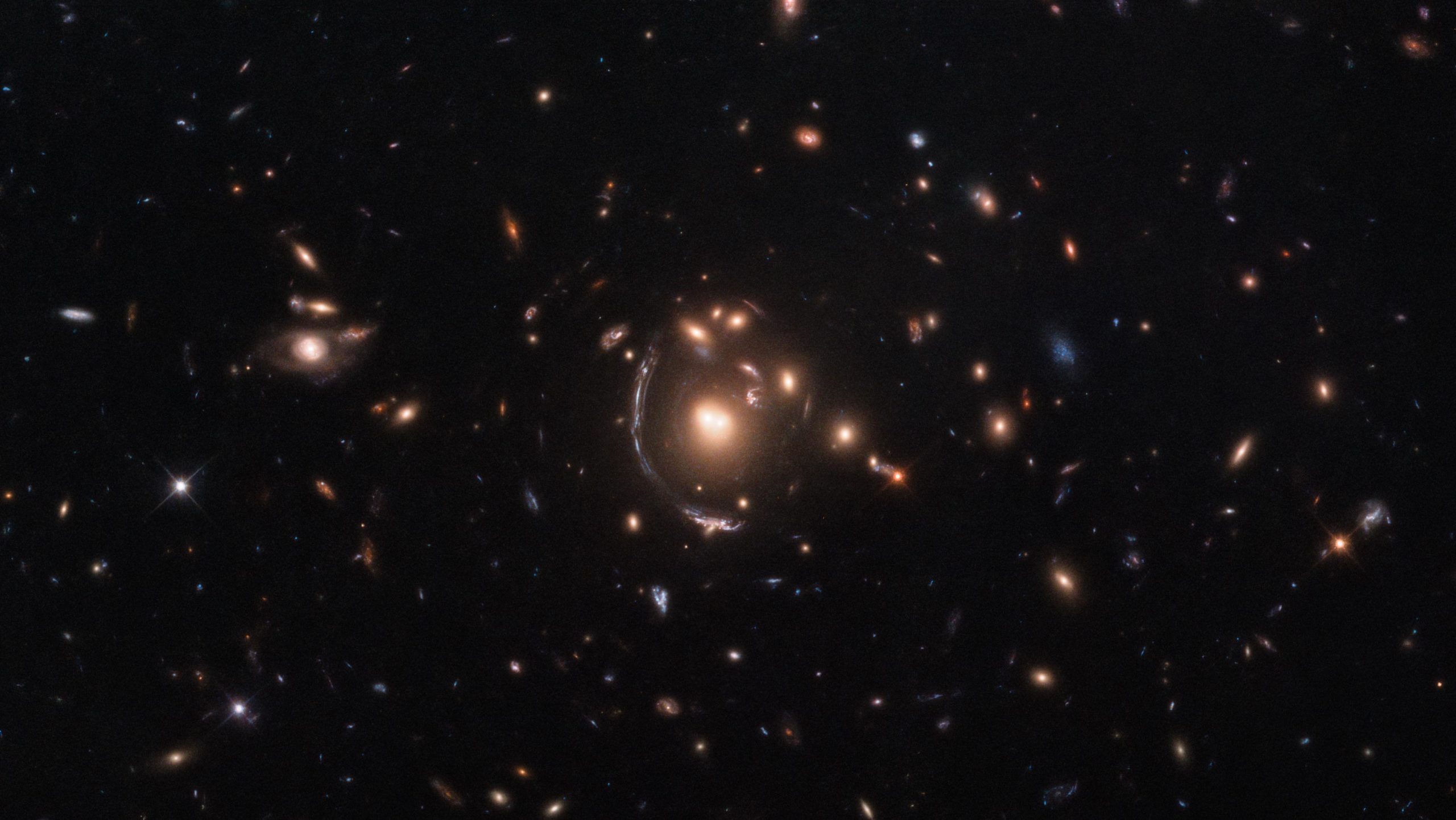
    Galaxy LRG-3-817
    The galaxy LRG-3-817, also referred to as SDSS J090122.37+181432.3, is seen in the image distorted by gravitational lensing effects. It forms a lengthy arc on the left side of the central galaxy cluster. Credit: ESA/Hubble & NASA, S. Allam et al.

    This NASA/ESA Hubble Space Telescope image features the galaxy LRG-3-817, also known as SDSS J090122.37+181432.3. The galaxy, its image distorted by the effects of gravitational lensing, appears as a long arc to the left of the central galaxy cluster.

    Gravitational lensing occurs when a large distribution of matter, such as a galaxy cluster, sits between Earth and a distant light source. As space is warped by massive objects, the light from the distant object bends as it travels to us and we see a distorted image of it. This effect was first predicted by Einstein’s general theory of relativity.

    Strong gravitational lenses provide an opportunity for studying properties of distant galaxies, since Hubble can resolve details within the multiple arcs that are one of the main results of gravitational lensing. An important consequence of lensing distortion is magnification, allowing us to observe objects that would otherwise be too far away and too faint to be seen. Hubble makes use of this magnification effect to study objects beyond the sensitivity of its 2.4-meter-diameter (7.9-feet-diameter) primary mirror, showing us the most distant galaxies humanity has ever encountered.

    This lensed galaxy was found as part of the Sloan Bright Arcs Survey, which discovered some of the brightest gravitationally lensed[1] high-redshift[2] galaxies in the night sky.

    1. A gravitational lens is a distribution of matter (such as a cluster of galaxies) between a distant light source and an observer, that is capable of bending the light from the source as the light travels towards the observer. This effect is known as gravitational lensing, and the amount of bending is one of the predictions of Albert Einstein’s general theory of relativity.
    2. In physics, redshift is a phenomenon where electromagnetic radiation (such as light) from an object undergoes an increase in wavelength. Whether or not the radiation is visible, “redshift” means an increase in wavelength, equivalent to a decrease in wave frequency and photon energy, in accordance with, respectively, the wave and quantum theories of light.

    Never miss a breakthrough: Join the SciTechDaily newsletter.
    Follow us on Google and Google News.

    Astronomy Astrophysics European Space Agency General Relativity Hubble Space Telescope NASA
    Share. Facebook Twitter Pinterest LinkedIn Email Reddit

    Related Articles

    Hubble’s Newest Discovery Isn’t a Star, It’s a Window Into the Dark Universe

    Stars Gone Haywire Revealed in Stunning New Hubble Space Telescope Images

    Hubble Deep Space Quest Makes Surprising Find in the Early Universe

    OwO What’s This? Astronomers Study Galactic Bulge for Clues to Black Hole Mystery

    Astronomers Build Incredible 3D Visualization of Exploded Star Using NASA’s Great Observatories [Video]

    Mysterious Gigantic Carbon Cocoons Discovered Surrounding Growing Galaxies

    Hubble Reveals Some of the Earliest Known Galaxies

    Hubble Views Abell 2261, An Elliptical Galaxy With an Unusually Large Core

    Hubble Captures Image of Compact Blue Dwarf Galaxy UGC 5497

    Leave A Reply Cancel Reply

    • Facebook
    • Twitter
    • Pinterest
    • YouTube

    Don't Miss a Discovery

    Subscribe for the Latest in Science & Tech!

    Trending News

    The Universe Is Expanding Too Fast and Scientists Can’t Explain Why

    “Like Liquid Metal”: Scientists Create Strange Shape-Shifting Material

    Early Warning Signals of Esophageal Cancer May Be Hiding in Plain Sight

    Common Blood Pressure Drug Shows Surprising Power Against Deadly Antibiotic-Resistant Superbug

    Scientists Uncover Dangerous Connection Between Serotonin and Heart Valve Disease

    Scientists Discover a “Protector” Protein That Could Help Reverse Hair Loss

    Bone-Strengthening Discovery Could Reverse Osteoporosis

    Scientists Uncover Hidden Trigger Behind Stem Cell Aging

    Follow SciTechDaily
    • Facebook
    • Twitter
    • YouTube
    • Pinterest
    • Newsletter
    • RSS
    SciTech News
    • Biology News
    • Chemistry News
    • Earth News
    • Health News
    • Physics News
    • Science News
    • Space News
    • Technology News
    Recent Posts
    • Scientists Overcome Major Quantum Bottleneck, Potentially Transforming Teleportation and Computing
    • Quantum Physics’ Strangest Problem May Hold the Key to Time Itself
    • Scientists Create “Liquid Gears” That Spin Without Touching
    • The Simple Habit That Could Help Prevent Cancer
    • Forgotten Medicinal Plant Shows Promise in Fighting Dangerous Superbugs
    Copyright © 1998 - 2026 SciTechDaily. All Rights Reserved.
    • Science News
    • About
    • Contact
    • Editorial Board
    • Privacy Policy
    • Terms of Use

    Type above and press Enter to search. Press Esc to cancel.