
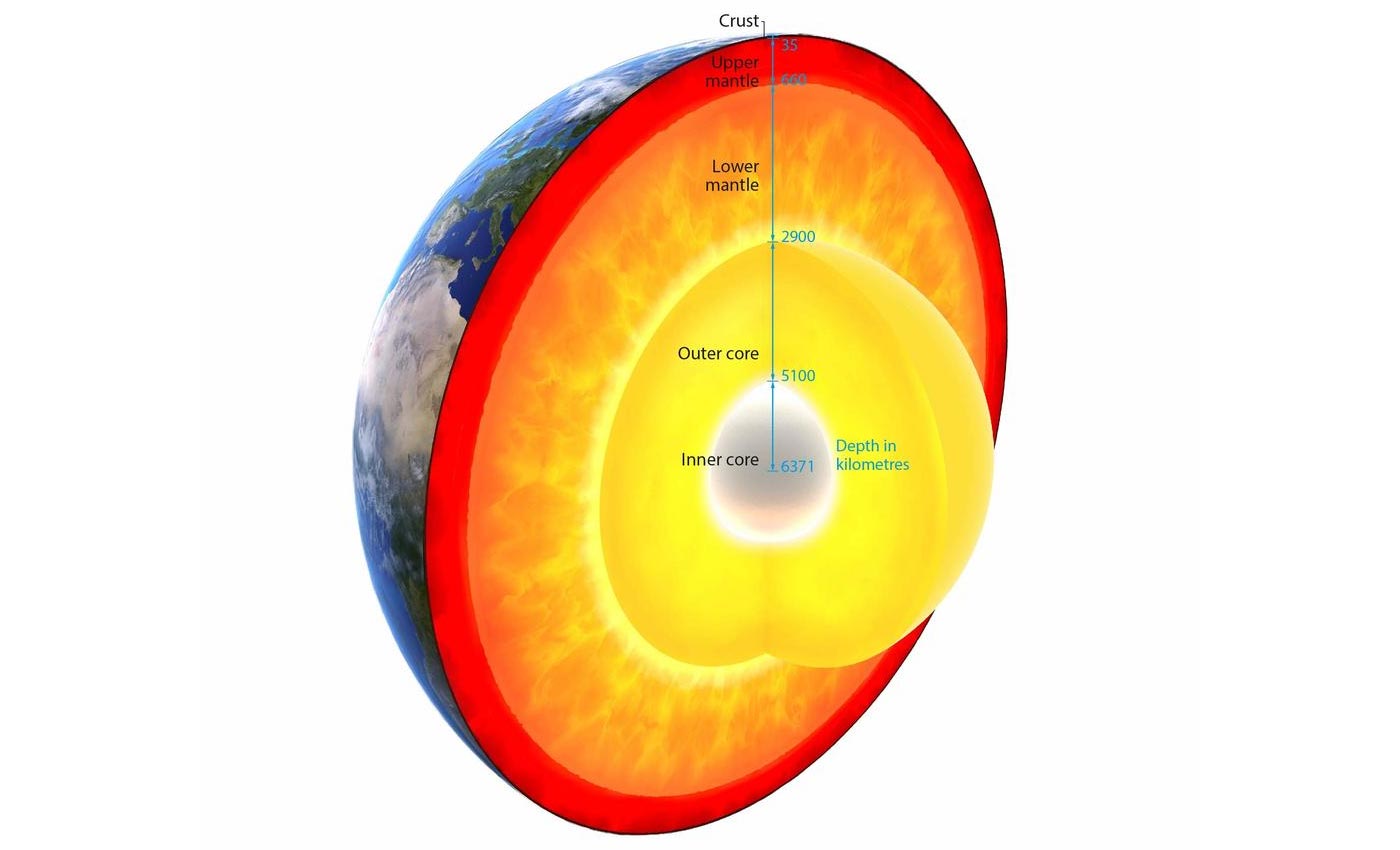
High-pressure, high-temperature investigation of real rock reveals unexpected behavior at more than 1000 kilometers depth.
Scientists have recreated the conditions of Earth´s deep mantle in the lab, deforming for the first time a real rock at conditions comparable to more than 1000 kilometers depth. By compressing and heating the mineral olivine to almost 400,000 times the ambient pressure and more than 700 degrees Celsius at the Extreme Conditions Beamline of DESY´s X-ray source PETRA III, the scientists created a mixture of Earth´s two most abundant minerals, bridgmanite, and ferropericlase, typical for the lower mantle.
The investigation revealed an unexpected behavior of the mixture that can explain certain directional differences (anisotropies) observed when earthquake waves travel through Earth, as the team around Samantha Couper from the University of Utah reports in the journal Frontiers in Earth Science. Previous high temperature studies had only investigated pure samples of a single mineral under such conditions.
Convection within Earth’s mantle is well-known to govern plate tectonics and thus is connected directly to our planet’s volcanic and earthquake activity. However, the deepest drill-cores in Earth’s crust extend only a few kilometers and the actual deformation of rocks within the deep Earth cannot be directly observed. Convection within Earth’s interior is instead investigated indirectly by interpreting the slowing and splitting of seismic waves as they travel through Earth’s interior.
It is widely accepted that observed anisotropies in seismic behavior in the deep Earth are caused by crystals of mantle minerals aligned with mantle flow. This preferred alignment of minerals, a so-called texture, is facilitated by an irreversible movement within a crystal’s lattice, leading to a plastic deformation.
The most abundant minerals which may texture in the lower mantle are bridgmanite, a magnesium silicate, and ferropericlase, a magnesium-iron oxide. Bridgmanite is also the most abundant mineral within the Earth, making up almost 40 percent of its volume. Understanding its deformation behavior is therefore highly important for interpreting the dynamics of Earth’s mantle. Many geologic experiments seeking to probe the lowermost mantle have been carried out on samples with a single mineral.
“However, due to grain-to-grain interactions, the deformation behavior of multiple minerals is potentially different from that of single minerals,” explains Couper. “Our goals for the experiment were therefore to study the high temperature and pressure deformation mechanisms active in bridgmanite and to determine the effect of multi-mineral interactions on texture development in both bridgmanite and ferropericlase.”
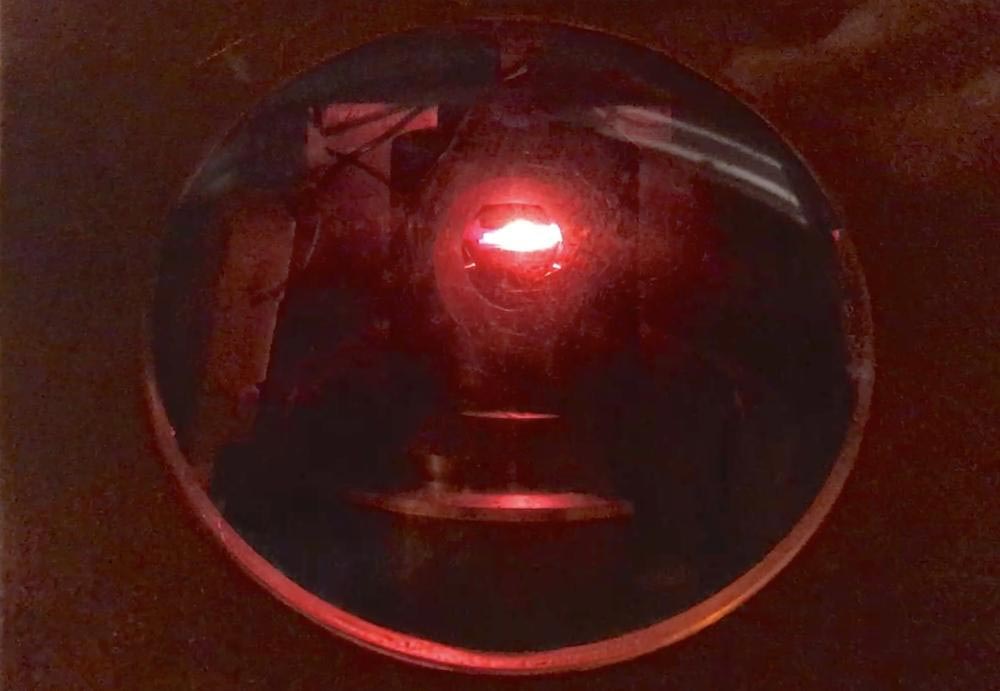
The team synthesized a rock of lower mantle composition by compressing olivine, a mineral stable within the upper mantle, between two tiny, but strong diamond anvils in a high-pressure cell. Heating the compressed sample with a strong laser converted the olivine into bridgmanite, ferropericlase, ringwoodite, and a small fraction of stishovite. The sample was held at 1000 Kelvin (726 degrees Celsius) and simultaneously compressed from 29 Giga-Pascals to 39 Giga-Pascals, corresponding to about 385,000 times the air pressure at sea level. “This is the first time an assemblage representative of a lower mantle rock has been compressed to deep lower mantle pressures while also held at high temperature,” stresses co-author Hanns-Peter Liermann, head of the Extreme Conditions Beamline at DESY.
Using the bright X-rays of PETRA III, the scientists could monitor the crystal structures of the sample during the experiment. Analysis of the X-ray data showed that the texture development in bridgmanite differed from that observed in high-pressure studies at room temperature. This indicates that the deformation mechanisms in bridgmanite vary with temperature. The team could also successfully simulate this behavior with a mathematical model. Ferropericlase, however, did not develop significant texture in the experiments, although it is softer than bridgmanite and would be expected to show texture earlier than bridgmanite.
These results are contrary to studies of pure ferropericlase samples where significant texture develops. This might be due to grain-to-grain interactions between ferropericlase and bridgmanite which could inhibit the grain re-orientation in ferropericlase that would result in texture. Surprisingly, this means that even though it is likely that ferropericlase undergoes significant deformation, the mineral is not contributing to observed seismic anisotropies within the lower mantle.
While there is still work to be done to deform a lower mantle assemblage at the pressures and temperatures of the lowermost mantle, about 136 Giga-Pascals and 4,000 Kelvin (3,7270 Celsius), the study currently serves as the closest approximation for deformed samples of lower mantle composition. “Our analysis indicates that grain-to-grain interactions between bridgmanite and ferropericlase may play a significant role in producing very different patterns of seismic anisotropy in the lower mantle,” summarizes Lowell Miyagi from the University of Utah, who led the research.
“With this hypothetical rock, we find that we can explain most seismic anisotropy observations in Earth’s lower mantle. The information gained in this study therefore may explain anomalous regions of seismic anisotropy in Earth and could change current interpretations of seismic data and thus our understanding of deformation within Earth.”
Reference: “Does Heterogeneous Strain Act as a Control on Seismic Anisotropy in Earth’s Lower Mantle?” by Samantha Couper, Sergio Speziale, Hauke Marquardt, Hanns-Peter Liermann and Lowell Miyagi, 14 October 2020, Frontiers in Earth Science.
DOI: 10.3389/feart.2020.540449
Scientists from the University of Utah in Salt Lake City, Deutsches GeoForschungsZentrum GFZ in Potsdam, and the University of Oxford and DESY contributed to this research.
Never miss a breakthrough: Join the SciTechDaily newsletter.
Follow us on Google and Google News.