
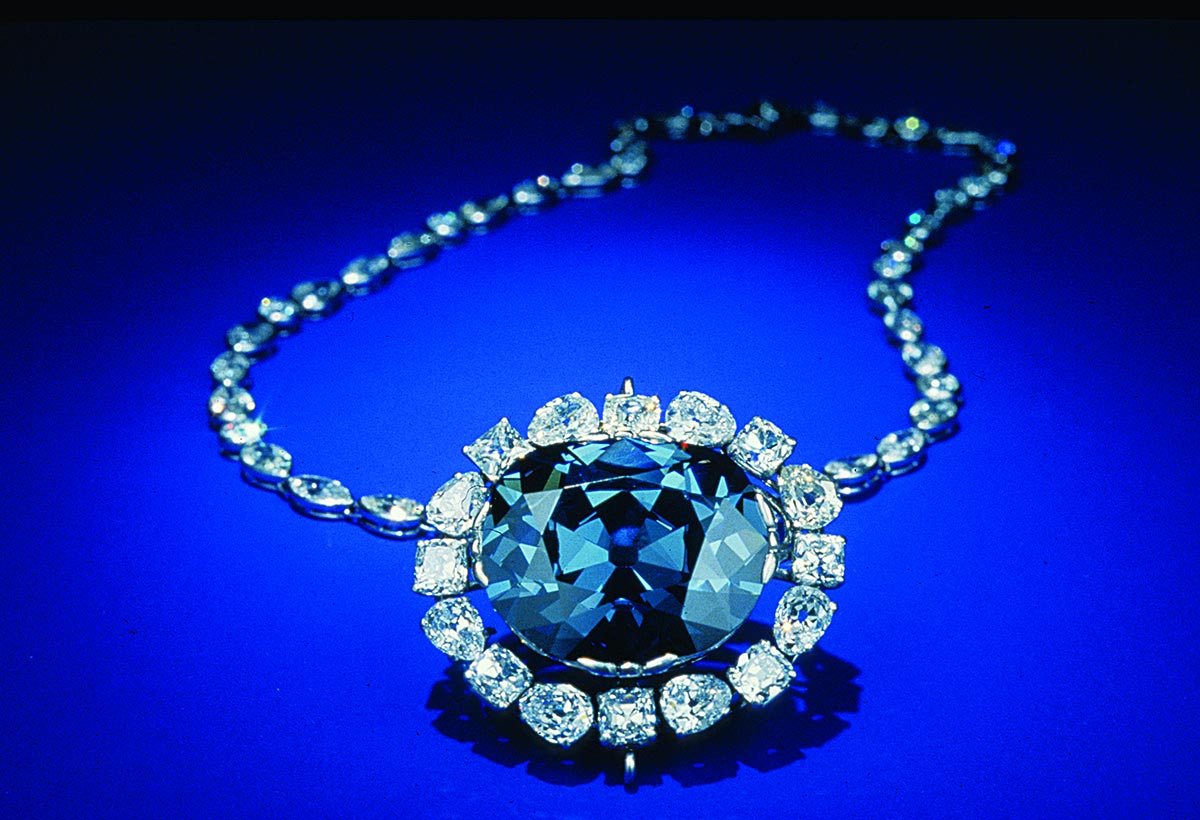
An analysis of the first large diamonds confirmed to come from deep under the Earth’s surface supports initial predictions showing that the Smithsonian’s famous Hope diamond may be “super deep,” originating from more than three times deeper in the Earth than most diamonds. It also suggests, in a new finding, that the “Crown Jewels” Cullinan diamond may also be a super-deep diamond.
Presenting the work at the Goldschmidt geochemistry conference, Dr. Evan Smith of the Gemological Institute of America (GIA) confirmed: “We examined the first large gem diamonds confirmed to originate from Earth’s lower mantle, which is several times deeper than most other diamonds. The results support earlier predictions based on smaller gems, suggesting that diamonds with properties similar to those studied, including both the Cullinan and Hope diamonds, are super-deep diamonds.”
Diamonds are formed under high pressure in the Earth’s mantle, the middle layer between the surface crust and the central core. While the majority of diamonds form in the base of the continental tectonic plates, at depths of 150-200 km (93-124 mi), some rare diamonds form deeper in the mantle. These “super-deep” diamonds originate beneath the rigid and stable continental plates, down where the mantle is slowly moving, or convecting. The Hope diamond is classified as a type IIb diamond, which contains the element boron, which can cause a blue tinge. Until now there has been uncertainty over whether “type IIb” diamonds formed in a shallow or deep environment. In particular, the uncertainty revolves around the origin of large type IIb diamonds, larger than 3 carats (about the size of a pea). It is only within the past couple of years that scientists have begun to understand where in the Earth these dazzling blue crystals form.
Now researchers Drs Evan Smith and Wuyi Wang, working at the GIA laboratory in New York, have detected the remains of the mineral bridgmanite in a large type IIb diamond. Smith said:
“Finding these remnants of the elusive mineral bridgmanite is significant. It’s very common in the deep Earth, at the extreme pressure conditions of the lower mantle, below a depth of 660 km (410 mi), even deeper than most super-deep diamonds. Bridgmanite doesn’t exist in the upper mantle, or at the surface. What we actually see in the diamonds when they reach surface is not bridgmanite, but the minerals left when it breaks down as the pressure decreases. Finding these minerals trapped in a diamond means that the diamond itself must have crystallized at a depth where bridgmanite exists, very deep within the Earth.”
Smith examined a large, 20-carat type IIb blue diamond from a mine in South Africa. By aiming a laser at the tiny inclusions trapped inside this diamond they found that the way the light scattered (using a Raman spectrometer) was characteristic of bridgmanite breakdown products.
He said “We also examined a large 124-carat diamond from the Letseng mine in Lesotho. This diamond, which is around the size of a walnut, is very pure, containing no nitrogen in its crystal structure, and is known as a “CLIPPIR” diamond. This is from the same class of diamond as the famous Cullinan Diamond, which is now the centerpiece of the British Crown Jewels. This large diamond showed the same characteristic bridgmanite breakdown products, meaning that it too had been formed as a super-deep diamond. What is special about this one is that it is the first CLIPPIR diamond for which we can firmly assign a lower mantle origin, that is, below 660 km. Previously, we had known that CLIPPIR diamonds are super-deep and speculated that their depth of origin might span 360 to 750 km depth, but we hadn’t actually seen any that were definitely from the deeper end of this window. This gives us a better idea of exactly where CLIPPIR diamonds, such as the Crown Jewel diamonds, come from. What we have learned here is that there is some overlap in the birthplace for CLIPPIR diamonds, such as the Cullinan, and type IIb diamonds, such as the Hope. This is the first time this has been found.”
Boron-rich type IIb diamonds, such as the Hope diamond, are rare; less than 1 in a thousand diamonds being classified as type IIb.
“Discovering the deep mantle origin means that the material in these diamonds undergoes a remarkable journey. We believe that the boron, which gives the Hope diamond its characteristic blue color, originates from the bottom of the oceans. From there, plate tectonics drags it hundreds of kilometers down into the mantle, where it can be incorporated into the diamond. It shows that there is a gigantic recycling route that brings elements from Earth’s surface down into the Earth, and then occasionally returns beautiful diamonds to the surface, as passengers in volcanic eruptions.”
Commenting, Dr Jeff Post, Curator-in-Charge of Gems and Minerals at the Smithsonian’s National Museum of Natural History, said “This fascinating work confirms that the Hope Diamond is extraordinary and special, and truly one of Earth’s rarest objects.”
Dr Christopher Beyer, of the Ruhr University, Bochum, Germany commented: “The discovery of remnants of bridgmanite break-down products in large gem-quality diamonds shows that inclusions in diamonds are capsules which come to us from otherwise inaccessible deep Earth. In addition, the unique signature of boron in type IIb diamonds supports the theory of whole mantle convection with subducting slabs descending into Earth’s lower mantle. Diamonds crystallize from a fluid, so further studies are now needed to track down the fluid composition and the conditions that facilitate the growth of these rare large diamonds.”
NOTE: Neither Dr. Post nor Dr. Beyer were involved in this work, these are independent comments.
The Goldschmidt Conference thanks the Smithsonian Museum of Natural History for their assistance in preparing this press notice.
The Goldschmidt Conference is the world’s main geochemistry conference, hosted by the Geochemical Society and the European Association of Geochemistry. Held annually, it covers such materials as climate change, astrobiology, planetary and stellar development and conditions, chemistry of Earth materials, pollution, the undersea environment, volcanoes, and many other subjects. For 2020 the scheduled Hawaii congress has been moved online, and takes place from 21-26 June, see https:/
Never miss a breakthrough: Join the SciTechDaily newsletter.
Follow us on Google and Google News.