
Close Menu
    Facebook X (Twitter) Instagram
    SciTechDaily
    • Biology
    • Chemistry
    • Earth
    • Health
    • Physics
    • Science
    • Space
    • Technology
    Facebook X (Twitter) Pinterest YouTube RSS
    SciTechDaily
    Home»Space»What Is Gravitational Lensing?
    Space

    What Is Gravitational Lensing?

    By NASADecember 30, 2022No Comments5 Mins Read
    Facebook Twitter Pinterest Telegram LinkedIn WhatsApp Email Reddit
    Share
    Facebook Twitter LinkedIn Pinterest Telegram Email Reddit
    Galaxy Cluster Abell 370 Hubble Rotated
    Galaxy cluster Abell 370, located about 4 billion light-years away, contains an astounding assortment of several hundred galaxies tied together by the mutual pull of gravity. Entangled among the galaxies are mysterious-looking arcs of blue light. These are actually distorted images of remote galaxies behind the cluster. These far-flung galaxies are too faint for Hubble to see directly. Instead, the gravity from the cluster acts as a huge lens in space that magnifies and stretches images of background galaxies like a funhouse mirror. Nearly 100 distant galaxies have multiple images caused by the lensing effect. The most stunning example is “the Dragon,” an extended feature that is probably several duplicated images of a single background spiral galaxy stretched along an arc. Astronomers chose Abell 370 as a target for Hubble because its gravitational lensing effects can be used for probing remote galaxies that inhabited the early universe. Credit: NASA, ESA, and J. Lotz and the HFF Team (STScI)

    Looking Through a Giant Magnifying Glass

    When taken to the extreme, gravity can create some intriguing visual effects that the Hubble Space Telescope is well suited to observing. Einstein’s general theory of relativity describes how mass concentrations distort the space around them. A gravitational lens can occur when a huge amount of matter, like a cluster of galaxies, creates a gravitational field that distorts and magnifies the light from distant galaxies that are behind it but in the same line of sight. The effect is like looking through a giant magnifying glass. It allows researchers to study the details of early galaxies too far away to be seen with current technology and telescopes.

    Smaller objects, like individual stars, can also act as gravitational lenses when they pass in front of more distant stars. For a few days or weeks, light from the more distant star temporarily appears brighter because it is magnified by the gravity of the closer object. This effect is known as gravitational microlensing.
    Einstein Ring LRG
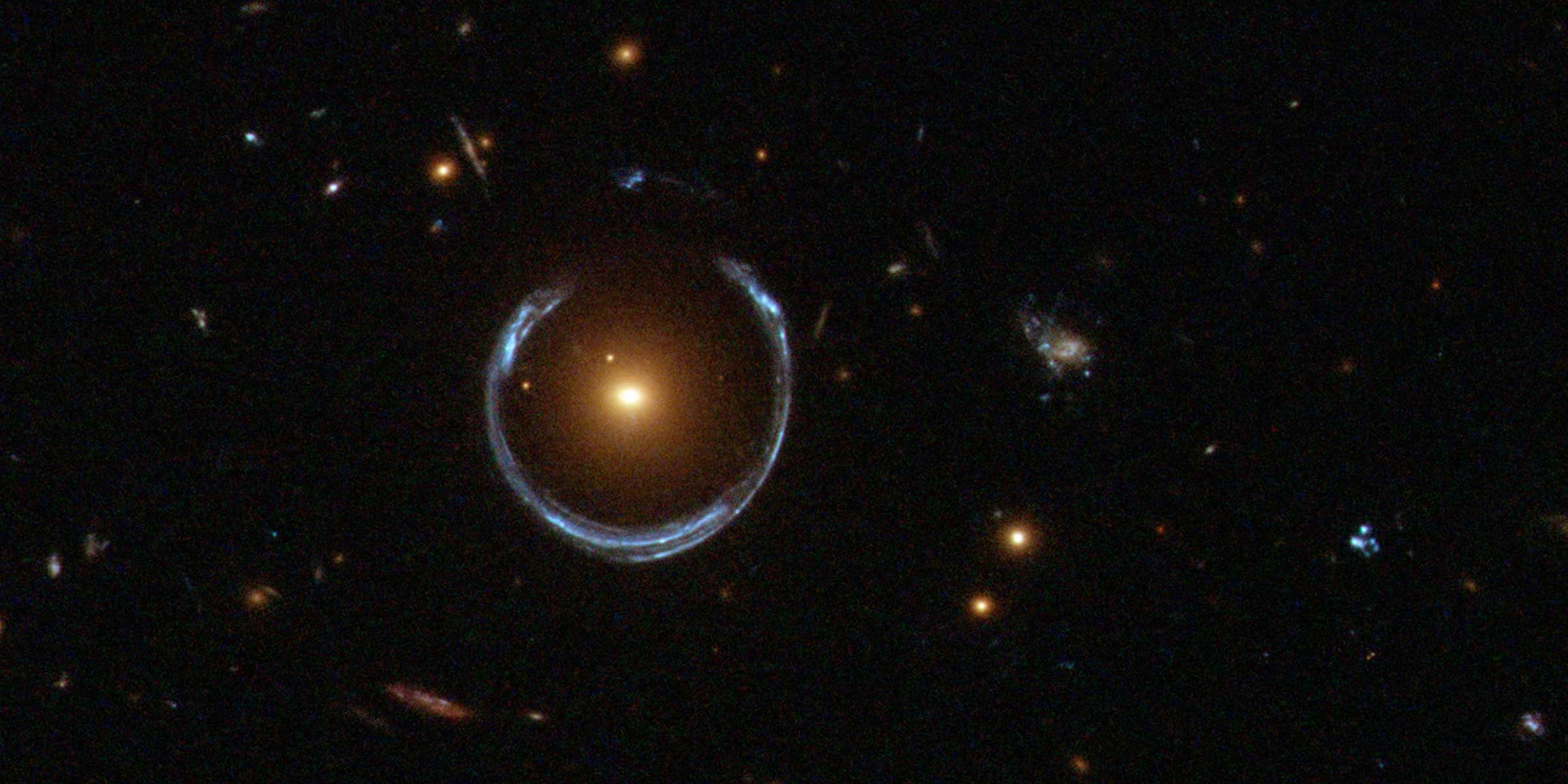
    The gravity of a luminous red galaxy (LRG) has gravitationally distorted the light from a much more distant blue galaxy. More typically, such light bending results in two discernible images of the distant galaxy, but here the lens alignment is so precise that the background galaxy is distorted into a horseshoe – a nearly complete ring. Credit: ESA/Hubble & NASA

    The simplest type of gravitational lensing occurs when there is a single concentration of matter at the center, such as the dense core of a galaxy. The light of a distant galaxy is redirected around this core, often producing multiple images of the background galaxy. When the lensing approaches perfect symmetry, a complete or almost-complete circle of light is produced, called an Einstein ring. Hubble observations have helped to greatly increase the number of Einstein rings known to astronomers. 

    More complex gravitational lensing arises in observations of massive clusters of galaxies. While the distribution of matter in a galaxy cluster generally does have a center, it is never circularly symmetric and can be significantly lumpy. Background galaxies are lensed by the cluster and their images often appear as short, thin “lensed arcs” around the outskirts of the cluster. 

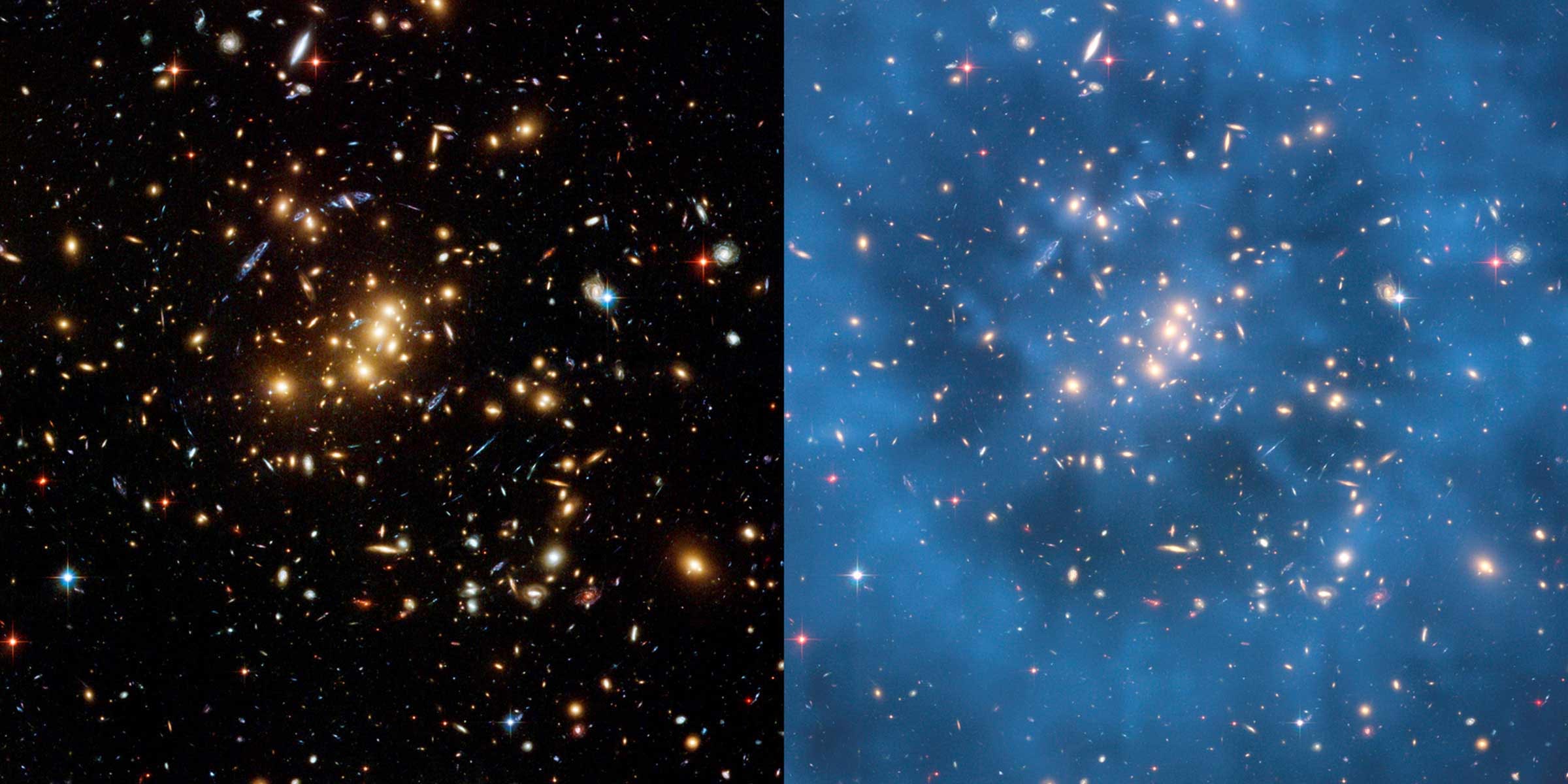
    These lensed images also act as probes of the matter distribution in the galaxy cluster. The results indicate that most of the matter in a galaxy cluster is not in the visible galaxies or hot gas around them and does not emit light, and is thus called dark matter. The distribution of lensed images reflects the distribution of all matter, both visible and dark. Hubble’s images of gravitational lensing have been used to create maps of dark matter in galaxy clusters.
    Galaxy Cluster Cl 0024+17
    On the left is a Hubble Space Telescope image of the galaxy cluster Cl 0024+17. On the right is the same image overlaid with a map of the cluster’s mass distribution. The ring-like structure evident in the map is one of the strongest pieces of evidence to date for the existence of dark matter. Credit: NASA, ESA, M. J. Jee and H. Ford (Johns Hopkins University)

    In turn, a map of the matter in a galaxy cluster helps provide a better understanding and analysis of the gravitationally lensed images. A model of the matter distribution can help identify multiple images of the same galaxy or predict where the most distant galaxies are likely to appear in a galaxy cluster image. Astronomers work between the gravitational lenses and the cluster matter distribution to improve our understanding of both.

    Because very distant galaxies are very faint, gravitational lenses extend Hubble’s view deeper into the universe. Gravitational lensing not only distorts the image of a background galaxy, it can amplify its light. Looking through a lensing galaxy cluster, Hubble can see fainter and more distant galaxies than otherwise possible. It is like having an extra lens that is the size of the galaxy cluster. The Frontier Fields project has examined multiple galaxy clusters, measured their lensing and matter distribution and identified a collection of these most distant galaxies.

    The diverse, lensed images of crosses, rings, arcs, and more are both intriguing and informative. Gravitational lensing probes the distribution of matter in galaxies and clusters of galaxies, and enables observations of the distant universe. Hubble’s data also provide a basis and guide for the James Webb Space Telescope, whose infrared observations complement those of Hubble.

    Learn more about gravitational lensing.

    Never miss a breakthrough: Join the SciTechDaily newsletter.
    Follow us on Google and Google News.

    Astronomy Astrophysics Gravitational Lensing NASA
    Share. Facebook Twitter Pinterest LinkedIn Email Reddit

    Related Articles

    NASA Scientists Probe Dark Energy – Time To Rework Albert Einstein’s Theory of Gravity?

    “X-Ray Magnifying Glass” Provides Unprecedented Look at Black Hole in the Early Universe

    Astronomers Use “X-Ray Magnifying Glass” To Enhance View of Distant Black Holes

    Astronomers Use Galaxy Clusters to Reveal New Dark Matter Insights

    Hubble Reveals Some of the Earliest Known Galaxies

    Fermi Makes First-Ever Gamma-Ray Measurements of a Gravitational Lens

    The Bolshoi Simulation: Boxing the Universe

    NASA’s Kepler Mission Discovers 11 New Extrasolar Systems with 26 Exoplanets

    Hubble Observes Rare Blue Stars in Andromeda’s Core

    Leave A Reply Cancel Reply

    • Facebook
    • Twitter
    • Pinterest
    • YouTube

    Don't Miss a Discovery

    Subscribe for the Latest in Science & Tech!

    Trending News

    Largest-Ever Study Finds Medicinal Cannabis Ineffective for Anxiety, Depression, PTSD

    250-Million-Year-Old Egg Solves One of Evolution’s Biggest Mysteries

    Living With Roommates Might Be Changing Your Gut Microbiome Without You Knowing

    Century-Old Cleaning Chemical Linked to 500% Increased Risk of Parkinson’s Disease

    What if Your Memories Never Happened? Physicists Take a New Look at the Boltzmann Brain Paradox

    One of the Universe’s Largest Stars May Be Getting Ready To Explode

    Scientists Discover Enzyme That Could Supercharge Ozempic-Like Weight Loss Drugs

    Popular Sweetener Linked to DNA Damage – “It’s Something You Should Not Be Eating”

    Follow SciTechDaily
    • Facebook
    • Twitter
    • YouTube
    • Pinterest
    • Newsletter
    • RSS
    SciTech News
    • Biology News
    • Chemistry News
    • Earth News
    • Health News
    • Physics News
    • Science News
    • Space News
    • Technology News
    Recent Posts
    • Scientists Say This Overlooked Organ Could Hold the Key to Longer Life
    • Want Less Stress? Landmark Study Points to a Simple Habit
    • Scientists Reveal Eating Fruits and Vegetables May Increase Your Risk of Lung Cancer
    • AI Reveals Explosive Growth of Floating Algae Across the World’s Oceans
    • 5.5 Million Bees Discovered Living Beneath a New York Cemetery
    Copyright © 1998 - 2026 SciTechDaily. All Rights Reserved.
    • Science News
    • About
    • Contact
    • Editorial Board
    • Privacy Policy
    • Terms of Use

    Type above and press Enter to search. Press Esc to cancel.