
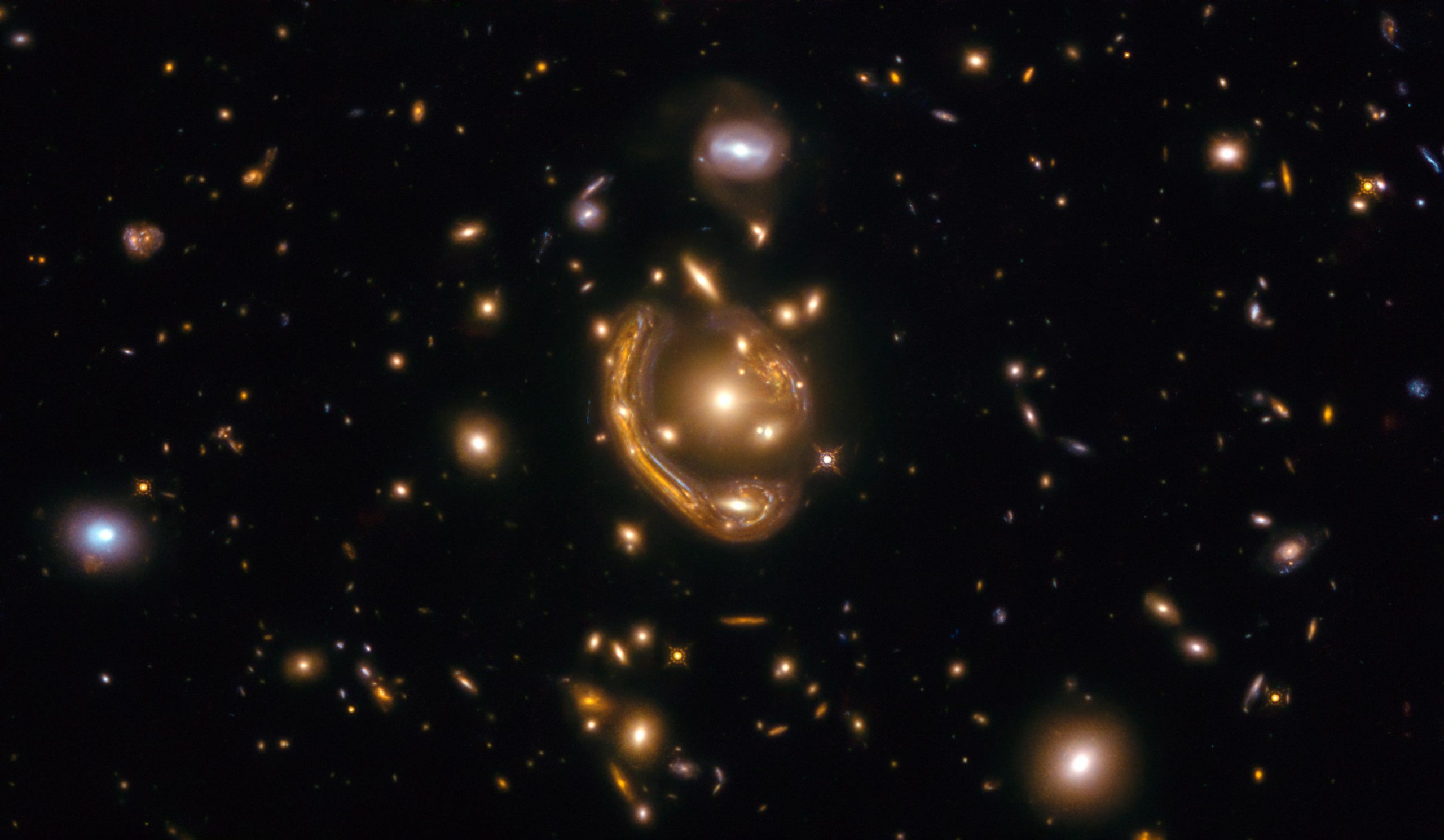
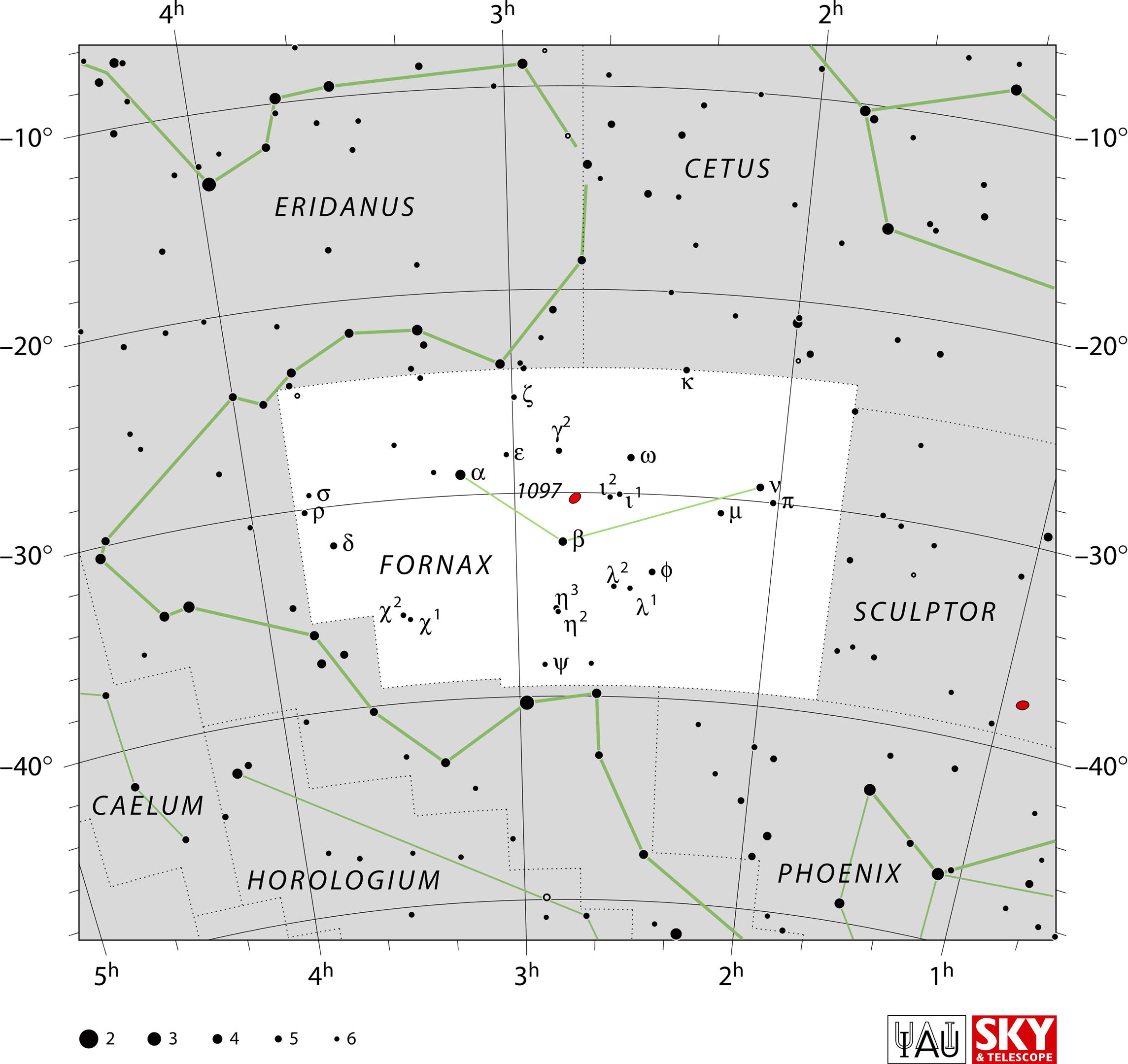
The narrow galaxy elegantly curving around its spherical companion in this image is a fantastic example of a truly strange and very rare phenomenon. This image, taken with the NASA/ESA Hubble Space Telescope, depicts GAL-CLUS-022058s, located in the southern hemisphere constellation of Fornax (The Furnace). GAL-CLUS-022058s is the largest and one of the most complete Einstein rings ever discovered in our Universe. The object has been nicknamed by the Principal Investigator and his team who are studying this Einstein ring as the “Molten Ring,” which alludes to its appearance and host constellation.
First theorized to exist by Einstein in his general theory of relativity, this object’s unusual shape can be explained by a process called gravitational lensing, which causes light shining from far away to be bent and pulled by the gravity of an object between its source and the observer. In this case, the light from the background galaxy has been distorted into the curve we see by the gravity of the galaxy cluster sitting in front of it. The near exact alignment of the background galaxy with the central elliptical galaxy of the cluster, seen in the middle of this image, has warped and magnified the image of the background galaxy around itself into an almost perfect ring. The gravity from other galaxies in the cluster is soon to cause additional distortions.
Objects like these are the ideal laboratory in which to research galaxies too faint and distant to otherwise see.
- An Einstein ring, also known as an Einstein–Chwolson ring or Chwolson ring, is created when light from a galaxy or star passes by a massive object en route to the Earth. Due to gravitational lensing, the light is diverted, making it seem to come from different places. If the source, lens, and observer are all aligned, the light appears as a ring.
- General relativity, also known as the general theory of relativity, is the geometric theory of gravitation published by Albert Einstein in 1915 and is the current description of gravitation in modern physics. General relativity generalizes special relativity and refines Newton’s law of universal gravitation, providing a unified description of gravity as a geometric property of space and time or four-dimensional spacetime. In particular, the curvature of spacetime is directly related to the energy and momentum of whatever matter and radiation are present. The relation is specified by the Einstein field equations, a system of partial differential equations.
- Gravitational microlensing is an astronomical phenomenon due to the gravitational lens effect. It can be used to detect objects that range from the mass of a planet to the mass of a star, regardless of the light they emit. Typically, astronomers can only detect bright objects that emit much light (stars) or large objects that block background light (clouds of gas and dust). These objects make up only a minor portion of the mass of a galaxy. Microlensing allows the study of objects that emit little or no light.
Never miss a breakthrough: Join the SciTechDaily newsletter.
Follow us on Google and Google News.
3 Comments
I read some articles on this site and I think your blog is really interesting and has great information. Thanks for sharing.
… a woman need, the one that will accept “Rings of Relativity” as a weeding ring…
… a woman needed, the one that will accept “Rings of Relativity”, as a weeding ring…
… a joke, this is needed in order to clarify the sentiment of a sentimental statement. Well, some need it, some don’t, … just to make sure ….