
Close Menu
    Facebook X (Twitter) Instagram
    SciTechDaily
    • Biology
    • Chemistry
    • Earth
    • Health
    • Physics
    • Science
    • Space
    • Technology
    Facebook X (Twitter) Pinterest YouTube RSS
    SciTechDaily
    Home»Space»Cosmic Illusions: Hubble Spots a Spiral Galaxy in Disguise
    Space

    Cosmic Illusions: Hubble Spots a Spiral Galaxy in Disguise

    By ESA/HubbleMarch 4, 2024No Comments2 Mins Read
    Facebook Twitter Pinterest Telegram LinkedIn WhatsApp Email Reddit
    Share
    Facebook Twitter LinkedIn Pinterest Telegram Email Reddit
    Galaxy NGC 4423
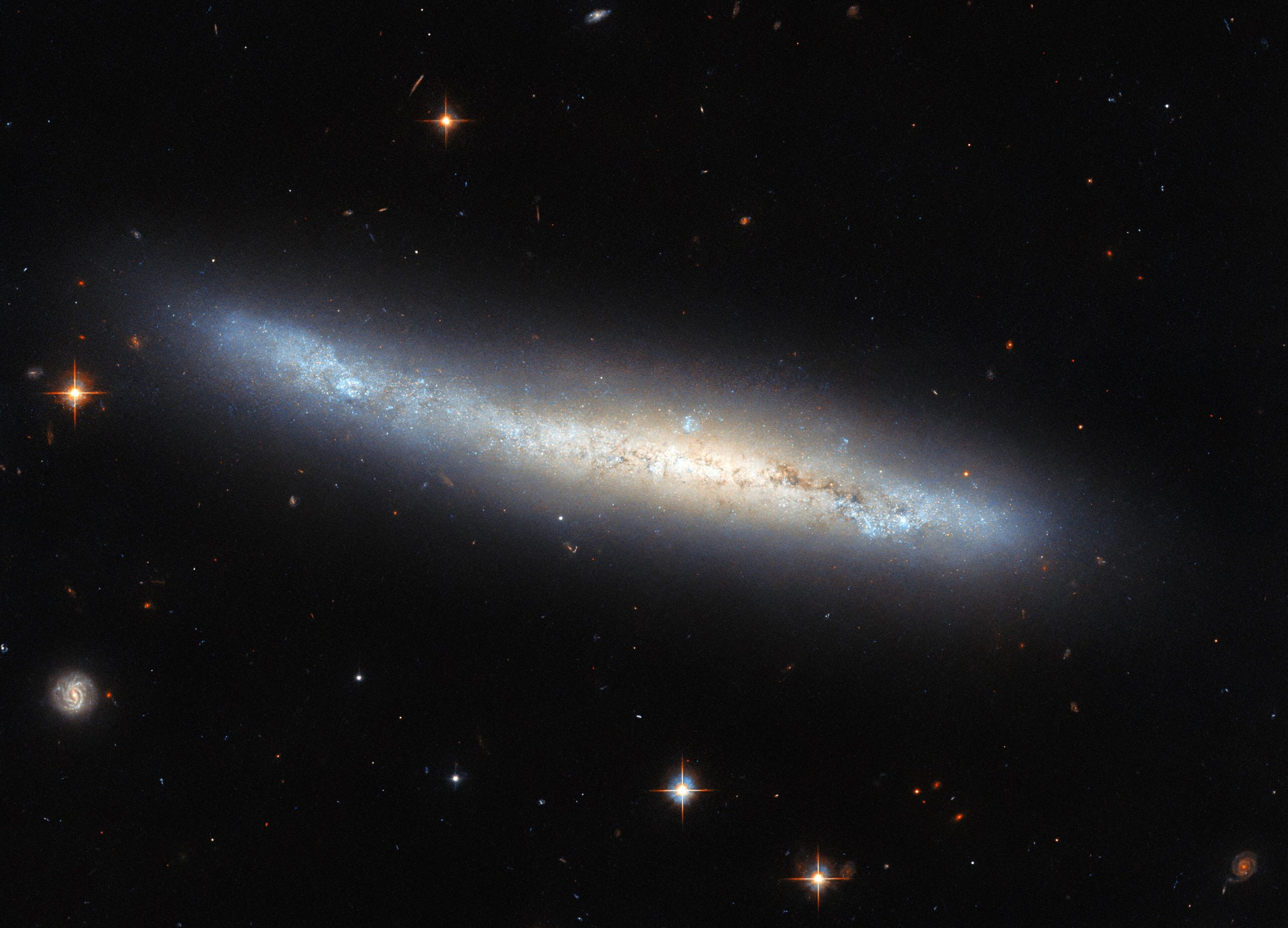
    This Hubble Space Telescope image features NGC 4423, a galaxy in the constellation of Virgo. It appears irregular at first glance but is actually a spiral galaxy. Its true shape, characterized by a dense central bulge and spiral arms, is obscured due to our fixed viewing angle from Earth.  Credit: ESA/Hubble & NASA, M. Sun

    NGC 4423, located in Virgo, misleadingly appears as an irregular galaxy but is truly a spiral galaxy. Our fixed perspective from Earth limits our view, and despite the movement of celestial objects, we are unlikely to see a change in our view of NGC 4423 due to the immense distances in space.

    Here we see NGC 4423, a galaxy that lies about 55 million light-years away in the constellation Virgo. In this image NGC 4423 appears to have quite an irregular, tubular form, so it might be surprising to find out that it is in fact a spiral galaxy. Knowing this, we can make out the denser central bulge of the galaxy, and the less crowded surrounding disc (the part that comprises the spiral arms).

    If NGC 4423 were viewed face-on it would resemble the shape that we most associate with spiral galaxies: the spectacular curving arms sweeping out from a bright center, interspersed with dimmer, darker, less populated regions. But when observing the skies we are constrained by the relative alignments between Earth and the objects that we are observing: we cannot simply reposition Earth so that we can get a better face-on view of NGC 4423!

    Of course, celestial objects do not remain sedentary in space, but often move at extremely rapid velocities relative to one another. This might suggest that, should a galaxy be moving in a fortuitous direction relative to Earth, we might be able to view it from a substantially different perspective once it has moved far enough. This is theoretically possible, but the reality is that the distances in space are simply far too big, and human lifetimes far too short, for a noticeable difference in relative alignment to occur. In other words, this is more-or-less the view of NGC 4423 that we will always have!

    Never miss a breakthrough: Join the SciTechDaily newsletter.
    Follow us on Google and Google News.

    Astronomy European Space Agency Hubble Space Telescope
    Share. Facebook Twitter Pinterest LinkedIn Email Reddit

    Related Articles

    A Diamond Necklace of Cosmic Proportions

    Hubble Snaps a Stunning Close-Up of a Magnificent Spiral Galaxy

    Extraordinary Hubble Image: Light Bends From the Beyond

    Hubble Space Telescope Sees Volcanic Activity Reforming the Atmosphere on a Rocky Exoplanet

    Hubble Spies a Luminous Heart With Dark Tendrils

    Spectacular Return to the Veil Nebula

    Hubble Spots a Peculiar Sight: Unusual Spiral Galaxy With a Heavy Arm

    A Flash of Life: Hubble Spies an Unusual Planetary Nebula

    Through the Cosmic Clouds: Hubble Spots a Beautiful Stellar Nursery

    Leave A Reply Cancel Reply

    • Facebook
    • Twitter
    • Pinterest
    • YouTube

    Don't Miss a Discovery

    Subscribe for the Latest in Science & Tech!

    Trending News

    A SpaceX Falcon 9 Rocket Hit the Moon and Blasted Open a 60-Foot Crater

    Study Reveals Your Organs May Be Aging at Very Different Speeds

    Scientists Finally Solve a 20-Year Mystery About Diamond Melting

    Ultra-Processed Foods Linked to 30% Higher Prostate Cancer Risk

    More Screen Time, Better Thinking? An 8-Year Study Finds a Surprising Link

    Cleaner Cars May Be Hiding a New Pollution Problem

    Common Plant Chemical Linked to Widespread Organ Damage in Aquatic Animals

    Dogs and Humans May Share a Surprising Biological Secret to Longevity

    Follow SciTechDaily
    • Facebook
    • Twitter
    • YouTube
    • Pinterest
    • Newsletter
    • RSS
    SciTech News
    • Biology News
    • Chemistry News
    • Earth News
    • Health News
    • Physics News
    • Science News
    • Space News
    • Technology News
    Recent Posts
    • NASA’s Powerful New Roman Space Telescope Is Cleared for Launch
    • Scientists Reveal How Cells Tame One of Biology’s Most Dangerous Metals
    • Hurricane Forecast Maps Are Getting Better – but One Big Problem Remains
    • Blackbirds Somehow Know When a Snake Is Too Dangerous To Attack
    • Scientists Find a Clue to Making Brain Stimulation More Reliable
    Copyright © 1998 - 2026 SciTechDaily. All Rights Reserved.
    • Science News
    • About
    • Contact
    • Editorial Board
    • Privacy Policy
    • Terms of Use

    Type above and press Enter to search. Press Esc to cancel.