
Close Menu
    Facebook X (Twitter) Instagram
    SciTechDaily
    • Biology
    • Chemistry
    • Earth
    • Health
    • Physics
    • Science
    • Space
    • Technology
    Facebook X (Twitter) Pinterest YouTube RSS
    SciTechDaily
    Home»Space»Hubble Spots a Peculiar Sight: Unusual Spiral Galaxy With a Heavy Arm
    Space

    Hubble Spots a Peculiar Sight: Unusual Spiral Galaxy With a Heavy Arm

    By ESA/HubbleMarch 22, 20215 Comments1 Min Read
    Facebook Twitter Pinterest Telegram LinkedIn WhatsApp Email Reddit
    Share
    Facebook Twitter LinkedIn Pinterest Telegram Email Reddit
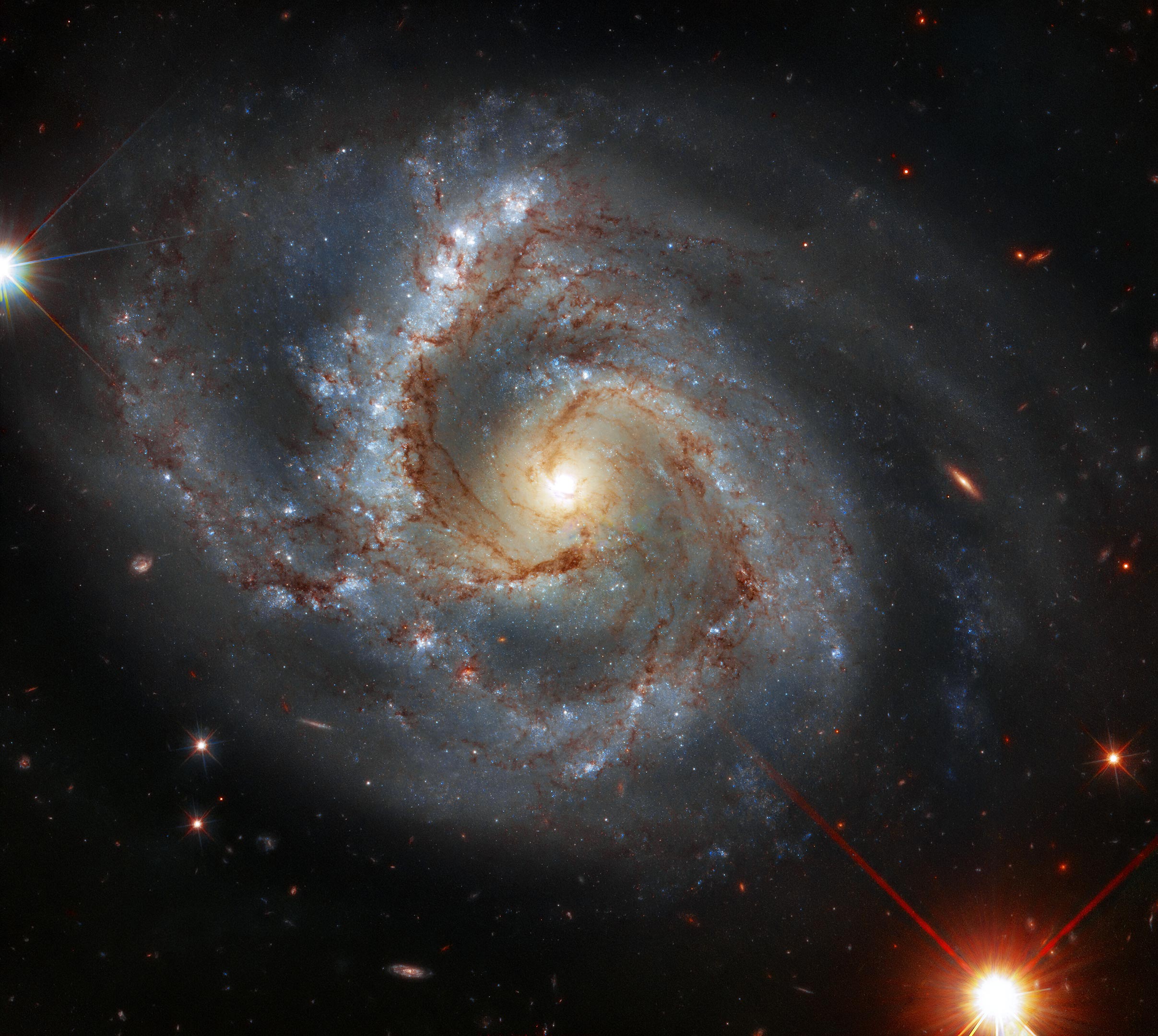
    Galaxy NGC 7678
    NGC 7678  is located approximately 164 million light-years away in the constellation of Pegasus (The Winged Horse).  Credit: ESA/Hubble & NASA, A. Riess et al.

    This week’s Hubble/ESA Picture of the Week features NGC 7678 — a galaxy located approximately 164 million light-years away in the constellation of Pegasus (The Winged Horse). With a diameter of around 115,000 light-years, this bright spiral galaxy is a similar size to our own galaxy (the Milky Way), and was discovered in 1784 by the German-British astronomer William Herschel.

    The Atlas of Peculiar Galaxies is a catalog that was produced in 1966 by the American astronomer Halton Arp. NGC 7678 is among the 338 galaxies presented in this catalog, which organizes peculiar galaxies according to their unusual features. Cataloged here as Arp 28, this galaxy is listed together with six others in the group “spiral galaxies with one heavy arm.”

    Never miss a breakthrough: Join the SciTechDaily newsletter.
    Follow us on Google and Google News.

    Astronomy European Space Agency Hubble Space Telescope NASA Popular
    Share. Facebook Twitter Pinterest LinkedIn Email Reddit

    Related Articles

    Hubble’s Newest Discovery Isn’t a Star, It’s a Window Into the Dark Universe

    Hubble Celebrates 34th Anniversary With a Spectacular View of the Little Dumbbell Nebula

    Hubble Views Spiral Galaxy NGC 5793

    Hubble Captures Face-On Image of Messier 61

    Hubble Views an Ongoing Cosmic Collision

    Hubble Views Newborn Stars in Galaxy IC 5052

    New XDF Image, The Deepest-Ever View of the Universe

    Hubble Zooms in on the Center of M4

    Hubble Image of Peculiar Galaxy Pair Arp 116

    5 Comments

    1. Phil Olson on March 23, 2021 6:20 am

      The dark clouds of dust seem directional as well. The heavy arm has a clear view ahead and dust behind. On over to the other side of the galaxy and the dust is on the leading edge or has been stirred into the mix.
      Did the galaxy run into an intergalactic blob of dust or is this some ancient merger leftover.

      The James Webb telescope is sure going to be busy answering questions like this for many years.

      Reply
    2. Jeff on March 23, 2021 8:29 pm

      I don’t believe this is a heavy arm at all..but rather that the galaxy is aligned at an angle. As the first commentator said, the “heavy arm” is much clearer without dust, while the receding arm is obscured across its body, suggesting a portion of the galactic bulge is interfering. If a galaxy is relatively close-by, you can have a foreshortening effect, I would gather the further you move away the more diminished the effect; however, this doesn’t mean there couldn’t be some asymmetry involved but I don’t think it could be as dramatic an effect as this picture suggests. When we consider the process. Cold gas moving thru the galactic nucleus inward eventually causing the central region to cast out highly energetic jets, which warm the surrounding gas and it slowly cools and forms stars as its moving back to the galactic nuclei.

      Reply
    3. Jeff on March 24, 2021 3:19 am

      https://upload.wikimedia.org/wikipedia/commons/thumb/6/64/VST_snaps_a_very_detailed_view_of_the_Triangulum_Galaxy.jpg/1200px-VST_snaps_a_very_detailed_view_of_the_Triangulum_Galaxy.jpg

      This is essentially the same effect at 2M light years where the one in the article NGC 7678 is around 167M light years. I think it simply becomes more distorted over more massive distances and it makes it harder to discern..like a Gaussian blur. But from my observations of galaxies unless there is a major disruptive force they generally remain fairly symmetric in terms of inflow and out flow. Much like a hurricane except space is much more isotropic and smooth then earths dynamic geo thermal environment. If there was a disruption large enough to create one arm with substantially more mass then the other, there would be a reciprocal reaction that would be symmetrical and most likely just as noticeable because of certain laws of motion. I don’t believe the arm in the foreground has any more significant mass then the one in the background.

      Reply
    4. Jeff on March 24, 2021 3:26 am

      If I had to guess I would bet it has a pretty massive galactic nuclei or supermassive blackhole. What a cool picture!!

      Reply
    5. James Collins on March 27, 2021 10:50 am

      A beautiful spiral Galaxy , really looking forward to the more powerful telescopes so we can see more clearly farther away . It’s not surprising that a spiral galaxy would be that way considering how fast everything seems to be moving , even our Milkyway has ran into and absorbed smaller galaxies over the years.

      Reply
    Leave A Reply Cancel Reply

    • Facebook
    • Twitter
    • Pinterest
    • YouTube

    Don't Miss a Discovery

    Subscribe for the Latest in Science & Tech!

    Trending News

    Largest-Ever Study Finds Medicinal Cannabis Ineffective for Anxiety, Depression, PTSD

    250-Million-Year-Old Egg Solves One of Evolution’s Biggest Mysteries

    Living With Roommates Might Be Changing Your Gut Microbiome Without You Knowing

    Century-Old Cleaning Chemical Linked to 500% Increased Risk of Parkinson’s Disease

    What if Your Memories Never Happened? Physicists Take a New Look at the Boltzmann Brain Paradox

    One of the Universe’s Largest Stars May Be Getting Ready To Explode

    Scientists Discover Enzyme That Could Supercharge Ozempic-Like Weight Loss Drugs

    Popular Sweetener Linked to DNA Damage – “It’s Something You Should Not Be Eating”

    Follow SciTechDaily
    • Facebook
    • Twitter
    • YouTube
    • Pinterest
    • Newsletter
    • RSS
    SciTech News
    • Biology News
    • Chemistry News
    • Earth News
    • Health News
    • Physics News
    • Science News
    • Space News
    • Technology News
    Recent Posts
    • Want Less Stress? Landmark Study Points to a Simple Habit
    • Scientists Reveal Eating Fruits and Vegetables May Increase Your Risk of Lung Cancer
    • AI Reveals Explosive Growth of Floating Algae Across the World’s Oceans
    • 5.5 Million Bees Discovered Living Beneath a New York Cemetery
    • Scientists Reverse Brain Aging With Simple Nasal Spray
    Copyright © 1998 - 2026 SciTechDaily. All Rights Reserved.
    • Science News
    • About
    • Contact
    • Editorial Board
    • Privacy Policy
    • Terms of Use

    Type above and press Enter to search. Press Esc to cancel.