
Close Menu
    Facebook X (Twitter) Instagram
    SciTechDaily
    • Biology
    • Chemistry
    • Earth
    • Health
    • Physics
    • Science
    • Space
    • Technology
    Facebook X (Twitter) Pinterest YouTube RSS
    SciTechDaily
    Home»Space»Solar Orbiter Will Encounter Intense Heat and Radiation – Here’s How It’s Protected
    Space

    Solar Orbiter Will Encounter Intense Heat and Radiation – Here’s How It’s Protected

    By NASA’s Goddard Space Flight CenterFebruary 4, 2020No Comments4 Mins Read
    Facebook Twitter Pinterest Telegram LinkedIn WhatsApp Email Reddit
    Share
    Facebook Twitter LinkedIn Pinterest Telegram Email Reddit
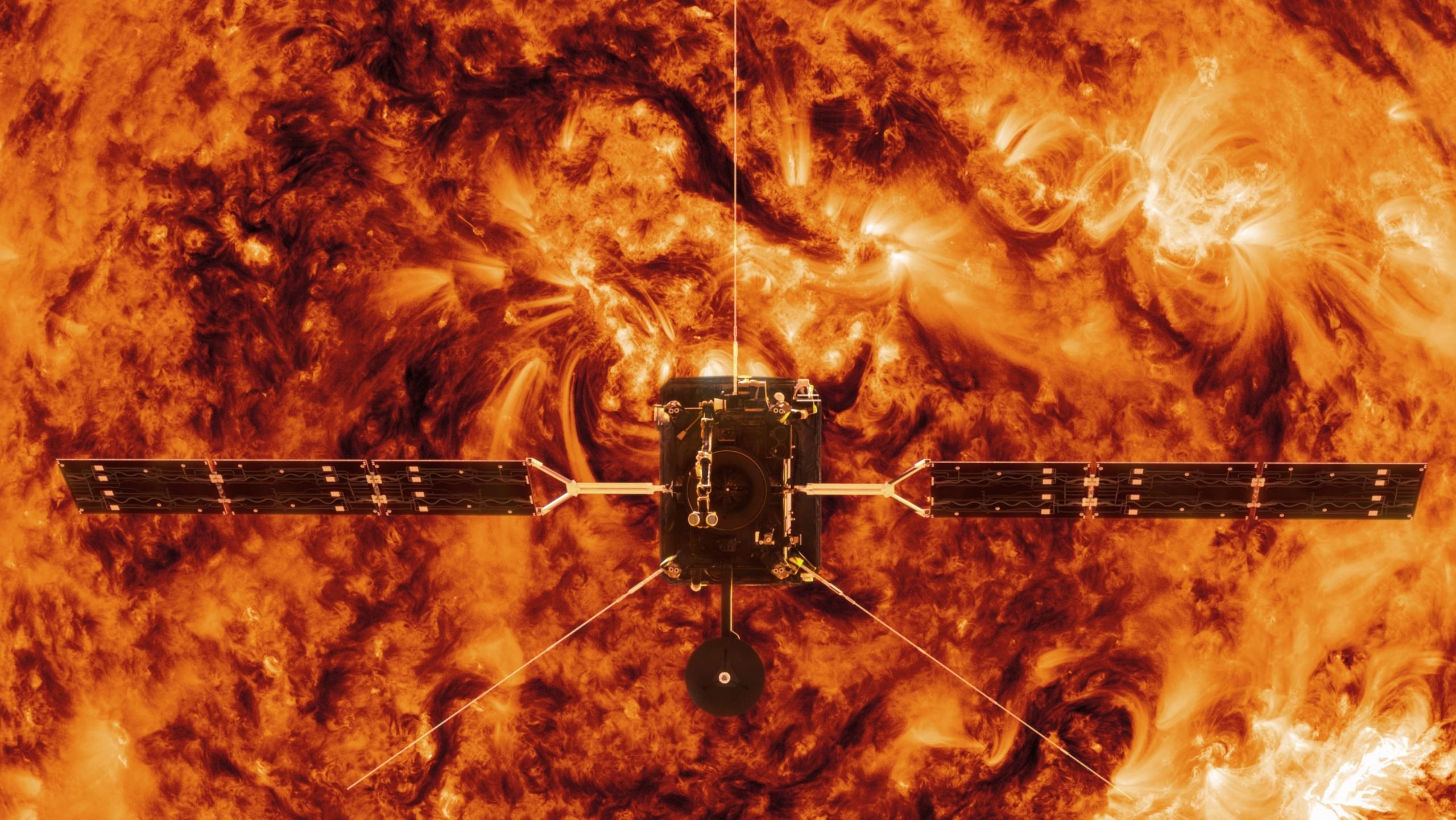
    Solar Orbiter Facing Sun
    Artist impression of ESA’s Solar Orbiter in front of the Sun (not to scale). The Sun is based on an image captured by NASA’s Solar Dynamics Observatory, and has been adapted for this artistic view. Credit: spacecraft: ESA/ATG medialab; Sun: NASA / SDO / P. Testa (CfA)

    When Solar Orbiter launches on its journey to the Sun, there’s one key piece of engineering making this ESA-NASA mission possible: the heat shield.

    Seeking a view of the Sun’s north and south poles, Solar Orbiter will journey out of the ecliptic plane — the belt of space, roughly in line with the Sun’s equator, through which the planets orbit. Slinging repeatedly past Venus in order to draw near the Sun and climb higher above the ecliptic, the spacecraft bounds from the Sun and back toward the orbit of Earth throughout its mission.

    “Although Solar Orbiter goes quite close to the Sun, it also goes quite far away,” said Anne Pacros, the payload manager at the European Space Agency’s, or ESA’s, European Space Research and Technology Centre in the Netherlands. “We have to survive both high heat and extreme cold.” In the dark of space, Solar Orbiter faces temperatures of minus 300 degrees Fahrenheit (150 degrees Celsius). At closest approach, 26 million miles (42 million kilometers) from the Sun, it will encounter intense heat and radiation.

    But Solar Orbiter’s 324-pound (147-kilogram) heat shield reflects and guides heat away from the spacecraft and can withstand up to 970° F (520° C).


    Trailer for the ESA-NASA Solar Orbiter mission. Credit: NASA’s Goddard Space Flight Center/Genna Duberstein. Animation by ESA/ATG Medialab.

    The heat shield is built like a 10-foot-by-8-foot (3-meter-by-2.4-meter) sandwich. The front layer — wafer-thin sheets of titanium foil — strongly reflects heat. A honeycomb-patterned aluminum base, covered in more foil insulation, forms the inner slice closest to the spacecraft and provides support.
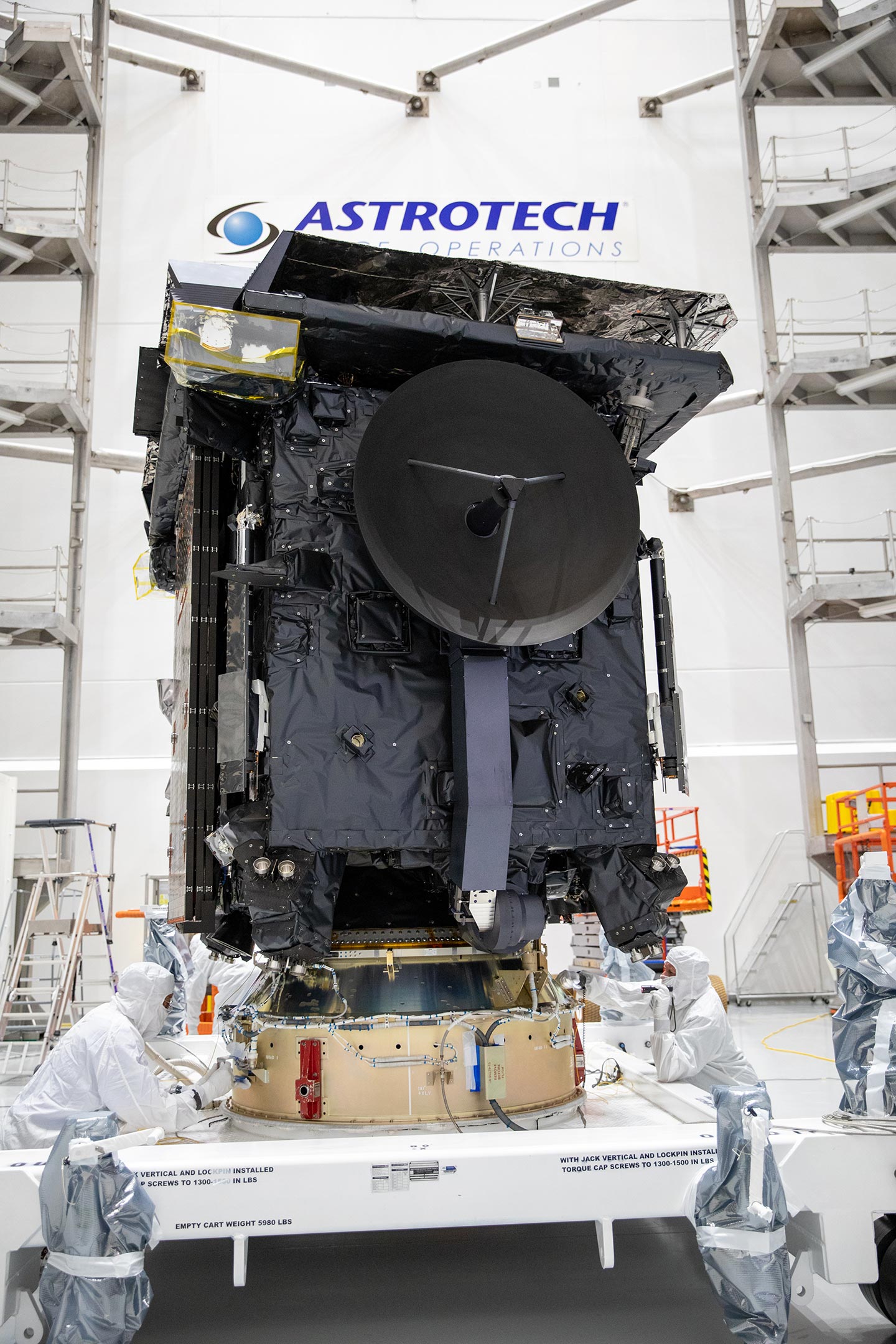
    Preparing Solar Orbiter Spacecraft
    The Solar Orbiter spacecraft is prepared for encapsulation in the Atlas V payload fairing. In this image, the front layer of thin titanium foil and star-shaped brackets are visible. The front layer reflects heat, while the brackets provide support. Credit: NASA/Ben Smegelsky

    Star-shaped titanium brackets keep the layers in place, like a toothpick tasked to hold bread together, but notably, this sandwich is missing its filling. The nearly 10-inch gap in the shield funnels heat out to space. A smaller, second gap lies between the inner slice and the spacecraft. Overall, the shield is 15 inches (38 cm) thick. It also has several eyes: peepholes for five of the spacecraft’s remote-sensing instruments to peer through.

    Solar Orbiter’s heat shield is coated with a thin, black layer of calcium phosphate, a charcoal-like powder much like pigments used in cave paintings thousands of years ago.

    “It’s funny that something as technologically advanced as this is actually very old,” Pacros said. But the coating resists degradation under the blow of intense solar ultraviolet radiation. Although the black powder does absorb some heat, it’s excellent at shedding that heat back out to space.

    Solar Orbiter also has to contend with its own heat. Its instruments work up a sweat while they’re running; panels of radiators on the side of the spacecraft eject heat and ensure the instruments don’t get too hot.

    Tight control of the spacecraft’s position and tilt is key to protecting the instruments. Once the spacecraft is past the 88-million-mile (142-million-kilometer) mark in its solar flybys — that’s 95% of the distance between the Sun and Earth — the heat shield must be pointed straight at the Sun. That means Solar Orbiter will crab walk through space, keeping the spacecraft and instruments tucked in the heat shield’s shadow.

    Solar Orbiter is an international cooperative mission between the European Space Agency and NASA. ESA’s European Space Research and Technology Centre (ESTEC) in the Netherlands manages the development effort. The European Space Operations Center (ESOC) in Germany will operate Solar Orbiter after launch. Solar Orbiter was built by Airbus Defence and Space, and contains 10 instruments: nine provided by ESA member states and ESA. NASA provided one instrument (SoloHI) and an additional sensor, the Heavy Ion Sensor, which is part of the Solar Wind Analyzer (SWA) instrument suite.

    Never miss a breakthrough: Join the SciTechDaily newsletter.
    Follow us on Google and Google News.

    Astronomy European Space Agency NASA Popular Solar Orbiter
    Share. Facebook Twitter Pinterest LinkedIn Email Reddit

    Related Articles

    Incredible New Views of the Sun – As You’ve Never Seen It Before

    Massive Solar Eruption Captured by Solar Orbiter Spacecraft

    Solar Orbiter Snaps Closest Pictures Ever of the Sun – Reveals New “Campfires” Phenomena

    Watch NASA/ESA Solar Orbiter Mission First Image Release – Closer to Sun That Any Spacecraft in History

    Cassini Detects Particles Being Accelerated to Ultra-High Energies

    Satellites Monitor the Colliding Winds of O-Type Stars

    New XDF Image, The Deepest-Ever View of the Universe

    Hubble Zooms in on the Center of M4

    Hubble Image of Peculiar Galaxy Pair Arp 116

    Leave A Reply Cancel Reply

    • Facebook
    • Twitter
    • Pinterest
    • YouTube

    Don't Miss a Discovery

    Subscribe for the Latest in Science & Tech!

    Trending News

    AI Could Detect Early Signs of Alzheimer’s in Under a Minute – Far Before Traditional Tests

    What if Dark Matter Has Two Forms? Bold New Hypothesis Could Explain a Cosmic Mystery

    This Metal Melts in Your Hand – and Scientists Just Discovered Something Strange

    Beef vs. Chicken: Surprising Results From New Prediabetes Study

    Alzheimer’s Breakthrough: Scientists Discover Key Protein May Prevent Toxic Protein Clumps in the Brain

    Quantum Reality Gets Stranger: Physicists Put a Lump of Metal in Two Places at Once

    Scientists May Have Found the Key to Jupiter and Saturn’s Moon Mystery

    Scientists Uncover Brain Changes That Link Pain to Depression

    Follow SciTechDaily
    • Facebook
    • Twitter
    • YouTube
    • Pinterest
    • Newsletter
    • RSS
    SciTech News
    • Biology News
    • Chemistry News
    • Earth News
    • Health News
    • Physics News
    • Science News
    • Space News
    • Technology News
    Recent Posts
    • Living With Roommates Might Be Changing Your Gut Microbiome Without You Knowing
    • Simple and Cheap Blood Test Could Detect Cancer and Other Diseases Before Symptoms Appear
    • Century-Old Cleaning Chemical Linked to 500% Increased Risk of Parkinson’s Disease
    • What if Your Memories Never Happened? Physicists Take a New Look at the Boltzmann Brain Paradox
    • Students Found an Ancient Star That Shouldn’t Be in the Milky Way
    Copyright © 1998 - 2026 SciTechDaily. All Rights Reserved.
    • Science News
    • About
    • Contact
    • Editorial Board
    • Privacy Policy
    • Terms of Use

    Type above and press Enter to search. Press Esc to cancel.