
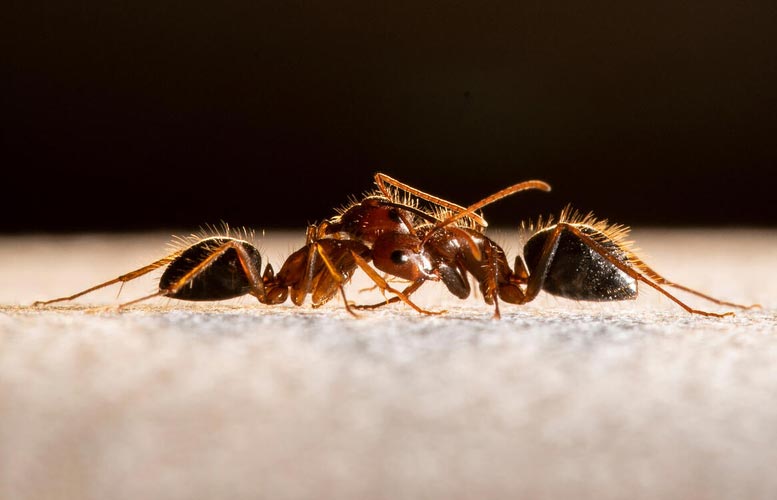
For most social animals, even humans, the ability to distinguish friend versus foe can be a challenge that often can lead to knee-jerk aggression. But when it comes to ants getting aggressive, there’s a more sophisticated method to their madness.
In a new study, published this month in the Journal of Experimental Biology, scientists in the Department of Biological Sciences at Vanderbilt report definitive evidence of a specific mechanism within ants that is responsible for unlocking aggressive behaviors toward other ants. The research — the first to pinpoint this mechanism and its precise role in ant biology — reports a social characteristic that could help account for their evolutionary success.
“Eusocial ants are one of the biggest success stories in evolutionary biology, thanks in no small part to their advanced organizational behaviors and complex social interactions,” said Laurence Zwiebel, senior author of the paper and Cornelius Vanderbilt Chair in Biological Sciences. “For years, researchers have hypothesized that ants have specific chemical markers that play key roles in their interactions. What surprised us is that ants not only have these markers, but require these signals be very precisely decoded by specific receptors to trigger aggression.”
One of the most important aspects of ant identity is the ability to distinguish nestmates from non-nestmates that typically act as bad actors. To do this, they rely on chemical markers made up of specific odorants on their bodies, which Zwiebel refers to as a “coat of many odors,” to emit complex odor blends that act as a sort of personal identifier for other ants.
In this study, the researchers discovered that ants have to smell and correctly decode these specific compounds on intruder ants from other colonies in order to “unlock” their aggressive behavior and defend their nest. This implies that ants default to acceptance and select aggression only if they are specifically triggered.
To study this “lock and key” mechanism, Zwiebel and graduate student Stephen Ferguson, the lead author on the study, gathered Camponotus floridanus ants from nine distinct colonies collected across the Florida Keys.
Before testing, they used a specific chemical agent previously discovered by Zwiebel lab to block or over-excite ant odorant receptors. They set up mini-dueling arenas for two ants (either from the same or different colonies) to interact and, if they decide, fight. During each arena test, they filmed the ants to score the interactions based on their aggressive behaviors — the most common being lunging, biting, or dragging.
While ants with normal receptors continued to recognize and fight ants from other colonies, ants with blocked or over-activated receptors displayed dramatically reduced aggressive behavior.
“Accepting friends and rejecting foes is one of the most important decisions an ant worker must make,” said Ferguson. “Our study finds that unless there is a clear and unambiguous threat, ants are more likely to be accepting than they are to be aggressive. This process may have contributed to the evolutionary success of these insects, and there may be important lessons about tempering aggression for other social beings such as humans.”
Reference: “Odor coding of nestmate recognition in the eusocial ant Camponotus floridanus” by Stephen T. Ferguson, Kyu Young Park, Alexandra A. Ruff, Isaac Bakis and Laurence J. Zwiebel, 28 January 2020, Journal of Experimental Biology.
DOI: 10.1242/jeb.215400
The research is supported by a grant from the National Institutes of Health and with endowment funding from Vanderbilt University.
Never miss a breakthrough: Join the SciTechDaily newsletter.
Follow us on Google and Google News.