
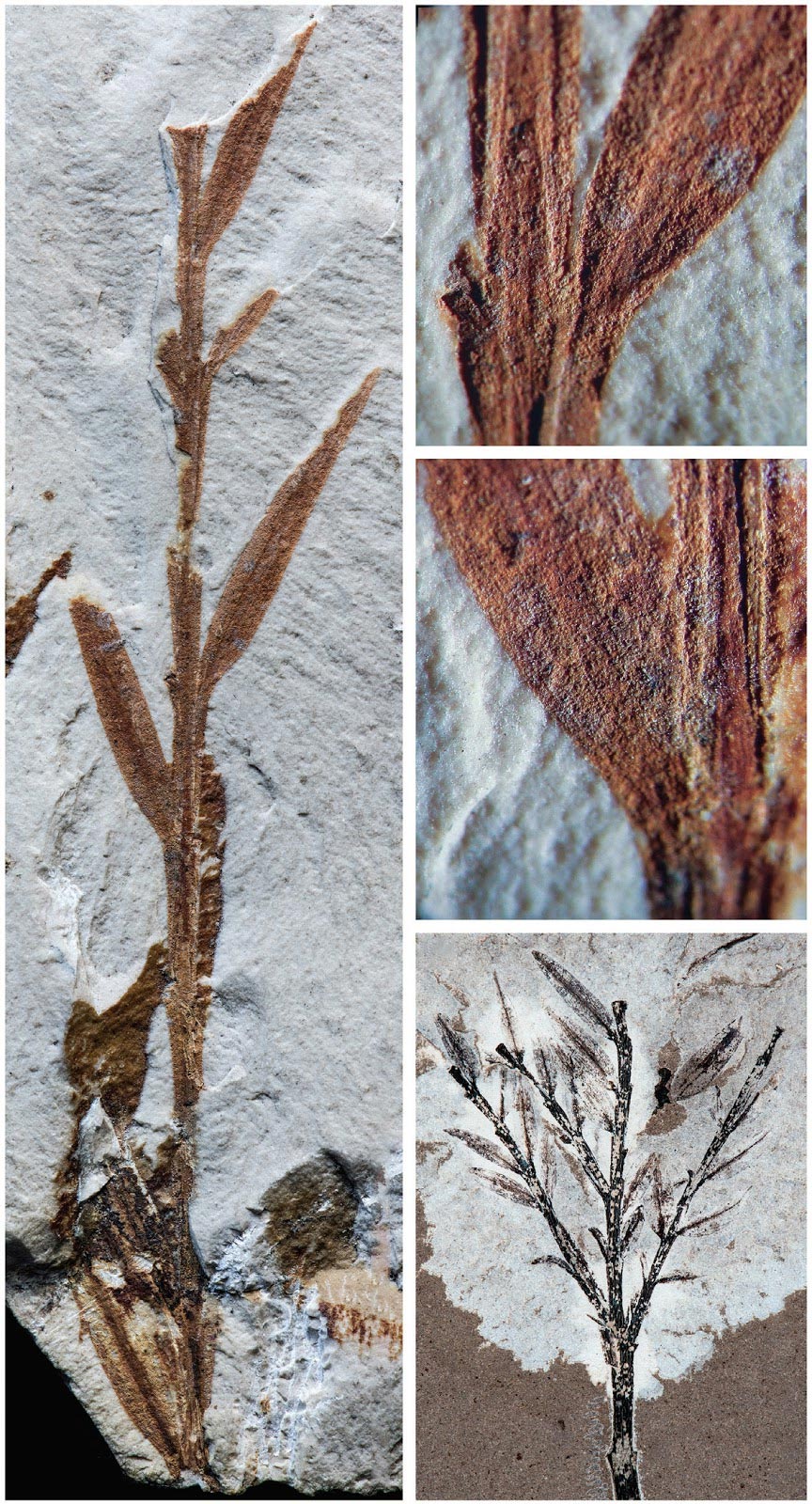
A fossilized leafy branch from the early Eocene in Patagonia described in 1941 is still often cited as the oldest bamboo fossil and the main fossil evidence for a Gondwanan origin of bamboos. However, a recent examination by Dr. Peter Wilf from Pennsylvania State University revealed the real nature of Chusquea oxyphylla. The recent findings, published in the paper in the open-access journal Phytokeys, show that it is actually a conifer.
The corrected identification is significant because the fossil in question was the only bamboo macrofossil still considered from the ancient southern supercontinent of Gondwana. The oldest microfossil evidence for bamboo in the Northern Hemisphere belongs to the Middle Eocene, while other South American fossils are not older than Pliocene.
Over the last decades, some authors have doubted whether the Patagonian fossil was really a bamboo or even a grass species at all. But despite its general significance, modern-day re-examinations of the original specimen were never published. Most scientists referring to it had a chance to study only a photograph found in the original publication from 1941 by the famous Argentine botanists Joaquín Frenguelli and Lorenzo Parodi.
In his recent study of the holotype specimen at Museo de La Plata, Argentina, Dr. Peter Wilf revealed that the fossil does not resemble members of the Chusquea genus or any other bamboo.
“There is no evidence of bamboo-type nodes, sheaths or ligules. Areas that may resemble any bamboo features consist only of the broken departure points of leaf bases diverging from the twig. The decurrent, extensively clasping leaves are quite unlike the characteristically pseudopetiolate leaves of bamboos, and the heterofacially twisted free-leaf bases do not occur in any bamboo or grass,” wrote Dr. Wilf.
Instead, Wilf linked the holotype to the recently described fossils of the conifer genus Retrophyllum from the same fossil site, the prolific Laguna del Hunco fossil lake-beds in Chubut Province, Argentina. It matches precisely the distichous fossil foliage form of Retrophyllum spiralifolium, which was described based on a large set of data — a suite of 82 specimens collected from both Laguna del Hunco and the early middle Eocene Río Pichileufú site in Río Negro Province.
Retrophyllum is a genus of six living species of rainforest conifers. Its habitat lies in both the Neotropics and the tropical West Pacific.
The gathered evidence firmly confirms that Chusquea oxyphylla has nothing in common with bamboos. Thus, it requires renaming. Preserving the priority of the older name, Wilf combined Chusquea oxyphylla and Retrophyllum spiralifolium into Retrophyllum oxyphyllum.
The exclusion of a living New World bamboo genus from the overall floral list for Eocene Patagonia weakens the New World biogeographic signal of the late-Gondwanan vegetation of South America, which already showed much stronger links to living floras of the tropical West Pacific.
The strongest New World signal remaining in Eocene Patagonia based on well-described macrofossils comes from fossil fruits of Physalis (a genus of flowering plants including tomatillos and ground cherries), which is an entirely American genus, concludes Dr. Wilf.
Reference: “Eocene “Chusquea” fossil from Patagonia is a conifer, not a bamboo” by Peter Wilf, 3 February 2020, PhytoKeys.
DOI: 10.3897/phytokeys.139.48717
Never miss a breakthrough: Join the SciTechDaily newsletter.
Follow us on Google and Google News.