
Scientists using an instrument aboard NASA’s Mars Atmosphere and Volatile EvolutioN, or MAVEN, spacecraft have discovered that water vapor near the surface of the Red Planet is lofted higher into the atmosphere than anyone expected was possible. There, it is easily destroyed by electrically charged gas particles — or ions — and lost to space.
Researchers said that the phenomenon they uncovered is one of several that has led Mars to lose the equivalent of a global ocean of water up to hundreds of feet (or up to hundreds of meters) deep over billions of years. Reporting on their finding on November 13, 2020, in the journal Science, researchers said that Mars continues to lose water today as vapor is transported to high altitudes after sublimating from the frozen polar caps during warmer seasons.
“We were all surprised to find water so high in the atmosphere,” said Shane W. Stone, a doctoral student in planetary science at the University of Arizona’s Lunar and Planetary Laboratory in Tucson. “The measurements we used could have only come from MAVEN as it soars through the atmosphere of Mars, high above the planet’s surface.”
To make their discovery, Stone and his colleagues relied on data from MAVEN’s Neutral Gas and Ion Mass Spectrometer (NGIMS), which was developed at NASA’s Goddard Space Flight Center in Greenbelt, Maryland. The mass spectrometer inhales air and separates the ions that comprise it by their mass, which is how scientists identify them.
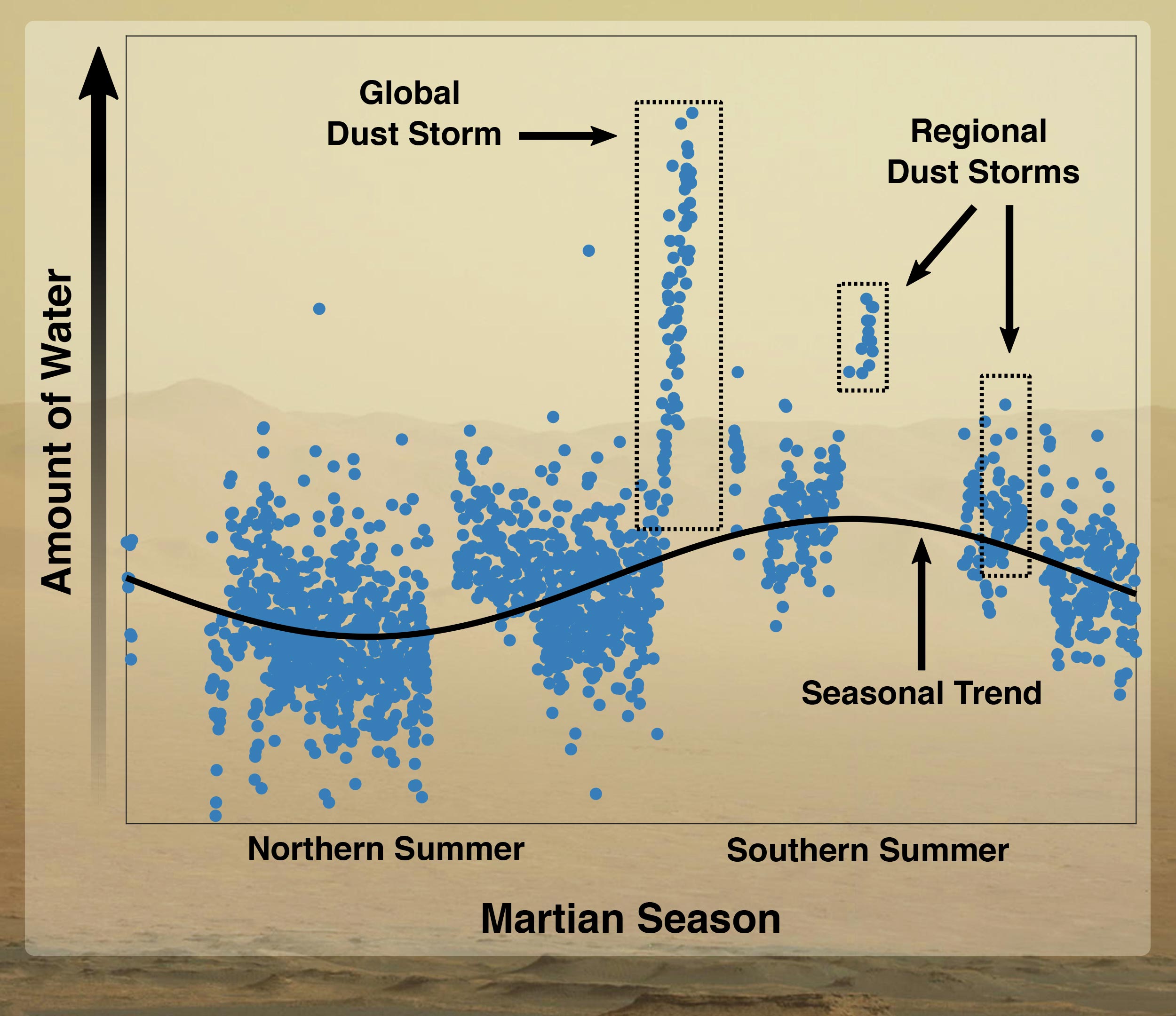
Stone and his team tracked the abundance of water ions high over Mars for more than two Martian years. In doing so, they determined that the amount of water vapor near the top of the atmosphere at about 93 miles, or 150 kilometers, above the surface is highest during summer in the southern hemisphere. During this time, the planet is closest to the Sun, and thus warmer, and dust storms are more likely to happen.

The warm summer temperatures and strong winds associated with dust storms help water vapor reach the uppermost parts of the atmosphere, where it can easily be broken into its constituent oxygen and hydrogen. The hydrogen and oxygen then escape to space. Previously, scientists thought that water vapor was trapped close to the Martian surface like it is on Earth.
“Everything that makes it up to the higher part of the atmosphere is destroyed, on Mars or on Earth,” Stone said, “because this is the part of the atmosphere that is exposed to the full force of the Sun.”
The researchers measured 20 times more water than usual over two days in June 2018, when a severe global dust storm enveloped Mars (the one that put NASA’s Opportunity rover out of commission). Stone and his colleagues estimated Mars lost as much water in 45 days during this storm as it typically does throughout an entire Martian year, which lasts two Earth years.
“We have shown that dust storms interrupt the water cycle on Mars and push water molecules higher in the atmosphere, where chemical reactions can release their hydrogen atoms, which are then lost to space,” said Paul Mahaffy, director of the Solar System Exploration Division at NASA Goddard and principal investigator of NGIMS.
Other scientists have also found that Martian dust storms can lift water vapor far above the surface. But nobody realized until now that the water would make it all the way to the top of the atmosphere. There are abundant ions in this region of the atmosphere that can break apart water molecules 10 times faster than they’re destroyed at lower levels.
“What’s unique about this discovery is that it provides us with a new pathway that we didn’t think existed for water to escape the Martian environment,” said Mehdi Benna, a Goddard planetary scientist and co-investigator of MAVEN’s NGIMS instrument. “It will fundamentally change our estimates of how fast water is escaping today and how fast it escaped in the past.”
Reference: “Hydrogen escape from Mars is driven by seasonal and dust storm transport of water” by Shane W. Stone, Roger V. Yelle, Mehdi Benna, Daniel Y. Lo, Meredith K. Elrod and Paul R. Mahaffy, 13 November 2020, Science.
DOI: 10.1126/science.aba5229
This research was funded by the MAVEN mission. MAVEN’s principal investigator is based at the University of Colorado Boulder’s Laboratory for Atmospheric and Space Physics, and NASA Goddard manages the MAVEN project.
Never miss a breakthrough: Join the SciTechDaily newsletter.
Follow us on Google and Google News.
2 Comments
That seems to explain Martian dryness. The other major factor is that Mars, being smaller than Earth, cooled faster and the iron core solidified. The result is that the very weak magnetic field no longer deflects the solar wind as it does on Earth. This subjects the Martian surface to be bombarded by intense and energetic radiation. This also contributes to loss of water. The intense radiation will also be hazardous to humans.
Dr. Chuck
Dreams of terraforming Mars were always subject to the limitations of physics. However, this discovery might help to force some dreamers to look deeper into the science (and engineering) before assuming that terraforming Mars is a worthwhile endeavor for any living or soon-to-be-born generations.