
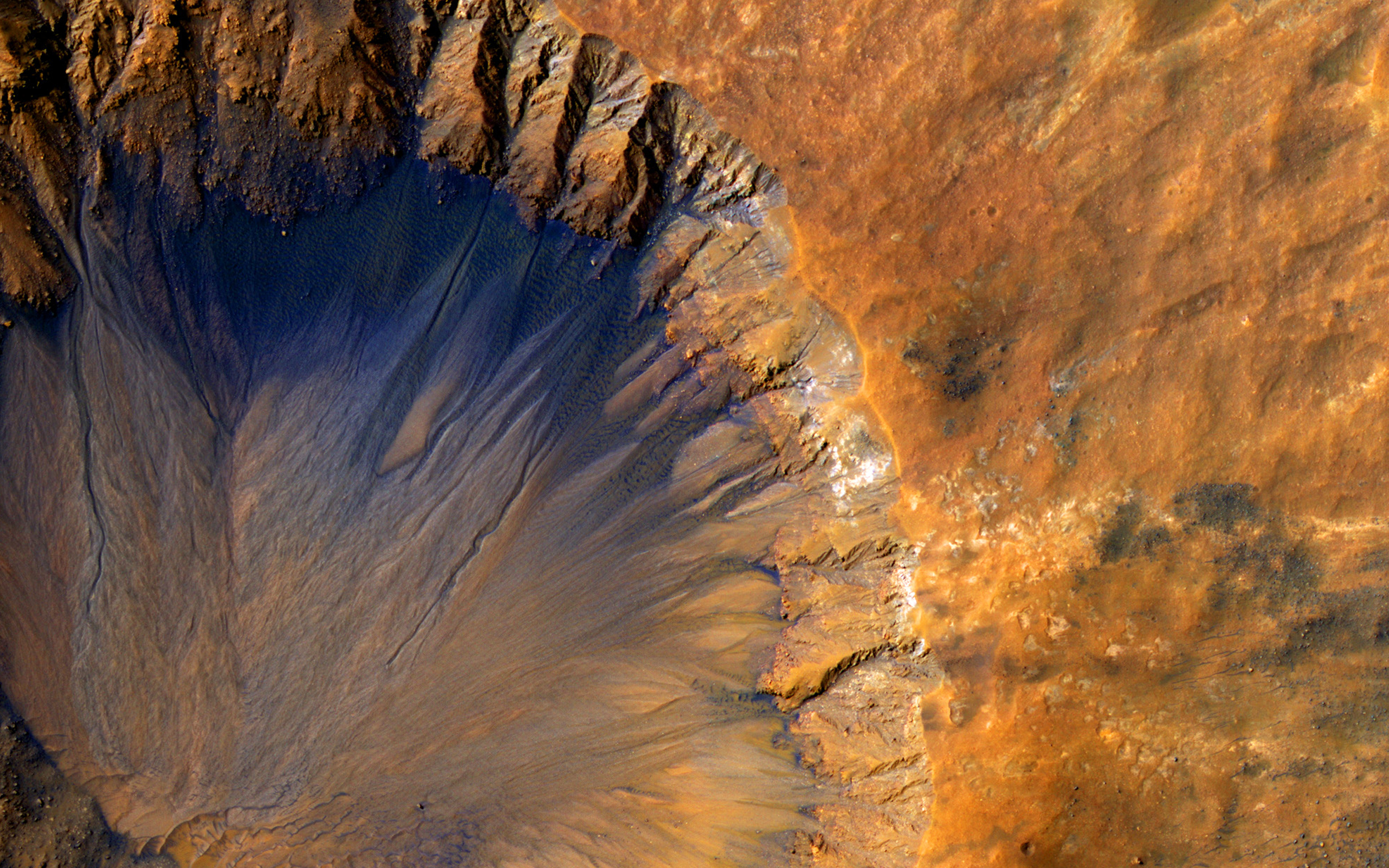
Martian dust storms heat the atmosphere, push water vapor sky-high, and expose it to UV radiation that destroys water molecules.
Mars scientists have long suspected that the Red Planet, which was once warm and wet like Earth, has lost most of its water to outer space. Since water is one of the key ingredients for life as we know it, scientists have been trying to understand how long it flowed on Mars and how it was lost.
Now a new Nature Astronomy study led by Michael Chaffin, a researcher at the Laboratory for Atmospheric and Space Physics (LASP) at the University of Colorado Boulder, indicates that regional dust storms can play a significant role in drying out the Red Planet.
Although Mars scientists like Chaffin have assumed that globe-enveloping dust storms, which typically strike every one to three Martian years, along with the hot summer months in the southern hemisphere, played a role in drying out the planet, they didn’t have the measurements they needed to tie the whole picture together. But in January and February 2019, coincident observations from three spacecraft orbiting Mars allowed an international team of researchers to collect unprecedented data during a regional dust storm. The results indicate that Mars loses double the amount of water during these storms than during calmer periods.

“Until now, Mars scientists didn’t realize how big of an impact regional dust storms have on the Martian atmosphere,” says Chaffin.
Solar Radiation Rips Apart Water Molecules
The study’s findings indicate that as the dust storm heats up the atmosphere, winds are generated that catapult water vapor to much higher altitudes than usual. At these highest altitudes, Mars’ atmosphere is sparse and water molecules are more vulnerable to ultraviolet radiation, which tears them into their lighter components of hydrogen and oxygen. The lightest element, hydrogen, is then easily lost to space. “All you have to do to lose water permanently is to lose one hydrogen atom, because then the hydrogen and oxygen can’t recombine into water,” says Chaffin. “So when you’ve lost a hydrogen atom, you’ve lost a water molecule.”
The study would not have been possible without the simultaneous measurements from four instruments aboard the spacecraft. NASA’s Mars Reconnaissance Orbiter measured the temperature, dust, and water-ice concentrations from the surface to about 62 miles, or 100 kilometers, above it. Within the same altitude range, the European Space Agency’s Trace Gas Orbiter measured the concentration of water vapor and ice, and the imaging ultraviolet spectrometer aboard NASA’s MAVEN spacecraft capped off the measurements by reporting the amount of hydrogen at the highest altitudes in Mars’ atmosphere, 620 miles (1,000 kilometers) above the planet’s surface.
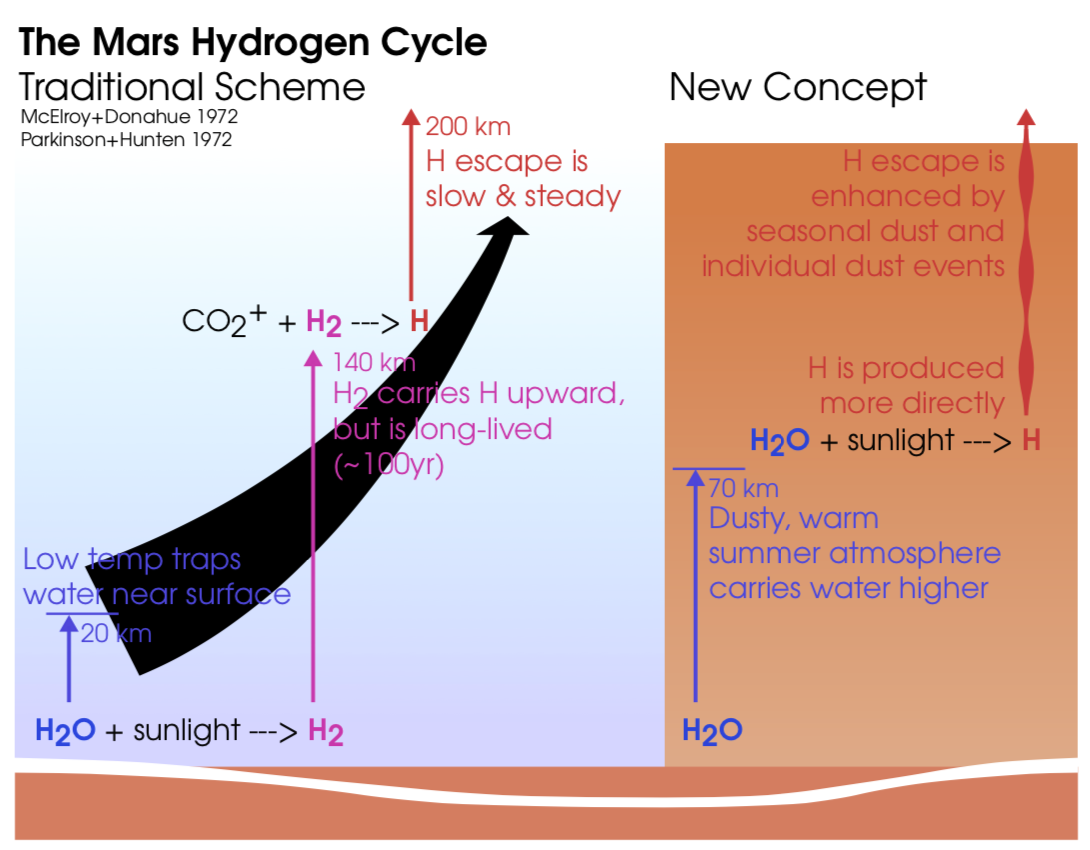
It was the first time that so many missions had focused on a single event. “We’ve really caught the whole system in action,” says Chaffin.
“This paper helps us virtually go back in time and say, ‘OK, now we have another way to lose water that will help us relate this little water we have on Mars today with the humongous amount of water we had in the past,” says Geronimo Villanueva, a Martian water expert at NASA’s Goddard Space Flight Center and co-author on Chaffin’s paper.
Ice Clouds Vanish as Atmosphere Heats Up
Images from MAVEN’s imaging ultraviolet spectrograph confirm that before the 2019 storm, ice clouds could be seen hovering above the soaring volcanoes in the Tharsis region of Mars. Because ice could no longer condense near the warmer surface, these clouds “disappeared completely when the dust storm was in full swing,” explains Chaffin, and then reappeared after the dust storm ended.
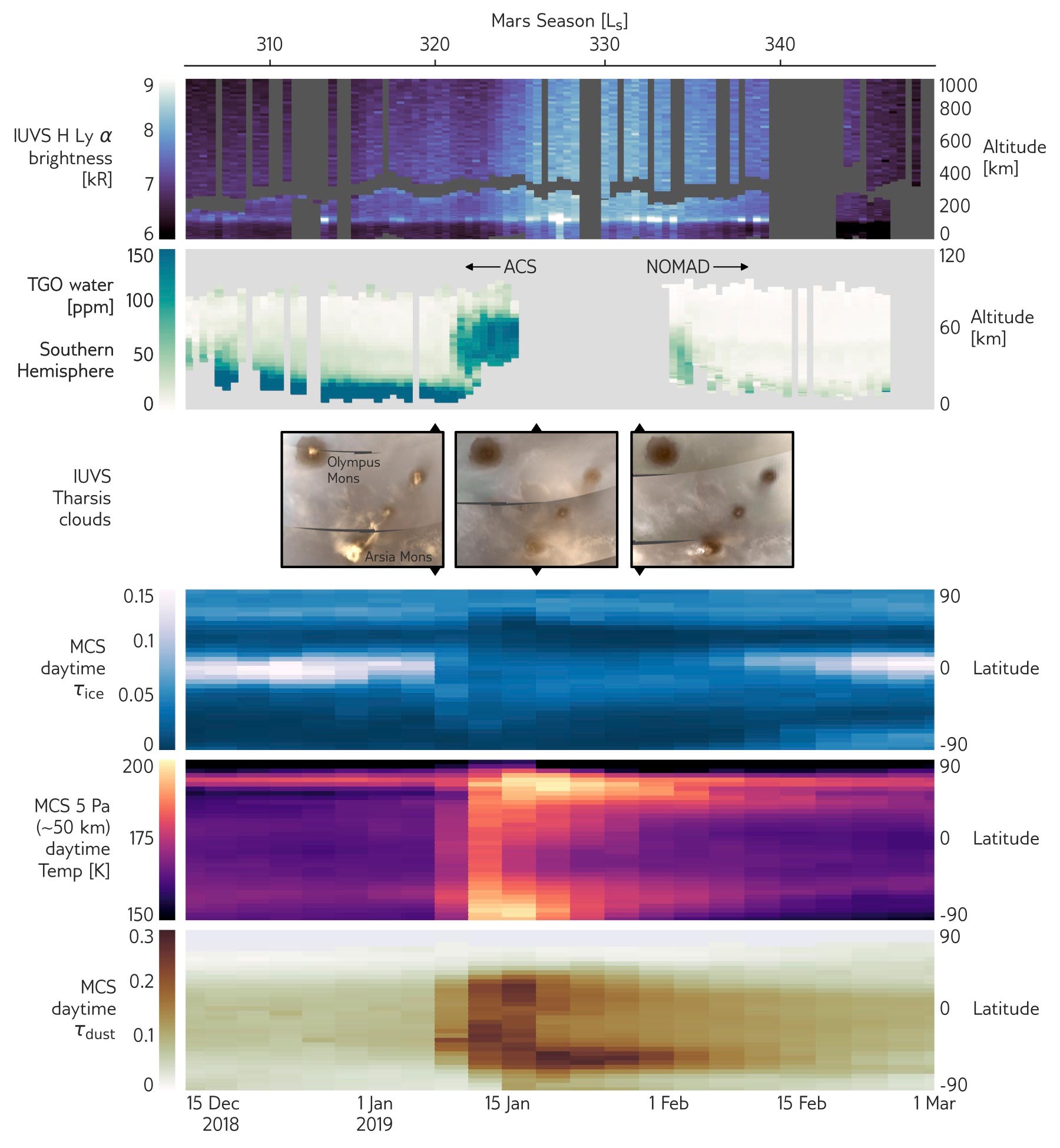
The combined observations showed water vapor in the lower atmosphere before the dust storm began. As the dust storm increased, heating the atmosphere and generating winds, the instruments saw water vapor catapulted to higher altitudes. Trace Gas Orbiter found 10 times more water in the middle atmosphere after the dust storm started, which coincides precisely with data from the infrared radiometer on the Mars Reconnaissance Orbiter. The MAVEN observations 650 miles (1,050 kilometers) above the surface also concurred, showing a 50% increase of hydrogen during the storm.
Collectively, the data from the three spacecraft paint a clear picture of how a regional dust storm can help Martian water escape. “The instruments should all tell the same story, and they do,” says Villanueva.
“It was an honor to lead this fantastic international team and help bring this result to light. Studies like this one demonstrate the power of cross-mission and international collaboration to drive Mars science forward,” says Chaffin.
For more on this research, see International Trio of Mars Orbiters Shows Small Dust Storms Help Dry Out the Red Planet.
Reference: “Martian water loss to space enhanced by regional dust storms” by M. S. Chaffin, D. M. Kass, S. Aoki, A. A. Fedorova, J. Deighan, K. Connour, N. G. Heavens, A. Kleinböhl, S. K. Jain, J.-Y. Chaufray, M. Mayyasi, J. T. Clarke, A. I. F. Stewart, J. S. Evans, M. H. Stevens, W. E. McClintock, M. M. J. Crismani, G. M. Holsclaw, F. Lefevre, D. Y. Lo, F. Montmessin, N. M. Schneider, B. Jakosky, G. Villanueva, G. Liuzzi, F. Daerden, I. R. Thomas, J.-J. Lopez-Moreno, M. R. Patel, G. Bellucci, B. Ristic, J. T. Erwin, A. C. Vandaele, A. Trokhimovskiy and O. I. Korablev, 16 August 2021, Nature Astronomy.
DOI: 10.1038/s41550-021-01425-w
This research was funded in part by the MAVEN mission. MAVEN’s principal investigator is based at LASP, and NASA Goddard manages the MAVEN project.
Never miss a breakthrough: Join the SciTechDaily newsletter.
Follow us on Google and Google News.