
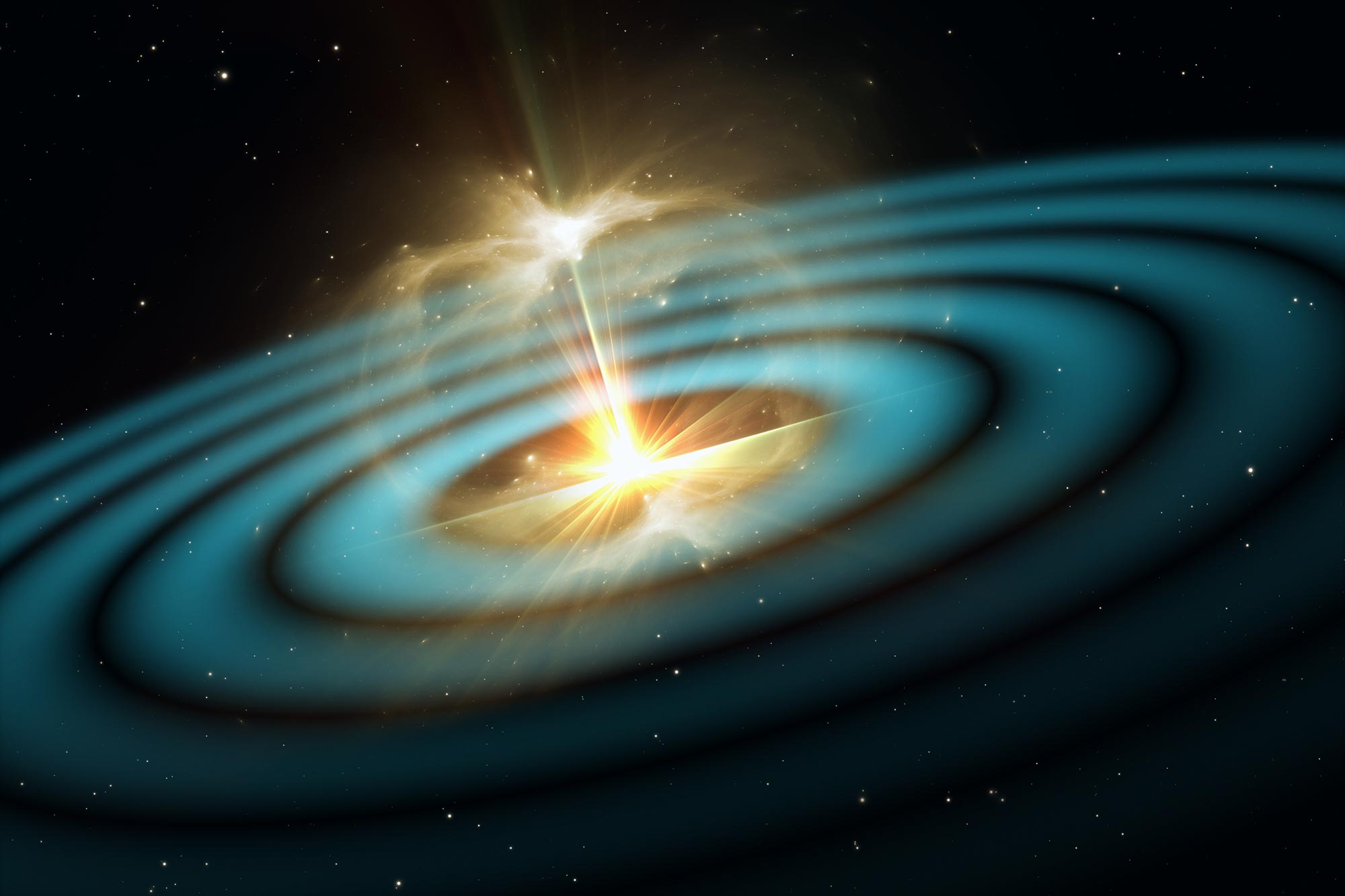
A new detector-based method clarifies how gravitational waves should be measured in an evolving universe.
Imagine trying to measure a ripple on the surface of a pond while the pond itself is slowly changing shape. That is the challenge scientists face when they study gravitational waves not as isolated signals from colliding black holes, but as part of the evolving universe itself.
Gravitational waves are tiny distortions in spacetime. Their first direct detection in 2015 opened a new era in astronomy, giving scientists a way to observe cosmic events that do not rely on light. Since then, researchers have become highly skilled at interpreting waves that travel through mostly empty, relatively calm regions of space. The signals from merging black holes are a clear example.
In those familiar cases, the setup is comparatively clean. The wave can be treated as a small disturbance passing through a stable background, and detectors measure the resulting stretch and squeeze in spacetime. The “wave” and the “background” can be separated in a meaningful way.
Why the Whole Universe Makes the Problem Harder
Cosmology changes the picture. Instead of studying a wave moving through an otherwise quiet patch of space, researchers must consider the universe as a whole. That includes spacetime itself, along with everything inside it, such as stars, galaxies, black holes, and the large-scale structure of the cosmos.
In this setting, the background is not still. The universe expands, matter is unevenly distributed, and small variations in density and motion constantly influence spacetime. These effects make it much harder to say exactly where the background ends and a gravitational wave begins.
That leads to a deceptively simple question: What does a gravitational wave detector actually measure when the entire universe is in motion?
A More Physical Way To Define the Signal
Dr. Guillem Domènech and colleagues at the Institute of Theoretical Physics at Leibniz University Hannover (LUH) have developed a detector-based framework designed to solve this problem.
Rather than starting with abstract mathematical components of a gravitational field, the team focused on what a real experiment would record. Their model uses two freely falling test masses, or atomic clocks, connected by a beam of light. When a gravitational wave passes through, it can slightly change the time the light takes to travel between them. That change appears as a measurable shift in timing or frequency.
The researchers derived this observable quantity in a coordinate-independent way, including effects up to second order in cosmic fluctuations. In other words, they worked out how to describe the detector’s signal without confusing a real physical effect with an artifact of the mathematical language used to describe the universe.
“Gravitational wave detectors measure differences in the frequencies and arrival times of light beams,” says lead author Guillem Domènech. “We calculate these quantities exactly within an expanding spacetime and distinctly isolate what is genuinely measurable from effects that rely on the mathematical description. This ensures that theoretical predictions for future experiments are rigorous and reliable.”
Building a Bridge Between Theory and Observation
The new approach gives theorists and experimentalists a common way to talk about gravitational wave measurements. In the simple limit of quiet spacetime, it reproduces the familiar signals measured by ground-based interferometers. In the more complex setting of cosmology, it keeps the prediction tied to what an actual detector would see.
That makes the framework especially useful for searches for primordial gravitational waves and other subtle signals spread across the universe. It is also relevant to current and future efforts that use pulsar timing arrays and the space-based observatory LISA.
Reference: “Observable Gravitational Wave Strain at Second Order” by Guillem Domènech, Shi Pi and Ao Wang, 3 June 2026, Physical Review Letters.
DOI: 10.1103/pwbs-xwrh
Never miss a breakthrough: Join the SciTechDaily newsletter.
Follow us on Google and Google News.
5 Comments
This is a massive leap forward for gravitational wave astronomy, and it strongly mirrors what we’ve been exploring with the Torsion Hill framework. For a long time, standard models treated space like a quiet, flat table. But this study openly treats the universe as a humming, dynamic environment where background fluctuations actively induce secondary signatures—a concept central to a Torsion Hill model.
Most importantly, Domènech’s team solved the mathematical “gauge” problem by anchoring their equations strictly to physical, coordinate-independent observables (like clock shifts between falling test masses). It’s a rigorous reality check: it proves that whether you model spacetime as a gravity well, a twisting gradient, or an expanding hill, the physics must ultimately answer to what a real detector can physically measure.
This post adds to my understanding and probably how to interpret Prof Balungi Francis’s findings in ‘Spacetime as a damped harmonic oscillator and the Dark Universe’ a paper that has changed how I view space time and dark energy. Thanks
C Memo 2606_141340,150138_Source 1.Reinterpretation【()】
Source 1.
https://scitechdaily.com/scientists-develop-a-new-way-to-measure-gravitational-waves-in-the-expanding-universe/
1.
_Scientists have developed a new method to measure gravitational waves in the expanding universe.
_Gravitational waves (generally studied as weak disturbances passing through quiet spacetime, but the situation becomes much more complex when considering the entire universe) become.
ㅡㅡㅡㅡㅡㅡㅡ
【&&&&&c1.()
>>>>That is not necessarily the case. If we view the entire universe from a magicsum perspective, detecting gravitational waves might become easier. 1340.
>>>> Gravitational waves appear in the process of the retrograde memory banc of msbase.galaxy or the natural decomposition of qpeoms, particularly in the complex unit system qms.nqvixer. Hmm. 2606142425.28.
】
1-1.
_New detector-based methods clearly reveal how to measure gravitational waves in an evolving universe.
_Imagine trying to measure ripples on the surface of a pond, while the pond itself is slowly changing shape in the process.
_This is exactly the difficulty scientists face when studying gravitational waves not as isolated signals arising from black hole collisions, but as part of the evolving universe itself.
ㅡㅡㅡㅡㅡㅡㅡ
【&&&&c1.()
^^^^^^ The assumption that gravitational waves have always originated from black holes may be incorrect.
It appears that black hole vixers are a fundamental property of spontaneous generation.
For example, what appears as blackhole.sample1.oms.vix.ain creates neutron stars vixxas. Gravitational waves appear in spacetime nkbanc(*) distortions even without black hole collisions. 1350.
sample1.
msbase12.qpeoms.2square.vector
oms.vix.a’6,vixx.a(b1,g3,k3,o5,n6)
b0acfd|0000e0
000ac0|f00bde
0c0fab|000e0d
e00d0c|0b0fa0
f000e0|b0dac0
d0f000|cae0b0
0b000f|0ead0c
0deb00|ac000f
ced0ba|00f000
a0b00e|0dc0f0
0ace00|df000b
0f00d0|e0bc0a
】
1-2.
_Gravitational waves are tiny distortions of spacetime. The first direct observation of gravitational waves in 2015 opened a new era in astronomy and provided scientists with a way to observe cosmic phenomena without relying on light.
_Since then, researchers have become very adept at interpreting gravitational waves passing through regions of the universe that are mostly empty and relatively calm. Signals generated from black hole mergers are a prime example.
_If you are familiar with this, the setup is relatively simple. (Waves can be considered as small disturbances passing through a stable background, and detectors measure the resulting stretching and contraction in spacetime.)
Therefore, the “waves” and the “background” can be separated in a meaningful way.
ㅡㅡㅡㅡㅡㅡㅡ
【&&&&&b2.()sample2.qms is considered the background. eqpms is defined as dark energy(*). 1335.
Waves appear where two galaxy systems overlap and generate patterns, representing detection values u(1-1)=gwave0 and unit(1+1)=gwave2.
Here, unit(n) is a galaxy system of arbitrary size. Hmm. 1333.
^^^^^^ The background of the universe is magicsum.value.true. The background strictly detects false1 errors occurring within a partial part of the universe. 1359.
>>>> The problem is that if the background and data from astronomical observations are confined to local elements cpls(*), it may be difficult to apply the universe’s magicsum as omsell.lagrange.area. Hmm. 1409.
】
2. Why the Whole Universe Makes the Problem More Difficult
_Cosmology completely changes the situation. Instead of studying waves passing through the quiet regions of the universe, researchers must (consider the entire universe).
_This includes (not only spacetime itself, but everything within it, namely stars, galaxies, black holes, and even the large-scale structure of the universe).
_In this situation, the background is not static. The universe is expanding, matter is unevenly distributed, and minute changes in density and motion constantly alter spacetime.
_Because of these effects, it becomes much more difficult to accurately distinguish where the background ends and where gravitational waves begin.
_This leads to a seemingly simple question: When the entire universe is moving, what is a gravitational wave detector actually measuring?
ㅡㅡㅡㅡㅡㅡ
【&&&&&b1.() My cosmology is msbase.msoss.eqpms_ magicsum Boson.Ordinal number theory. It seeks a holistic balance value, not a partial one. Hmm.1308.
Therefore, it is (considering the entire universe, including not only spacetime itself but everything within it, namely stars, galaxies, black holes, and even the large-scale structure of the universe).
^^^^So, even in a simple example1.msbase4.galaxy, a galaxy cluster contains 672 galaxies. Hmm. 1312. Here, the numbers 1 through 16 are the order numbers of the masses of the stars, and the value of the sum of an arithmetic sequence or the value of the product of a geometric sequence, value.magicsum.mass, holds true. 1315.20.
example1.
01100716
15080902
14051203
04110613
】
2-1. A more physical method for defining signals
_Dr. Guillem Domenech and his colleagues at the Institute of Theoretical Physics at the University of Leibniz Hanover (LUH) developed a detector-based framework designed to solve this problem. _Instead of starting from the abstract mathematical components of the gravitational field, the research team focused on what would be recorded in actual experiments.
_Their model uses two free-falling test masses—atomic clocks—connected by a beam of light. As gravitational waves pass through, the time it takes for light to travel between the two masses can vary slightly. These variations manifest as measurable changes in time or frequency.
_The researchers derived these observations in a coordinate-system-independent manner, including up to the second-order term of cosmic variation. In other words, they figured out a way to explain detector signals without confusing actual physical effects with errors in the mathematical language used to describe the universe.
2-2.
_”Gravitational wave detectors measure the difference between the frequency of the beam of light and the time of arrival,” says lead author Guillem Domènech.
_ “We accurately calculate these quantities within expanding spacetime and clearly distinguish between effects that are actually measurable and those based on mathematical explanations. This ensures that theoretical predictions for future experiments are rigorous and reliable.”
3. Building a Bridge Between Theory and Observation
This new approach provides both theorists and experimentalists with a common way to discuss gravitational wave measurements.
In simple static spacetime extremes, it reproduces familiar signals measured by ground-based interferometers. In more complex cosmological contexts, it correlates predicted results with what actual detectors will observe.
Thanks to these features, this framework is particularly useful for exploring primordial gravitational waves and subtle signals spread throughout the universe.
It is also relevant to current and future research using pulsar timing arrays and the space-based observatory LISA. ≈===========
#1. Q&A/AI Q&A.1628.2443
#1. Isn’t most of James Webb’s observational data deep space information that has flown in around the Lagrange points?
/Yes, that is correct. The James Webb Space Telescope stays around the Second Lagrange Point (L2), located about 1.5 million km from Earth, and collects deep space data.
—————————————————————-
#2. Isn’t the claim that it is optimized for deep space research because it allows us to look clearly into the depths of space just a physical interpretation of the light information that has flown from deep space to the Lagrange points? Couldn’t indirect information be distorted even more severely by spacetime distortion?
—————————————————————-
#3.
Lagrange L2 seems like a well, appearing to be a place where one draws water; how can James Webb know even where it rained? The James Webb Space Telescope (JWST) does not fly directly to distant planets; instead, it detects the presence of water vapor by using transmission spectroscopy, which analyzes starlight passing through the atmosphere as a planet flies in front of a star.
Just as a planet casts a shadow behind a “lantern” of starlight, the JWST identifies atmospheric water vapor by reading the patterns of how atmospheric components absorb or transmit specific wavelengths of light. The phenomenon of rain is inferred from temperature and weather conditions through the analysis of atmospheric gases and cloud particles.
(Random Answer 1.)
The Principle by which James Webb Detects Exoplanet Atmospheres and Water
1. It analyzes starlight using transmission spectroscopy. Through this, it aims to detect not only water (water vapor) but also the chemical fingerprints of biological activity, such as dimethyl sulfide (DMS), which is produced by marine microorganisms or phytoplankton on Earth. L2 Wellside and Rain from the Sky: Here, ‘wellside’ refers to the planet’s surface (or atmosphere), and ‘rain’ refers to the water present on the planet. Beyond confirming the existence of this rain (water vapor) itself, the James Webb Space Station (JWST) precisely analyzes whether unique gases produced by microorganisms (‘bacteria’) exist around the wellside where the rainwater collects.
One of the observation targets currently receiving the most attention is Hycean, a planet located about 124 light-years from Earth that is presumed to have deep oceans (hydrogen oceans).
There is a problem , The issue isn’t that the physical mirrors, CCD sensors, or lasers are misreading the photons and signals hitting them. The issue is that the software and mathematical models interpreting those raw signals are inherently flawed because they were built on an incorrect premise.
Mainstream physics builds its data-reduction pipelines on a foundational assumption: that space is a flat, empty, passive backdrop, and any signal (light or gravitational) is just an isolated event passing through it.
When the raw data contradicts that assumption—like the Little Red Dots lacking dust signatures, or gravitational waves showing unexpected secondary distortions—scientists don’t change the underlying premise. Instead, they write “reconciliation equations” (mathematical patches) to force the raw readings to match the old model. A few people are getting it and some just don’t want to change their outlook .
Here’s a torsion hill equation for cleaner observation , Here is the formula representing this structural medium resistance: $$\Delta \nu = \nu_0 \left(1 – \frac{\rho_{\text{local}}}{\rho_{\text{medium}}} \cdot \frac{1}{2\pi}\right)$$ This gives us a clean, coordinate-independent way to plot the data. If we plug the raw sensor readings from the JWST surveys into this ratio, the “anomalous” redness drops right out as a natural consequence of a highly compressed early medium.