
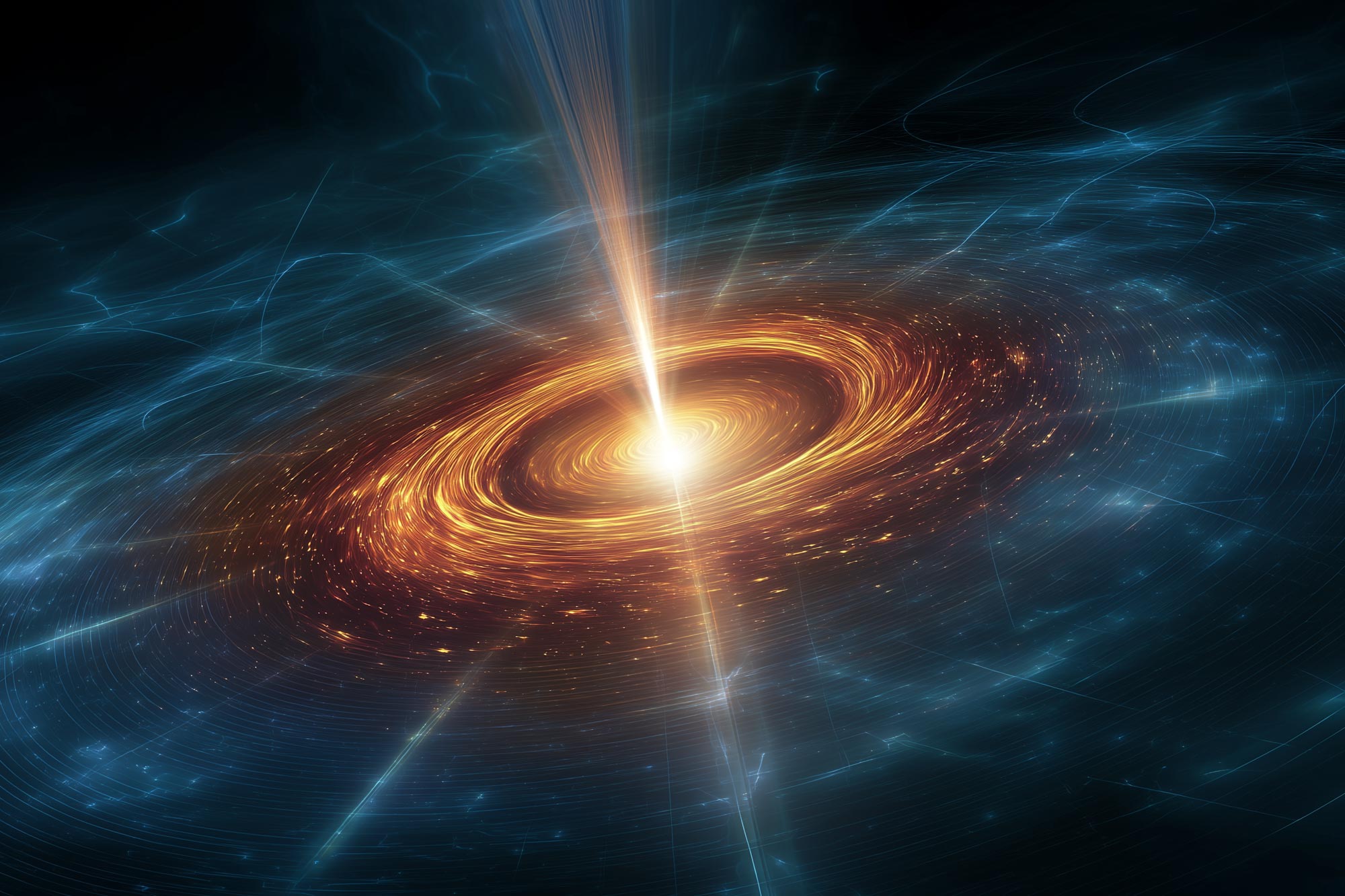
A new study suggests that during a potential phase of primordial matter domination, particle interactions may have led to the formation of the universe’s first compact cosmic objects.
Less than a second after the Big Bang, before the first atoms existed, tiny particles may have clustered into halos of matter that later collapsed to form the earliest black holes, boson stars, and so-called cannibal stars.
This finding comes from a new study published in Physical Review D by researchers at SISSA – Scuola Internazionale Superiore di Studi Avanzati, working with INFN, IFPU, and the University of Warsaw. Building on the idea proposed by some cosmological models that the early Universe experienced a short-lived Early Matter-Dominated Era (EMDE), the team explored how particles might have interacted during that time. Their results suggest that these interactions could have produced a surprising range of cosmic structures.
According to the study, even in its first fleeting moments, the Universe may already have been a setting for remarkably complex physical processes.
Right After Inflation: What Happened Next
Recent advances in cosmology have made it possible to reconstruct in detail the history of the Universe, from the rapid initial expansion known as inflation to primordial nucleosynthesis, the formation of the first atomic nuclei heavier than hydrogen, which occurred between 10 seconds and 20 minutes after the Big Bang. The intermediate period, however, remains largely unexplored.
As the authors explain: “An intriguing possibility is that during this interval, matter temporarily dominated the Universe.”
In this scenario, matter halos can naturally be formed. Furthermore, if the particles could interact with one another, then the interactions can lead to a gravothermal collapse, resulting in compact objects such as black holes and other exotic cosmic structures.
Strange Structures at the Dawn of the Universe
Among these compact objects, researchers suggest that cannibal stars could have formed. Cannibal stars are similar to traditional stars, except that it is the particle self-annihilations instead of nuclear fusion that powers the stars.
At the same time, the authors note, boson stars may also have formed, where the quantum nature of particles supports the star. These stars might have populated the newborn Universe for only a few seconds before collapsing further into primordial black holes (PBHs). Alternatively, the PBHs could have formed directly from the collapse of the matter halos.
New Hypotheses on Primordial Black Holes
According to the study, the halos formed during an EMDE had relatively small masses (smaller than 10²⁸ grams) and, following gravothermal collapse, could have generated even smaller primordial black holes.
Using a simplified theoretical model, the researchers showed that in some cases, PBHs might be overproduced, violating observational constraints; in others, asteroid-mass PBHs could form, potentially accounting for all the dark matter in the Universe. Finally, some PBHs might evaporate quickly, disappearing before primordial nucleosynthesis, that is, before the formation of light atoms such as hydrogen and helium.
New Perspectives on the Universe
The results also open up broader perspectives.
As the authors conclude, “It would be interesting to explore the formation of cannibal stars and boson stars in the present-day Universe, through the collapse of self-interacting dark matter halos. Moreover, though more speculative, studying star formation and accretion in simple particle models could provide new insights into the complex astrophysical processes that shape our Universe.”
Reference: “Gravothermalizing into primordial black holes, boson stars, and cannibal stars” by Pranjal Ralegankar, Daniele Perri and Takeshi Kobayashi, 9 October 2025, Physical Review D.
DOI: 10.1103/xpwl-w5zk
Never miss a breakthrough: Join the SciTechDaily newsletter.
Follow us on Google and Google News.
3 Comments
B Memo 2511130256_Source 1. Reinterpretation Storytelling 【】
Source 1.
https://scitechdaily.com/cannibal-stars-and-black-holes-may-have-formed-in-the-universes-first-second/
1.
_”Cannibal stars” and black holes may have formed in the universe’s first second.
_Shortly after the Big Bang, bizarre cosmic objects like black holes, boson stars, and even “cannibal stars” may have formed from a halo of matter. New research suggests the newborn universe was already teeming with unexpected structures and energies.
1-1.
_New research suggests that the universe’s first compact objects may have formed from particle interactions in a potential phase dominated by primordial matter.
Less than a second after the Big Bang, before the first atoms even existed, small particles may have clumped together into halos of matter, which later collapsed to form the first black holes, boson stars, and so-called cannibal stars.
1-2.
These findings stem from a new study published in Physical Review D by researchers at SISSA – Scuola Internazionale Superiore di Studi Avanzati, in collaboration with INFN, IFPU, and the University of Warsaw. Building on the idea, proposed in some cosmological models, that the early universe experienced a short-lived Early Matter-Dominated Epoch (EMDE), the team explored how particles might have interacted during that time. Their findings suggest that these interactions likely created a surprisingly diverse array of cosmic structures.
The study suggests that even in its early days, the universe likely served as a backdrop for remarkably complex physical processes.
2. Immediate Inflation: What Happened Next?
Recent advances in cosmology have enabled us to reconstruct the history of the universe in detail. From the initial rapid expansion known as inflation to primordial nucleosynthesis, the process of forming the first atomic nuclei heavier than hydrogen, occurring between 10 and 20 minutes after the Big Bang, we can now reconstruct the history of the universe.
However, this intermediate period remains largely unknown.
The authors explain: “An intriguing possibility is that matter temporarily dominated the universe during this period.”
2-1.
In this scenario, a halo of matter could form spontaneously.
Furthermore, if particles can interact with each other, [that interaction could lead to gravitational thermal collapse], creating dense celestial bodies such as black holes and other unusual cosmic structures.
[The universe began with the appearance of ordinary matter baryons. Immediately following their appearance, the Big Bang (nk2-1.banc.bigbang) began. Huh?
[A baryon, or baryon, is a hadron composed of three quarks. It contrasts with a meson, which consists of one quark and one antiquark. Protons and neutrons are prime examples. Because baryons are composed of quarks, they experience strong interactions.]
>>>>Matter halos may be caused by the accretion disk mode of a black hole.
>>>>Some consider galactic halos to be dark matter. msbase.galaxy.haro represents msbase+1(white_void, oss.zerosum, qpeoms=1). Huh?
>>>Gravitational heat (lattice) collapse? If it’s gravothermal_collapse, isn’t it sample1.oms.vix.ain.boa? Huh.
>>>>In particular, the collapse of a boson star occurs between adam seconds and eve minutes after the Big Bang. It appears to be a fleeting event. Oh my.
】
2-3. Strange structures appearing at the dawn of the universe
_Researchers suggest that cannibal stars may have formed among these dense celestial bodies. Cannibal stars are similar to regular stars, but differ in that their energy is generated by particle annihilation rather than nuclear fusion.
_At the same time, the authors point out that boson stars, which are supported by the quantum properties of particles, may also have formed.
【Boson star??? god! good!! There’ll be a Higgs star NK next to it. Hehe. Since they’re small stars, they’ll become particle dwarfs. If they become large boson stars, like NK2.boson, they’ll likely be the precursors of supernovae. Hmm. This is so much fun!!
ㅡㅡㅡㅡㅡㅡㅡㅡㅡ
Note 2511130229. Rewritten
>>>>> The gravitational collapse of stars (the supernova explosion of the large star nk2, the white dwarfization of the small star nk), and the *gravothermal_collapse chain reaction, seem to be related to the movement of the center of gravity (address_pi.r(api.r)) of the black hole oms.vixers. Oh.
>>>> There appear to be six boa black hole centers in sample1.oms.vix.ain.
>>> Their addresses are oms.vix.a’6,vixx.a(b1,g3,k3,o5,n6).
In cosmology, baryon acoustic oscillations (BAO) are fluctuations in the density of baryon matter in the universe, possibly caused by acoustic density waves in the primordial plasma of the early universe.
>>>>In particular, a(b1<g3<k3<o5>>>>Here, the uniqueness of sample1.oms.vix.ain lies in its overall closed particle density. Furthermore, its chiral symmetry key enables orbital movement of particles.
For reference,
[*gravothermal is a term that describes the thermal effects that occur during gravitational collapse, primarily dealing with the interaction between gravity and thermodynamics in stars and dark matter collections.
Key Meaning of Gravothermal
Thermal Effect of Gravitational Collapse: This refers to the phenomenon where internal heat contributes to maintaining the gravitational field when a star or dark matter collection collapses due to gravity.
Applications: This phenomenon plays a crucial role in astrophysics, including supernova explosions, the evolution of neutron stars, dark matter collections, and the formation of supermassive black holes.
Scientific Context: Gravothermal instability is a phenomenon in which thermal energy in a high-temperature, high-density environment promotes gravitational collapse. It is used to study stellar evolution and changes in dark matter structure.
Gravothermal is a key concept in astrophysics that explains the interaction between gravity and heat, playing a crucial role in the death of stars and the evolution of dark matter collections.
sample1. msbase12.qpeoms.2square.vector
oms.vix.a’6,vixx.a(b1,g3,k3,o5,n6)
b0acfd|0000e0
000ac0|f00bde
0c0fab|000e0d
e00d0c|0b0fa0
f000e0|b0dac0
d0f000|cae0b0
0b000f|0ead0c
0deb00|ac000f
ced0ba|00f000
a0b00e|0dc0f0
0ace00|df000b
0f00d0|e0bc0a
】
_These stars may have existed in the newborn Universe for only a few seconds before further collapsing into primordial black holes (PBHs). Alternatively, PBHs could have formed directly from the collapse of a matter halo.
3. A New Hypothesis for Primordial Black Holes
Studies suggest that halos formed during EMDEs had relatively small masses (less than 10²⁸ grams), and that gravitational thermal collapse could have produced much smaller primordial black holes.
Using a simplified theoretical model, the researchers showed that in some cases, PBHs could be produced in excess, violating observational constraints.
In other cases, PBHs of asteroid masses could form, potentially accounting for all the dark matter in the universe. Finally, some PBHs could evaporate quickly and disappear before primordial nucleosynthesis, i.e., before lighter atoms like hydrogen or helium could be produced.
From a KDS point of view, this scenario is almost a direct picture of early-time R/L asymmetry. An Early Matter-Dominated Era with self-interacting dark matter naturally creates many local R-overdensities that sit near their critical value Φ̃_crit, then undergo gravothermal collapse into primordial black holes, boson stars and short-lived annihilation-powered “cannibal stars”. In KDS language, the “neutral medium” of the early Universe is not a passive background but an active fractal flow that keeps crossing its critical surface, leaving behind a structured PBH mass spectrum and a non-trivial stochastic gravitational-wave background instead of a single, smooth dark-matter component.
Sorry, but the Standard Model is wrong. It requires too many placeholders in order to exist, and recent evidence (the DESI program) shows that it is incorrect, unless we add even more placeholders. There is another way, but we have to abandon ldcm to see it.