

- Astronomers have found a remarkably powerful jet shooting out from a black hole that formed just 3 billion years after the Big Bang.
- This jet is so distant that it can only be seen because its particles boost ancient light from the Big Bang—called the cosmic microwave background—into powerful X-rays.
- Thanks to this effect, NASA’s Chandra X-ray Observatory was able to detect not just one, but two black holes with jets from the early universe.
- By combining Chandra’s X-ray vision with radio data from the Very Large Array (VLA), scientists are uncovering how early black holes influenced their galaxies during one of the most active periods in cosmic history.

Powerful Jet Discovery in the Early Universe
A black hole in the distant universe has unleashed an unexpectedly powerful jet, according to a new discovery using NASA’s Chandra X-ray Observatory. What makes this jet especially remarkable is that it’s so ancient, it’s lit up by the faint afterglow of the Big Bang.
Astronomers teamed up Chandra with the Karl G. Jansky Very Large Array (VLA) to study this black hole during a time known as “cosmic noon.” That’s the period about three billion years after the universe began, when galaxies and supermassive black holes were growing faster than ever before.
Jet Mechanism Revealed Through Illustration
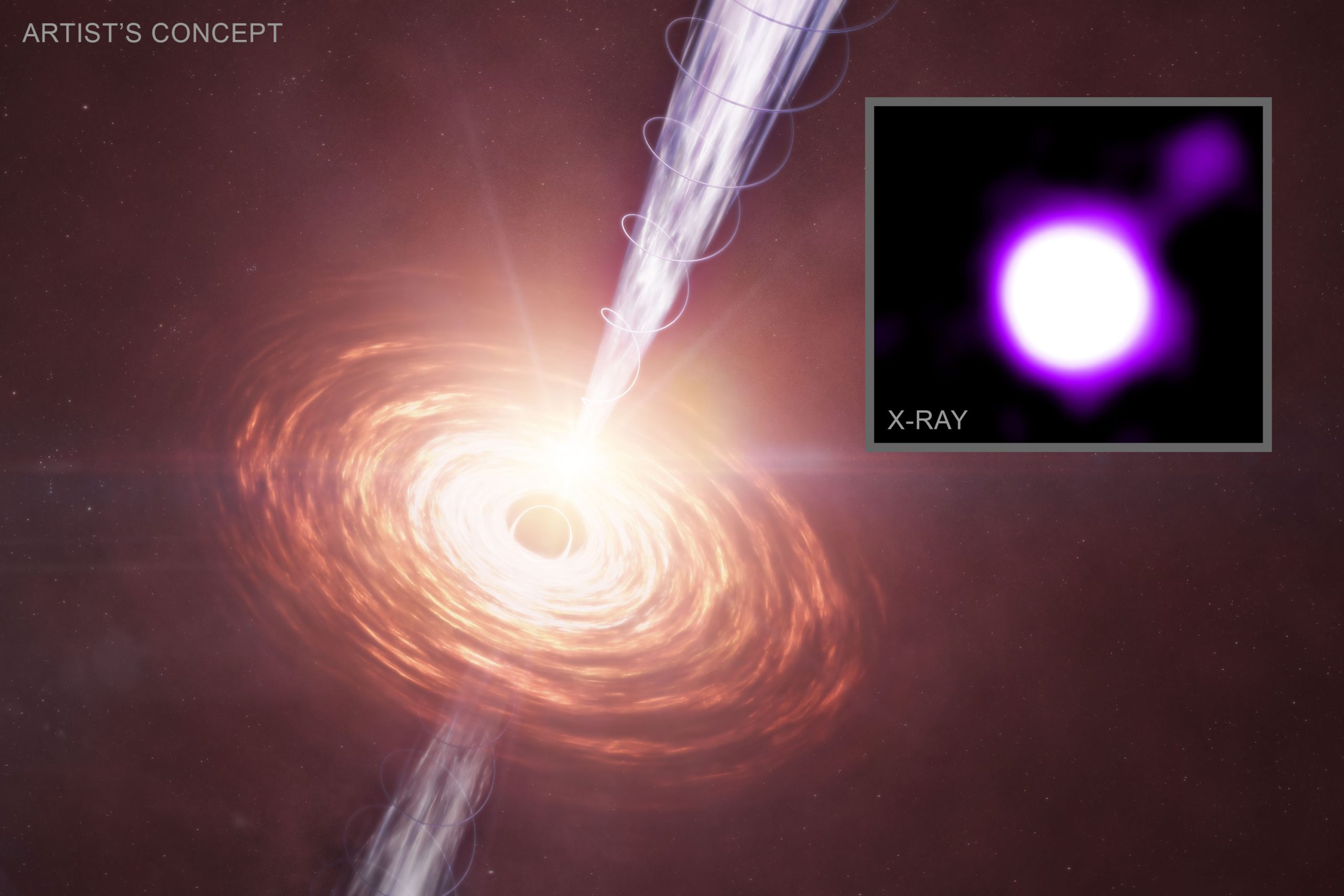
An artist’s illustration (below) helps visualize what’s happening: matter spirals into a supermassive black hole while a high-speed jet blasts outward. The black hole is located 11.6 billion light-years from Earth, when the cosmic microwave background (CMB), the leftover glow from the Big Bang, was much denser than it is now.
As the electrons in the jets fly away from the black hole, they move through the sea of CMB radiation and collide with microwave photons. These collisions boost the energy of the photons up into the X-ray band (purple and white), allowing them to be detected by Chandra even at this great distance, which is shown in the inset.
Double Jet Surprise at Vast Distances
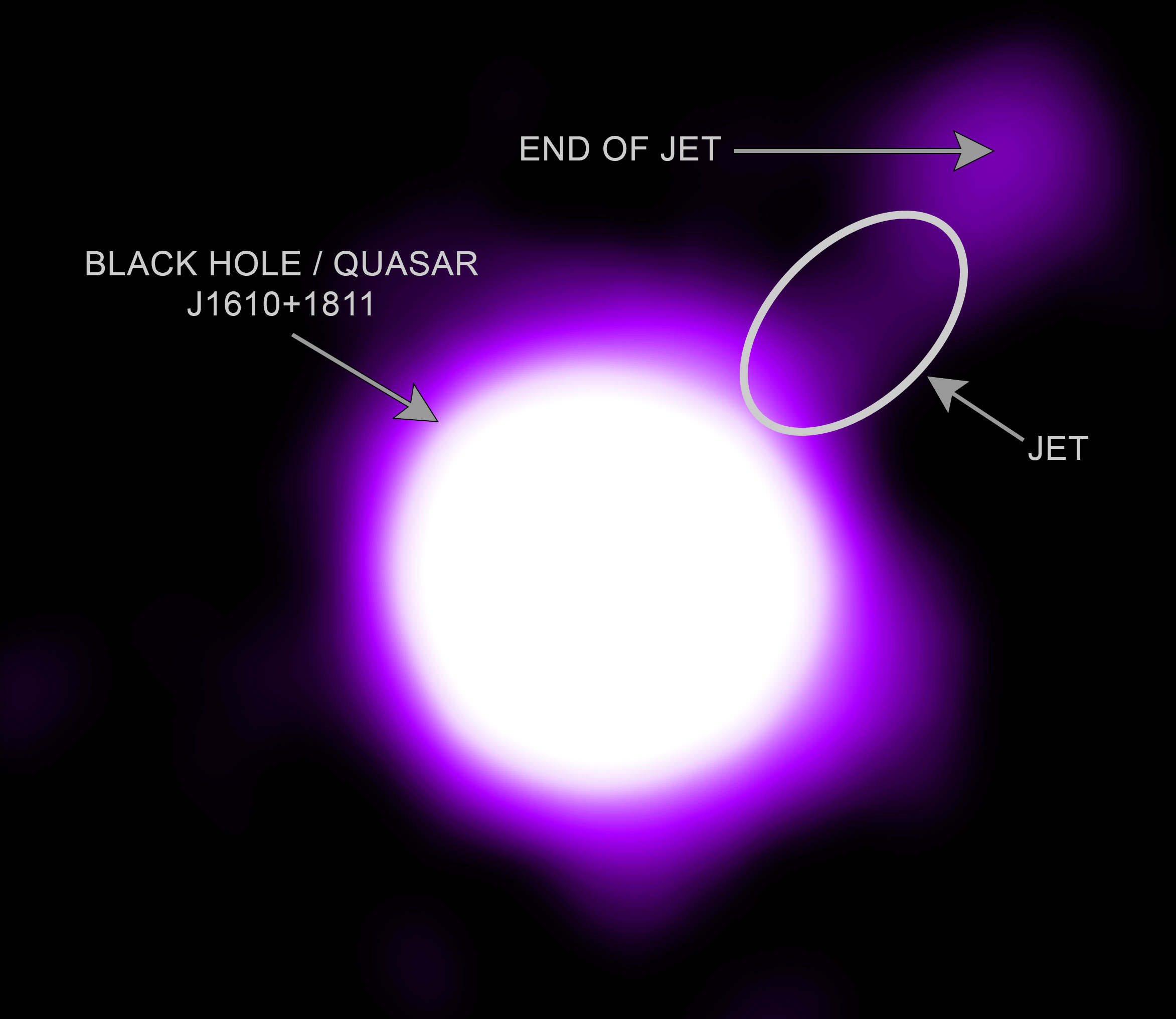
Researchers, in fact, identified and then confirmed the existence of two different black holes with jets over 300,000 light-years long. The two black holes are 11.6 billion and 11.7 billion light-years away from Earth, respectively. Particles in one jet are moving at between 95% and 99% of the speed of light (called J1405+0415) and in the other at between 92% and 98% of the speed of light (J1610+1811). The jet from J1610+1811 is remarkably powerful, carrying roughly half as much energy as the intense light from hot gas orbiting the black hole.
The team was able to detect these jets despite their great distances and small separation from the bright, growing supermassive black holes — known as “quasars” — because of Chandra’s sharp X-ray vision, and because the CMB was much denser then than it is now, enhancing the energy boost described above.
Einstein’s Relativity Adds a Twist
When quasar jets approach the speed of light, Einstein’s theory of special relativity creates a dramatic brightening effect. Jets aimed toward Earth appear much brighter than those pointed away. The same brightness astronomers observe can come from vastly different combinations of speed and viewing angle. A jet racing at near-light speed but angled away from us can appear just as bright as a slower jet pointed directly at Earth.
The researchers developed a novel statistical method that finally cracked this challenge of separating effects of speed and of viewing angle. Their approach recognizes a fundamental bias: astronomers are more likely to discover jets pointed toward Earth simply because relativistic effects make them appear brightest. They incorporated this bias using a modified probability distribution, which accounts for how jets oriented at different angles are detected in surveys.
Mapping Jet Angles With Statistics
Their method works by first using the physics of how jet particles scatter the CMB to determine the relationship between jet speed and viewing angle. Then, instead of assuming all angles are equally likely, they apply the relativistic selection effect: jets beamed toward us (smaller angles) are overrepresented in our catalogs. By running ten thousand simulations that match this biased distribution to their physical model, they could finally determine the most probable viewing angles: about 9 degrees for J1405+0415 and 11 degrees for J1610+1811.
These results were presented by Jaya Maithil (Center for Astrophysics | Harvard & Smithsonian) at the 246th meeting of the American Astronomical Society in Anchorage, AK, and were published in The Astrophysical Journal.
Reference: “Investigating the Emission Mechanism in the Spatially Resolved Jets of Two z ≈ 3 Radio-loud Quasars” by Jaya Maithil, Daniel A. Schwartz, Aneta Siemiginowska, Preeti Kharb, Diana M. Worrall, John F. C. Wardle, Giulia Migliori, Chi C. Cheung, Bradford Snios, Doug B. Gobeille, Herman L. Marshall and Mark Birkinshaw, 9 June 2025, The Astrophysical Journal.
DOI: 10.3847/1538-4357/adccc1
NASA’s Chandra X-ray Observatory is one of the most powerful telescopes ever built for detecting X-ray emissions from extremely hot regions of the universe, such as exploded stars, black holes, and galaxy clusters. Managed by NASA’s Marshall Space Flight Center in Huntsville, Alabama, Chandra plays a crucial role in exploring high-energy cosmic phenomena. Science operations are directed by the Smithsonian Astrophysical Observatory’s Chandra X-ray Center in Cambridge, Massachusetts, with flight operations based in Burlington, Massachusetts.
Never miss a breakthrough: Join the SciTechDaily newsletter.
Follow us on Google and Google News.