
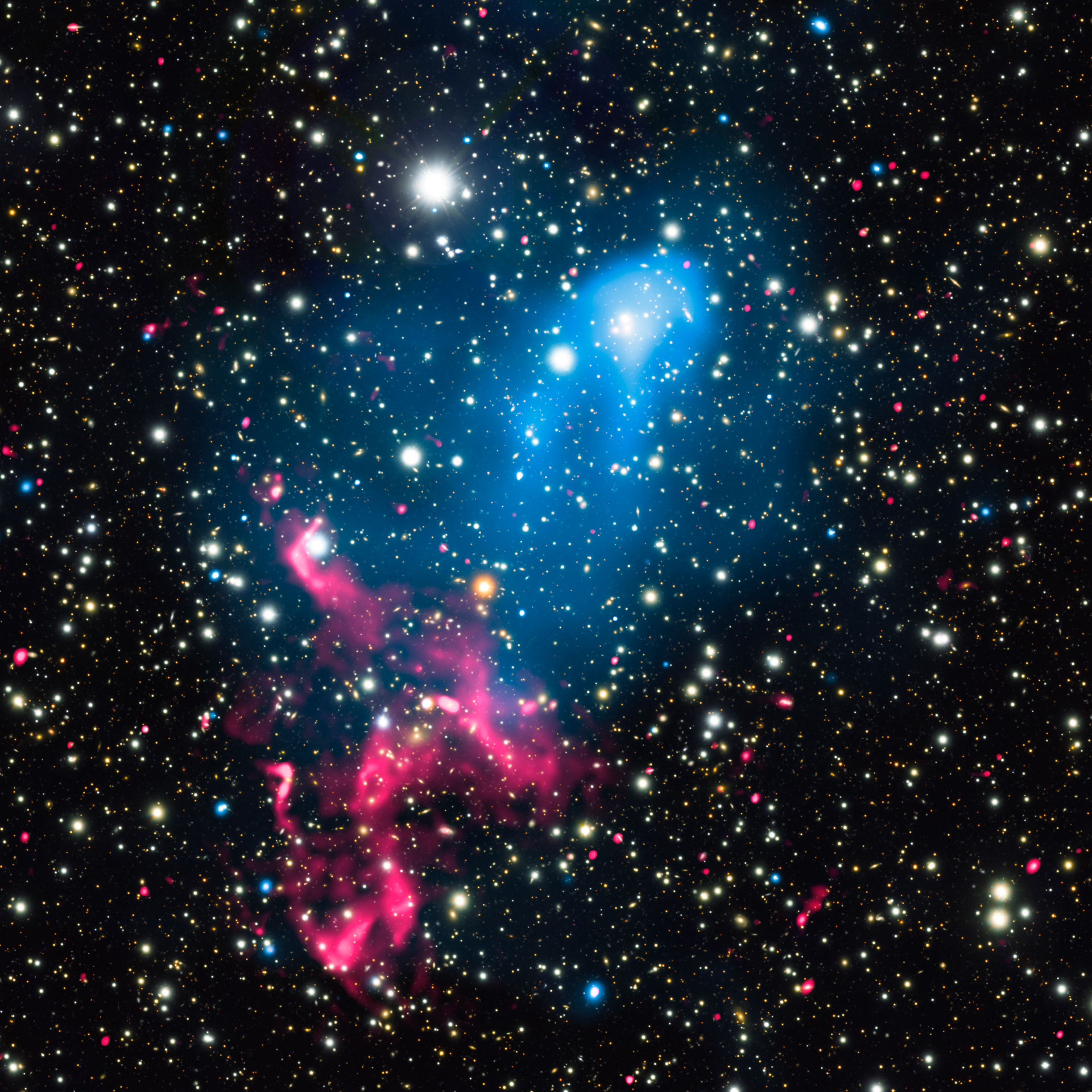
Using data from NASA’s Chandra X-ray Observatory and several other telescopes, a team of astronomers has discovered a cosmic one-two punch unlike any ever seen before. The phenomena occurred in a pair of colliding galaxy clusters called Abell 3411 and Abell 3412. This result shows that an eruption from a supermassive black hole combined with a galaxy cluster merger can create a stupendous cosmic particle accelerator.
Two of the most powerful phenomena in the Universe, a supermassive black hole, and the collision of giant galaxy clusters, have combined to create an incredible cosmic particle accelerator.
By combining data from NASA’s Chandra X-ray Observatory, the Giant Metrewave Radio Telescope (GMRT) in India, the NSF’s Karl G. Jansky Very Large Array, and other telescopes, researchers have found out what happens when matter ejected by a giant black hole is swept up in the merger of two enormous galaxy clusters.
“We have seen each of these spectacular phenomena separately in many places,” said Reinout van Weeren of the Harvard-Smithsonian Center for Astrophysics (CfA) in Cambridge, Massachusetts, who led the study that appears in the inaugural issue of the journal Nature Astronomy. “This is the first time, however, that we have seen them clearly linked together in the same system.”
This cosmic double whammy is found in a pair of colliding galaxy clusters called Abell 3411 and Abell 3412 located about two billion light-years from Earth. The two clusters are both very massive, each weighing about a quadrillion — or a million billion — times the mass of the Sun.
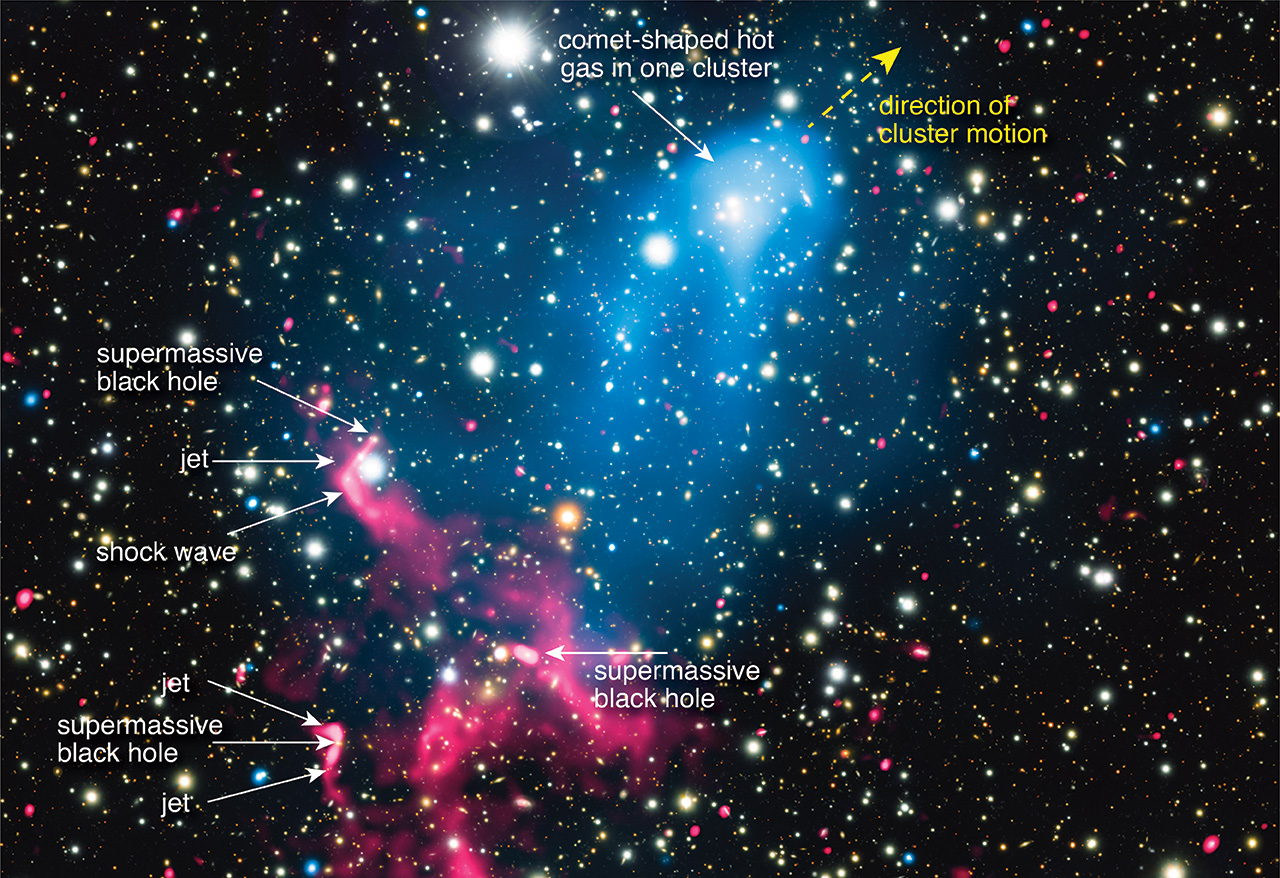
The comet-shaped appearance of the X-rays detected by Chandra is produced by hot gas from one cluster plowing through the hot gas of the other cluster. Optical data from the Keck Observatory and Japan’s Subaru telescope, both on Mauna Kea, Hawaii, detected the galaxies in each cluster.
First, at least one spinning, supermassive black hole in one of the galaxy clusters produced a rotating, tightly-wound magnetic funnel. The powerful electromagnetic fields associated with this structure have accelerated some of the inflowing gas away from the vicinity of the black hole in the form of an energetic, high-speed jet.
Then, these accelerated particles in the jet were accelerated again when they encountered colossal shock waves — cosmic versions of sonic booms generated by supersonic aircraft — produced by the collision of the massive gas clouds associated with the galaxy clusters.
“It’s almost like launching a rocket into low-Earth orbit and then getting shot out of the Solar System by a second rocket blast,” said co-author Felipe Andrade-Santos, also of the CfA. “These particles are among the most energetic particles observed in the Universe, thanks to the double injection of energy.”
This discovery solves a long-standing mystery in galaxy cluster research about the origin of beautiful swirls of radio emission stretching for millions of light years, detected in Abell 3411 and Abell 3412 with the GMRT.
The team determined that as the shock waves travel across the cluster for hundreds of millions of years, the doubly accelerated particles produce giant swirls of radio emission.
“This result shows that a remarkable combination of powerful events generate these particle acceleration factories, which are the largest and most powerful in the Universe,” said co-author William Dawson of Lawrence Livermore National Lab in Livermore, California. “It is a bit poetic that it took a combination of the world’s biggest observatories to understand this.”
These results were presented at the 229th meeting of the American Astronomical Society meeting in Grapevine, TX. NASA’s Marshall Space Flight Center in Huntsville, Alabama, manages the Chandra program for NASA’s Science Mission Directorate in Washington. The Smithsonian Astrophysical Observatory in Cambridge, Massachusetts, controls Chandra’s science and flight operations.
Reference: “The Case for Electron Re-Acceleration at Galaxy Cluster Shocks” by Reinout J. van Weeren, Felipe Andrade-Santos, William A. Dawson, Nathan Golovich, Dharam V. Lal, Hyesung Kang, Dongsu Ryu, Marcus Brüggen, Georgiana A. Ogrean, William R. Forman, Christine Jones, Vinicius M. Placco, Rafael M. Santucci, David Wittman, M. James Jee, Ralph P. Kraft, David Sobral, Andra Stroe and Kevin Fogarty, 4 January 2017, Nature Astronomy.
DOI: 10.1038/s41550-016-0005
arXiv: 1701.01439
Never miss a breakthrough: Join the SciTechDaily newsletter.
Follow us on Google and Google News.