
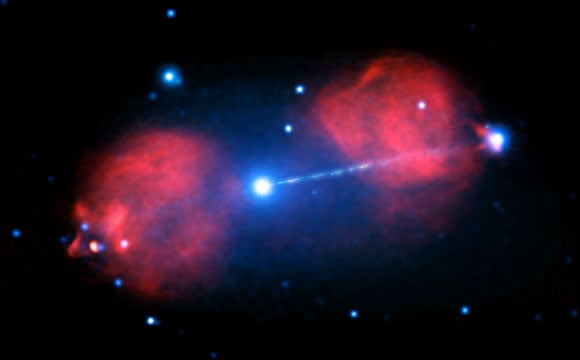
Astronomers have discovered a giant jet spanning continuously for over 300,000 light-years blasting out of the galaxy Pictor A. In addition to the main jet, they also discovered evidence of a jet moving in the opposite direction.
The Star Wars franchise has featured the fictitious “Death Star,” which can shoot powerful beams of radiation across space. The Universe, however, produces phenomena that often surpass what science fiction can conjure.
The Pictor A galaxy is one such impressive object. This galaxy, located nearly 500 million light-years from Earth, contains a supermassive black hole at its center. A huge amount of gravitational energy is released as material swirls towards the event horizon, the point of no return for infalling material. This energy produces an enormous beam, or jet, of particles traveling at nearly the speed of light into intergalactic space.
To obtain images of this jet, scientists used NASA’s Chandra X-ray Observatory at various times over 15 years. Chandra’s X-ray data (blue) have been combined with radio data from the Australia Telescope Compact Array (red) in this new composite image.
By studying the details of the structure seen in both X-rays and radio waves, scientists seek to gain a deeper understanding of these huge collimated blasts.
The jet [to the right] in Pictor A is the one that is closest to us. It displays continuous X-ray emission over a distance of 300,000 light-years. By comparison, the entire Milky Way is about 100,000 light-years in diameter. Because of its relative proximity and Chandra’s ability to make detailed X-ray images, scientists can look at detailed features in the jet and test ideas of how the X-ray emission is produced.
In addition to the prominent jet seen pointing to the right in the image, researchers report evidence of another jet pointing in the opposite direction, known as a “counterjet.” While tentative evidence for this counterjet had been previously reported, these new Chandra data confirm its existence. The relative faintness of the counterjet compared to the jet is likely due to the motion of the counterjet away from the line of sight to the Earth.

The labeled image shows the location of the supermassive black hole, the jet, and the counterjet. Also labeled is a “radio lobe” where the jet is pushing into surrounding gas and a “hotspot” caused by shock waves — akin to sonic booms from a supersonic aircraft — near the tip of the jet.
The detailed properties of the jet and counterjet observed with Chandra show that their X-ray emission likely comes from electrons spiraling around magnetic field lines, a process called synchrotron emission. In this case, the electrons must be continuously re-accelerated as they move out along the jet. How this occurs is not well understood
The researchers ruled out a different mechanism for producing the jet’s X-ray emission. In that scenario, electrons flying away from the black hole in the jet at near the speed of light move through the sea of cosmic background radiation (CMB) left over from the hot early phase of the Universe after the Big Bang. When a fast-moving electron collides with one of these CMB photons, it can boost the photon’s energy up into the X-ray band.
The X-ray brightness of the jet depends on the power in the beam of electrons and the intensity of the background radiation. The relative brightness of the X-rays coming from the jet and counterjet in Pictor A do not match what is expected in this process involving the CMB, and effectively eliminate it as the source of the X-ray production in the jet.
A paper describing these results will be published in the Monthly Notices of the Royal Astronomical Society. The authors are Martin Hardcastle from the University of Hertfordshire in the UK, Emil Lenc from the University of Sydney in Australia, Mark Birkinshaw from the University of Bristol in the UK, Judith Croston from the University of Southampton in the UK, Joanna Goodger from the University of Hertfordshire, Herman Marshall from the Massachusetts Institute of Technology in Cambridge, MA, Eric Perlman from the Florida Institute of Technology, Aneta Siemiginowska from the Harvard-Smithsonian Center for Astrophysics in Cambridge, MA, Lukasz Stawarz from Jagiellonian University in Poland and Diana Worrall from the University of Bristol.
Reference: “Deep Chandra observations of Pictor A” by M. J. Hardcastle, E. Lenc, M. Birkinshaw, J. H. Croston, J.L. Goodger, H. L. Marshall, E. S. Perlman, A. Siemiginowska, L. Stawarz and D. M. Worrall, 30 November 2015, MNRAS.
DOI: 10.1093/mnras/stv2553
arXiv:1510.08392
Never miss a breakthrough: Join the SciTechDaily newsletter.
Follow us on Google and Google News.
6 Comments
What is the redshift of the parent galaxy and the hotspot? Has there been another ejected hotspot identified on the opposite lobe?
Halton Arp suggested there was a nexus between active galaxies and ejected material, especially quasars of non relativistic redshifts.
I meant to say noncosmological redshift, not nonrelativistic. Sorry.
It remains unclear how these outflows and jets are launched and driven. There is no universal mechanism that can explain the origin of all these jets and outflows. There is no consensus about the exact ejection mechanism. Similar to many other astrophysical phenomena, there is a gloomy song about a black hole as the central engine launching jets. Aside of the hypothetical nature of the black holes there are a lot of other questions, including: where does the material for these jets come from? Whether or not the black holes are in protostars and young stars, all of which have outflows or is something else at work here? If something else is plausible then why do we need black holes in this phenomenon?
“There is no universal mechanism that can explain the origin of all these jets and outflows. There is no consensus about the exact ejection mechanism.”
I can understand the ejection mechanism; vast amounts of matter and energy focused together. What I wonder (from the article):
“This energy produces an enormous beam, or jet, of particles traveling at nearly the speed of light into intergalactic space.”
How’s it get focused into a beam or jet? What’s focusing it? Surely gravity, but why’s the result a coherent jet?
Do the jets apply force to the source black hole? Does the force provide propulsion to the black hole? How much?
Plasma physics can explain the jets.