
Close Menu
    Facebook X (Twitter) Instagram
    SciTechDaily
    • Biology
    • Chemistry
    • Earth
    • Health
    • Physics
    • Science
    • Space
    • Technology
    Facebook X (Twitter) Pinterest YouTube RSS
    SciTechDaily
    Home»Space»NASA’s MAVEN Spacecraft Observes Weird Glowing and Pulsing in Mars’ Night Sky
    Space

    NASA’s MAVEN Spacecraft Observes Weird Glowing and Pulsing in Mars’ Night Sky

    By NASA Goddard Space Flight CenterAugust 9, 2020No Comments6 Mins Read
    Facebook Twitter Pinterest Telegram LinkedIn WhatsApp Email Reddit
    Share
    Facebook Twitter LinkedIn Pinterest Telegram Email Reddit
    Mars Ultraviolet Nightglow
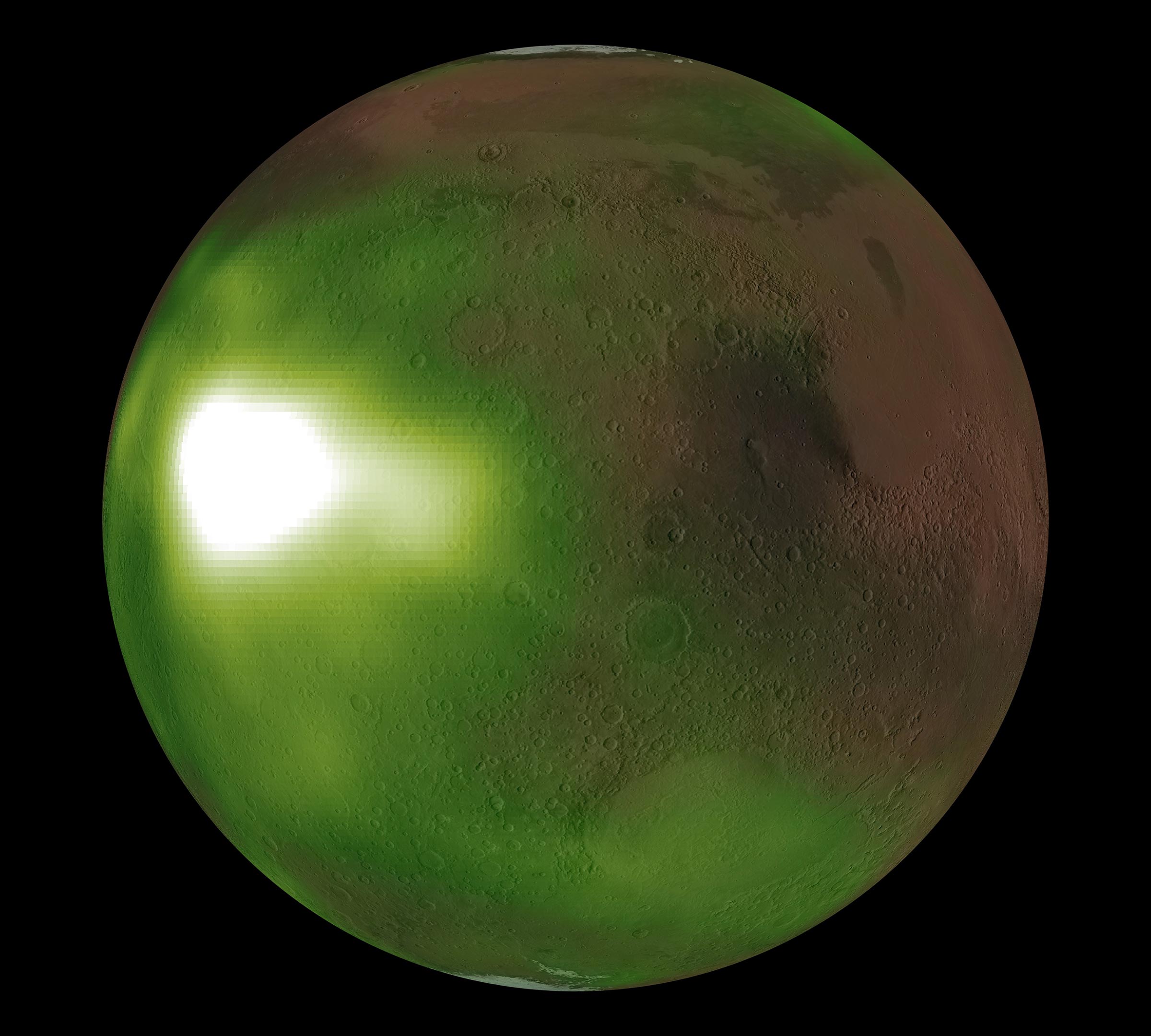
    This is an image of the ultraviolet “nightglow” in the Martian atmosphere. Green and white false colors represent the intensity of ultraviolet light, with white being the brightest. The nightglow was measured at about 70 kilometers (approximately 40 miles) altitude by the Imaging UltraViolet Spectrograph instrument on NASA’s MAVEN spacecraft. A simulated view of the Mars globe is added digitally for context. The image shows an intense brightening in Mars’ nightside atmosphere. The brightenings occur regularly after sunset on Martian evenings during fall and winter seasons, and fade by midnight. The brightening is caused by increased downwards winds which enhance the chemical reaction creating nitric oxide which causes the glow. Credit: NASA/MAVEN/Goddard Space Flight Center/CU/LASP

    Vast areas of the Martian night sky pulse in ultraviolet light, according to images from NASA’s MAVEN spacecraft. The results are being used to illuminate complex circulation patterns in the Martian atmosphere.

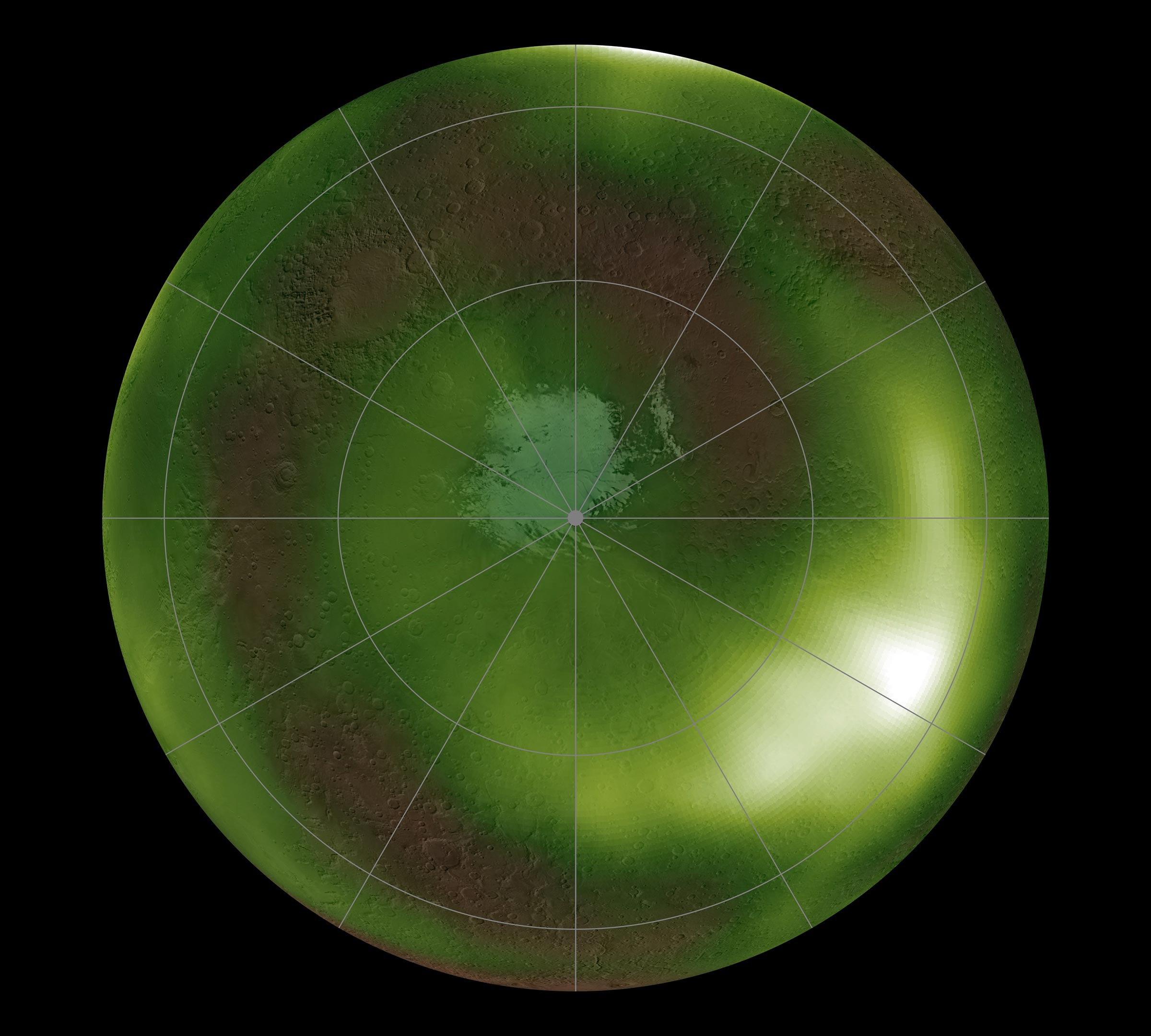
    The MAVEN team was surprised to find that the atmosphere pulsed exactly three times per night, and only during Mars’ spring and fall. The new data also revealed unexpected waves and spirals over the winter poles, while also confirming the Mars Express spacecraft results that this nightglow was brightest over the winter polar regions.


    Mars’ nightside atmosphere glows and pulsates in this data animation from MAVEN spacecraft observations. Green-to-white false color shows the enhanced brightenings on Mars’ ultraviolet “nightglow” measured by MAVEN’s Imaging UltraViolet Spectrograph at about 70 kilometers (approximately 40 miles) altitude. A simulated view of the Mars globe is added digitally for context, with ice caps visible at the poles. Three nightglow brightenings occur over one Mars rotation, the first much brighter than the other two. All three brightenings occur shortly after sunset, appearing on the left of this view of the night side of the planet. The pulsations are caused by downwards winds which enhance the chemical reaction creating nitric oxide which causes the glow. Months of data were averaged to identify these patterns, indicating they repeat nightly. Credit: NASA/MAVEN/Goddard Space Flight Center/CU/LASP

    “MAVEN’s images offer our first global insights into atmospheric motions in Mars’ middle atmosphere, a critical region where air currents carry gases between the lowest and highest layers,” said Nick Schneider of the University of Colorado’s Laboratory for Atmospheric and Space Physics (LASP), Boulder, Colorado. The brightenings occur where vertical winds carry gases down to regions of higher density, speeding up the chemical reactions that create nitric oxide and power the ultraviolet glow. Schneider is the instrument lead for the MAVEN Imaging Ultraviolet Spectrograph (IUVS) instrument that made these observations, and the lead author of a paper on this research that was published on August 5, 2020, in the Journal of Geophysical Research, Space Physics. Ultraviolet light is invisible to the human eye but detectable by specialized instruments.
    Mars Glowing Nightside Atmosphere
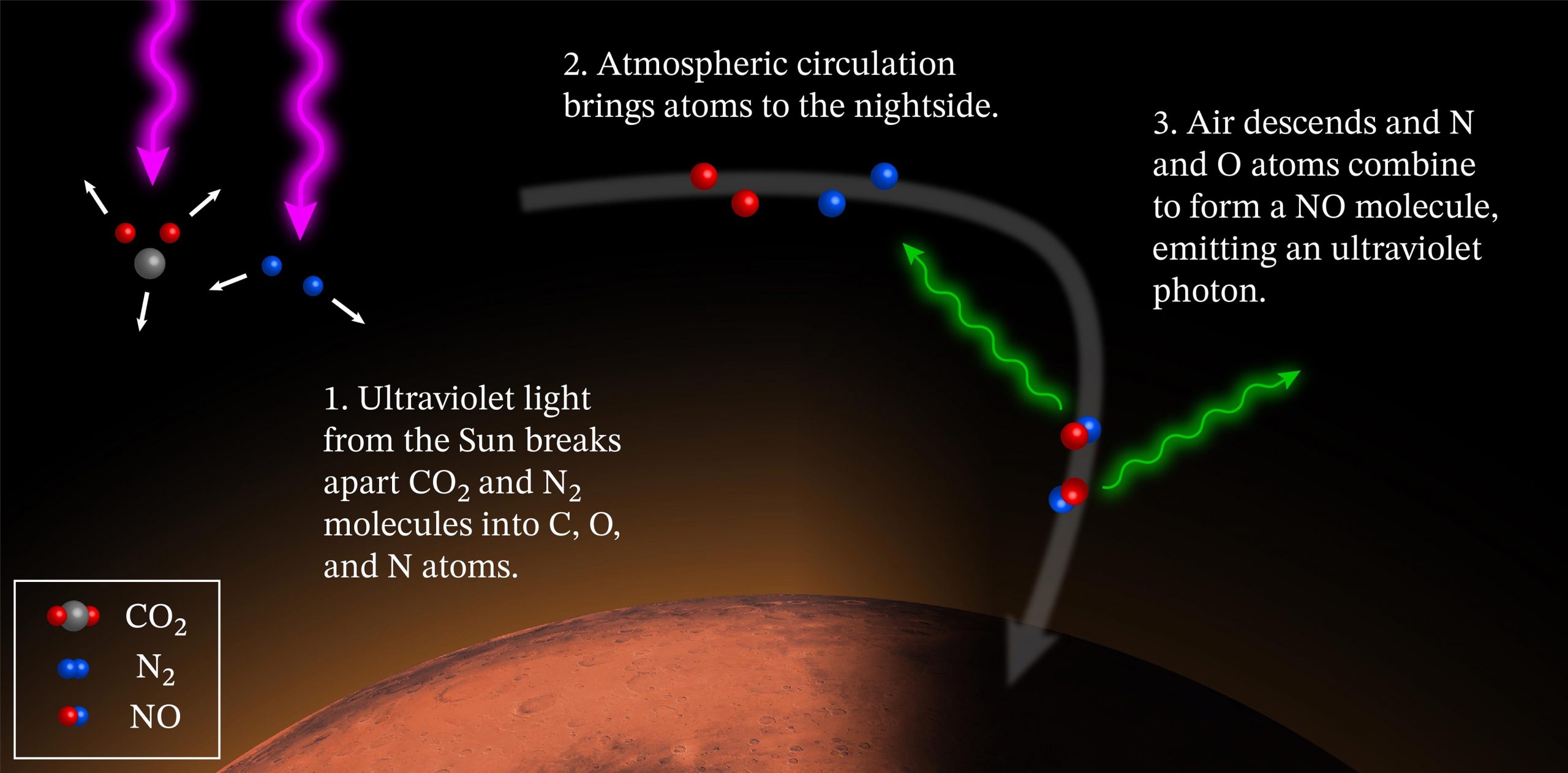
    The diagram explains the cause of Mars’ glowing nightside atmosphere. On Mars’ dayside, molecules are torn apart by energetic solar photons. Global circulation patterns carry the atomic fragments to the nightside, where downward winds increase the reaction rate for the atoms to reform molecules. The downwards winds occur near the poles at some seasons and in the equatorial regions at others. The new molecules hold extra energy which they emit as ultraviolet light. Credit: NASA/MAVEN/Goddard Space Flight Center/CU/LASP

    “The ultraviolet glow comes mostly from an altitude of about 70 kilometers (approximately 40 miles), with the brightest spot about a thousand kilometers (approximately 600 miles) across, and is as bright in the ultraviolet as Earth’s northern lights,” said Zac Milby, also of LASP. “Unfortunately, the composition of Mars’ atmosphere means that these bright spots emit no light at visible wavelengths that would allow them to be seen by future Mars astronauts. Too bad: the bright patches would intensify overhead every night after sunset, and drift across the sky at 300 kilometers per hour (about 180 miles per hour).”

    The pulsations reveal the importance of planet-encircling waves in the Mars atmosphere. The number of waves and their speed indicates that Mars’ middle atmosphere is influenced by the daily pattern of solar heating and disturbances from the topography of Mars’ huge volcanic mountains. These pulsating spots are the clearest evidence that the middle atmosphere waves match those known to dominate the layers above and below.

    “MAVEN’s main discoveries of atmosphere loss and climate change show the importance of these vast circulation patterns that transport atmospheric gases around the globe and from the surface to the edge of space,” said Sonal Jain, also of LASP.
    Martian Nightglow Atmosphere South Pole
    This is an image of the ultraviolet “nightglow” in the Martian atmosphere over the south pole. Green and white false colors represent the intensity of ultraviolet light, with white being the brightest. The nightglow was measured at about 70 kilometers (approximately 40 miles) altitude by the Imaging UltraViolet Spectrograph instrument on NASA’s MAVEN spacecraft. A simulated view of the Mars globe is added digitally for context, and the faint white area in the center of the image is the polar ice cap. The image shows an unexpectedly bright glowing spiral in Mars’ nightside atmosphere. The cause of the spiral pattern is unknown. Credit: NASA/MAVEN/Goddard Space Flight Center/CU/LASP

    Next, the team plans to look at nightglow “sideways”, instead of down from above, using data taken by IUVS looking just above the edge of the planet. This new perspective will be used to understand the vertical winds and seasonal changes even more accurately.

    The Martian nightglow was first observed by the SPICAM instrument on the European Space Agency’s Mars Express spacecraft. However, IUVS is a next-generation instrument better able to repeatedly map out the nightside glow, finding patterns and periodic behaviors. Many planets including Earth have nightglow, but MAVEN is the first mission to collect so many images of another planet’s nightglow.

    Reference: “Imaging of Martian Circulation Patterns and Atmospheric Tides Through MAVEN/IUVS Nightglow Observations” by N. M. Schneider, Z. Milby, S. K. Jain, F. González‐Galindo, E. Royer, J.‐C. Gérard, A. Stiepen, J. Deighan, A. I. F. Stewart, F. Forget, F. Lefèvre and S. W. Bougher, 5 August 2020, JGR Space Physics.
    DOI: 10.1029/2019JA027318

    The research was funded by the MAVEN mission. MAVEN’s principal investigator is based at the University of Colorado’s Laboratory for Atmospheric and Space Physics, Boulder, and NASA Goddard manages the MAVEN project. NASA is exploring our Solar System and beyond, uncovering worlds, stars, and cosmic mysteries near and far with our powerful fleet of space and ground-based missions.

    Never miss a breakthrough: Join the SciTechDaily newsletter.
    Follow us on Google and Google News.

    Atmospheric Science Mars MAVEN NASA NASA Goddard Space Flight Center Popular
    Share. Facebook Twitter Pinterest LinkedIn Email Reddit

    Related Articles

    NASA’s MAVEN at 10: Unveiling the Red Planet’s Hidden Atmosphere

    The Great Escape: NASA’s Hubble and MAVEN Help Solve Mystery of Mars’ Vanishing Water

    The Great Solar Wind Disappearance: Groundbreaking Discovery by NASA’s MAVEN Mission

    Stunning Views of Mars Captured by Ultraviolet Eye Aboard NASA’s MAVEN Spacecraft

    Martian Atmospheric Breakdown: Helicopters Flying on Mars May Glow at Dusk

    NASA’s Mars Orbiter Maps Electric Currents Around the Red Planet – Fundamental to Atmospheric Loss

    Unexpected Discovery by NASA’s MAVEN on Mars Helps Explain Disruptive Phenomenon on Earth

    Surprising Clues to Martian Climate Uncovered As NASA’s MAVEN Maps Winds in Mars’ Upper Atmosphere [Video]

    “Mind Boggling” Mars Mystery As Oxygen Doesn’t Behave by Known Chemistry

    Leave A Reply Cancel Reply

    • Facebook
    • Twitter
    • Pinterest
    • YouTube

    Don't Miss a Discovery

    Subscribe for the Latest in Science & Tech!

    Trending News

    The Universe Is Expanding Too Fast and Scientists Can’t Explain Why

    “Like Liquid Metal”: Scientists Create Strange Shape-Shifting Material

    Early Warning Signals of Esophageal Cancer May Be Hiding in Plain Sight

    Common Blood Pressure Drug Shows Surprising Power Against Deadly Antibiotic-Resistant Superbug

    Scientists Uncover Dangerous Connection Between Serotonin and Heart Valve Disease

    Scientists Discover a “Protector” Protein That Could Help Reverse Hair Loss

    Bone-Strengthening Discovery Could Reverse Osteoporosis

    Scientists Uncover Hidden Trigger Behind Stem Cell Aging

    Follow SciTechDaily
    • Facebook
    • Twitter
    • YouTube
    • Pinterest
    • Newsletter
    • RSS
    SciTech News
    • Biology News
    • Chemistry News
    • Earth News
    • Health News
    • Physics News
    • Science News
    • Space News
    • Technology News
    Recent Posts
    • A Common Diabetes Drug May Hold the Key to Stopping HIV From Coming Back
    • Ancient “Syphilis-Like” Disease in Vietnam Challenges Key Scientific Assumptions
    • Drinking Alcohol To Cope in Your 20s Could Damage Your Brain for Life
    • Scientists Crack Alfalfa’s Chromosome Mystery After Decades of Debate
    • Ancient Ant-Plant Alliance Collapses As Predatory Wasps Move In
    Copyright © 1998 - 2026 SciTechDaily. All Rights Reserved.
    • Science News
    • About
    • Contact
    • Editorial Board
    • Privacy Policy
    • Terms of Use

    Type above and press Enter to search. Press Esc to cancel.